Clinical and Operational Guidance for Agencies Providing Post-Bariatric Home Health Therapy in Houston and Southeast Texas
Bariatric surgery — including Roux-en-Y gastric bypass, sleeve gastrectomy, and adjustable gastric banding — is performed on approximately 250,000 Americans annually, and Houston is among the top markets for bariatric procedures given the region’s high obesity prevalence and its concentration of comprehensive bariatric surgery programs. The post-bariatric patient population presents home health agencies with a growing clinical opportunity and a set of specific operational and clinical challenges that require thoughtful preparation rather than simple adaptation of general home health protocols.
Understanding why post-bariatric patients require home health services requires understanding both the surgery and the patient population undergoing it. Bariatric surgery patients have, by definition, significant obesity — typically defined as a BMI of 40 or above, or 35 or above with obesity-related comorbidities — that creates physical, mobility, and functional challenges before surgery and that produces a specific post-surgical clinical picture that differs substantially from other surgical recovery trajectories.
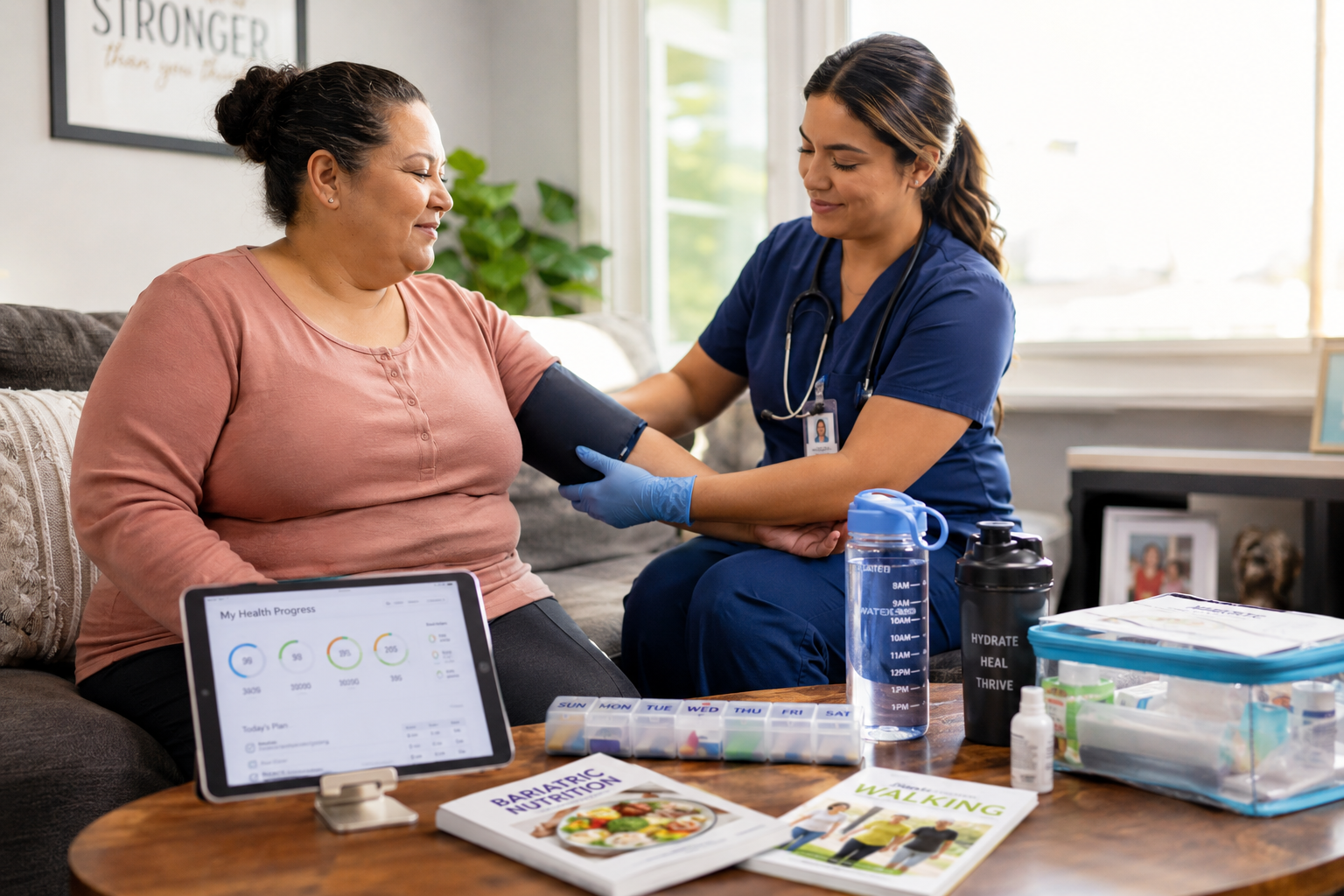
The immediate post-operative period following bariatric surgery involves recovery from major abdominal surgery with specific activity restrictions, pain management challenges, and the early dietary progression from liquids through soft foods that characterizes bariatric recovery. Home health services in this period focus primarily on wound assessment and care, vital sign monitoring, medication management education for the dramatically altered medication absorption that follows gastric bypass, and early activity progression. The nursing team carries the primary clinical management role in this phase, but occupational therapy and physical therapy have specific contributions that begin even in the immediate post-surgical weeks.
Physical therapy in the immediate post-bariatric period addresses the functional mobility challenges that severe obesity plus post-surgical recovery creates. Many bariatric surgery patients have significant pre-existing mobility limitations — from osteoarthritis, from the physiological consequences of obesity, from the deconditioning that often accompanies obesity-related activity restriction — that are not immediately resolved by the surgery and that require specific clinical attention in the early post-operative period. The PT who evaluates the patient’s functional mobility status at start of care, identifies the specific barriers to safe ambulation and transfer, and initiates a progressive mobility program that respects both surgical restrictions and the patient’s pre-existing functional limitations provides a clinical service that significantly accelerates safe functional recovery.
Equipment considerations for post-bariatric patients are a specific operational challenge that agencies must plan for. Standard home health equipment — walker frames, wheelchairs, commodes, shower chairs, hospital beds, blood pressure cuffs — has weight rating limits that many bariatric surgery patients exceed. Bariatric-capacity versions of all of these items exist, but they require specific ordering processes, may not be immediately available through standard DME suppliers, and may require advance planning that is not possible when referrals arrive with same-day or next-day admission requirements. Agencies with post-bariatric home health programs develop relationships with bariatric-capable DME suppliers and establish procurement protocols that ensure appropriate equipment is available when it is needed.
Home environment assessment for post-bariatric patients requires specific attention to the furniture, bathroom fixtures, and structural features that may not be rated for or functionally appropriate for the patient’s weight. The toilet that is appropriate for a 150-pound patient may be at risk of structural failure for a 450-pound patient without a bariatric-rated raised toilet seat. The standard shower chair that adequately supports most patients collapses under bariatric weight loads. The bed that provides adequate sleeping surface for the average patient may be too narrow for comfortable and safe positioning of a morbidly obese patient. OT assessment of these specific environmental considerations produces recommendations that protect patient safety in ways that standard home safety assessment protocols designed for the general home health population do not automatically capture.
Nutrition and dietary compliance education in the early post-bariatric period is a component of care where occupational therapy and nursing collaborate in ways that address both the behavioral and the functional dimensions of the dramatically altered dietary regimen that bariatric surgery requires. The post-gastric bypass patient must adopt a radically different approach to eating — tiny portions, extremely slow eating pace, careful chewing, avoidance of drinking fluids with meals, specific food texture progressions, vitamin and mineral supplementation — that requires sustained behavioral change under conditions of significant physical and emotional adjustment. OT assessment of the patient’s ability to implement these requirements in their actual kitchen and with their actual household and social dynamics identifies barriers to compliance that nutritional counseling alone cannot address.
Dumping syndrome — the constellation of symptoms produced by rapid emptying of food into the small intestine in post-gastric bypass patients — is a clinical complication that home health therapists must be able to recognize and respond to. Early dumping syndrome (occurring within 30 minutes of eating) produces nausea, vomiting, diarrhea, dizziness, and sweating as fluid shifts into the intestinal lumen. Late dumping syndrome (occurring 1-3 hours post-meal) produces hypoglycemia symptoms as exaggerated insulin response to rapid glucose absorption causes blood sugar to plummet. Clinicians working with post-gastric bypass patients who observe these symptoms during or after meals should recognize them as dumping syndrome and communicate with the nursing and surgical team, not misattribute them to other causes.
Long-term post-bariatric home health needs are substantial and often underappreciated. The significant weight loss that typically occurs in the 12-18 months following surgery produces dramatic changes in musculoskeletal loading, skin integrity, and functional capacity that generate recurring home health needs. Patients who experienced limited mobility and significant deconditioning at their pre-surgical weight and who are now substantially lighter require PT support for the progressive reconditioning program that safely rebuilds functional capacity in a musculoskeletal system that is adapting to radically different weight loading conditions. Excess skin — the skin redundancy that follows massive weight loss — creates skin integrity risks, hygiene challenges, and functional limitations in specific movement patterns that OT and nursing address through skin care protocols, adaptive techniques, and referral for evaluation of surgical skin removal procedures when appropriate.
Psychological dimensions of post-bariatric recovery are clinically significant and frequently underaddressed in home health. Bariatric surgery is major surgery, and the psychological adjustment to the dramatically altered body, the new relationship with food, and the rapid changes in social and interpersonal dynamics that weight loss produces can be overwhelming even for patients who appear to be doing well physically. Post-bariatric patients have elevated rates of depression, anxiety, and in some cases substance use disorder — the addiction transfer phenomenon in which the compulsive relationship with food is substituted by a compulsive relationship with alcohol or other substances following surgery. MSW assessment and intervention for the psychological dimensions of post-bariatric recovery is a clinical contribution that home health agencies with MSW capacity can provide and that post-surgical programs without strong home health integration cannot.
Referral relationships with bariatric surgery programs — the comprehensive bariatric centers at Houston’s major hospital systems, the bariatric surgical practices in the Houston metropolitan area, and the bariatric nurse coordinators who manage post-surgical follow-up — are some of the most productive specialty referral relationships a home health agency can develop. Bariatric surgery programs discharge complex patients with specific and predictable home health needs, and the surgical team’s confidence in the receiving home health agency’s ability to manage these patients appropriately is the determining factor in referral decisions.
Humane Care Therapy Inc. provides OT, PT, and MSW staffing that supports post-bariatric home health care for agencies across Houston and Southeast Texas. Contact us at (281) 619-3771 or visit humanecaretherapy.com.
Related HCT staffing services: Occupational Therapy and Physical Therapy staffing in Houston.