How Emerging Tools — Used Correctly — Make Home Health Clinicians More Effective Without Replacing the Human Element
Technology in home health therapy occupies an interesting and sometimes contradictory position. On one hand, the pace of technological development in healthcare — in digital health platforms, remote monitoring tools, artificial intelligence applications, and mobile documentation systems — has never been faster, and the potential for these tools to enhance clinical practice is genuinely substantial. On the other hand, home health therapy is fundamentally a human practice — built on therapeutic relationships, clinical observation, hands-on assessment, and the judgment that comes from being physically present with patients in their actual lives — and the tools that enhance this practice are very different from the tools that attempt to replace the human elements it requires.
Navigating this distinction — understanding which technologies genuinely enhance clinical effectiveness in home health therapy and which ones create the appearance of enhancement without the substance — is an increasingly important clinical leadership competency. Agencies and clinicians that invest in the right technologies gain measurable advantages in documentation efficiency, patient engagement, clinical monitoring, and care coordination. Those that adopt technology uncritically, or that resist it entirely, miss opportunities that their more sophisticated competitors are actively capturing.
Mobile documentation technology has already transformed home health therapy practice, and the quality of the transformation depends almost entirely on the specific platform and the agency’s configuration and training investment. Electronic medical records accessible on mobile devices allow clinicians to complete documentation at the point of care — in the patient’s home, immediately following or concurrent with the clinical encounter — rather than at the end of the day from memory. The documentation quality improvement associated with point-of-care documentation is substantial: details observed during the session that cannot be recalled three hours later are captured accurately, clinical reasoning is recorded while it is fresh, and the temporal gap between clinical encounter and documentation that creates both memory errors and compliance questions is eliminated.
The difference in mobile documentation quality between well-configured and poorly-configured systems is dramatic. A mobile EMR that loads slowly on the clinic’s Wi-Fi but crashes repeatedly on cellular networks, whose touch interface is difficult to navigate in a patient’s living room, and whose voice-to-text capability is unreliable in environments with background noise is not a documentation enhancement — it is a source of daily frustration that extends visit time and reduces documentation completeness. Agencies that invest in mobile EMR optimization — testing platform performance on the cellular networks used in different parts of their service area, configuring documentation templates for mobile navigation efficiency, and providing adequate clinician training for mobile documentation workflows — realize the benefits that the technology is capable of providing.
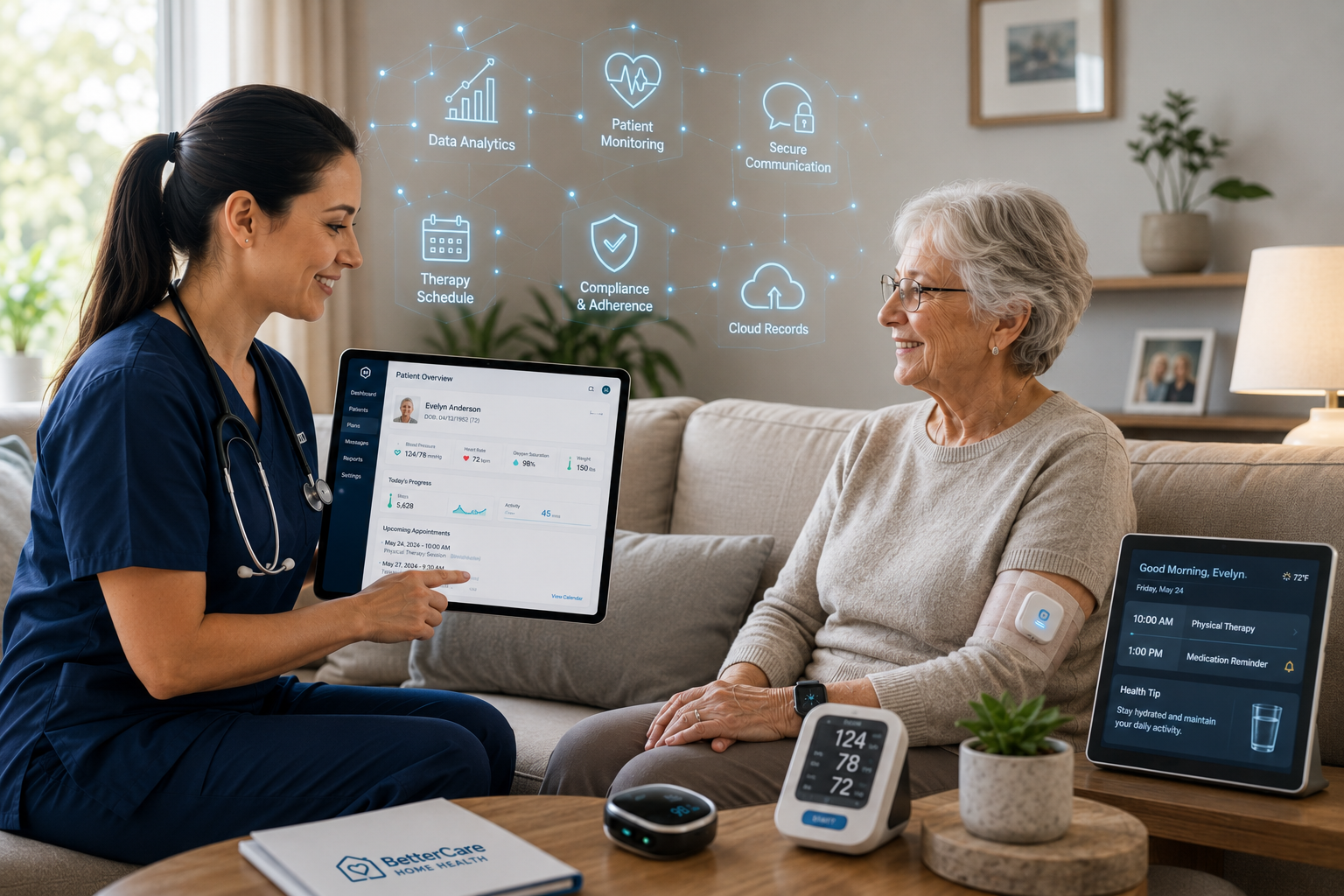
Remote monitoring technology is the category with the fastest growth and the most direct application to the between-visit surveillance that home health therapy’s episodic nature makes clinically important. Activity monitors that track daily step counts and movement patterns, remote blood pressure and weight monitoring systems for cardiac and renal patients, continuous glucose monitoring data accessible to the care team for diabetic patients, and sleep quality monitoring tools for patients where sleep disruption is a clinical concern all provide between-visit clinical information that allows more precise and responsive clinical decision-making than visit-based assessment alone.
The clinical applications of remote monitoring data for therapy practice are specific and emerging. A PT treating a post-cardiac heart failure patient with access to daily weight data can modify the next session’s exercise prescription based on fluid retention indicators that suggest higher-than-usual physiological load. An OT monitoring a patient’s daily activity patterns can identify the mid-morning activity collapse that confirms the fatigue-timing pattern the patient described verbally and design a pacing schedule that specifically addresses the identified pattern rather than the average pattern the patient reports. An MSW reviewing the activity monitor data for a patient at depression risk can observe the declining movement patterns that may indicate worsening mood before the patient reports it in a clinical conversation.
Artificial intelligence applications in home health are advancing from the experimental phase toward clinical implementation, and clinical staff need conceptual frameworks for evaluating these tools critically rather than adopting them uncritically or dismissing them reflexively. AI-assisted OASIS scoring — systems that analyze clinical documentation and suggest OASIS item scores based on the documented clinical picture — has the potential to reduce systematic scoring errors when the AI model is well-validated and when clinicians understand that AI suggestions require clinical judgment review rather than uncritical acceptance. AI-generated documentation assistance — systems that convert voice recordings of clinical encounters into structured documentation drafts — can reduce the time burden of documentation while maintaining the clinical specificity that quality documentation requires, provided that clinicians review and edit the output rather than simply signing AI-generated text.
The ethical and clinical caution warranted by AI documentation tools in home health relates specifically to the compliance implications of documentation that clinical staff have not personally composed. When an AI system generates documentation text that a clinician signs without thorough review and editing, and when that text contains inaccuracies or lacks the clinical specificity that the clinical encounter actually produced, the clinician has signed documentation that may be both clinically inaccurate and compliance-deficient — without necessarily being aware of either problem. Training clinicians to treat AI documentation assistance as a drafting tool requiring thorough review and editing, rather than as a final product requiring only a signature, is essential for maintaining documentation integrity in practices that adopt these tools.
Telehealth in home health continues to evolve in its clinical and regulatory dimensions, as discussed in prior blog posts. What is worth adding in the context of broader technology integration is the principle that telehealth’s value in home health is maximized when it is used to enhance rather than replace the in-person clinical encounters that home health therapy requires. Telehealth check-ins between scheduled visits, remote caregiver coaching sessions, and technology-supported home program monitoring extend the clinical team’s reach and impact between visits. These uses of telehealth supplement in-person care in ways that produce clinical value. Uses of telehealth that attempt to substitute for in-person assessment or skilled therapeutic intervention create both clinical and billing compliance risks that offset any efficiency gains.
Patient engagement platforms — digital tools that allow patients to report symptoms between visits, receive home exercise program guidance, access educational content about their conditions and self-management strategies, and communicate with their care team — are increasingly available and increasingly adopted by forward-looking home health agencies. The clinical impact of these platforms depends on their implementation quality: patients who are adequately trained to use them, whose care teams actually review and respond to the data they generate, and who find them accessible and useful experience better engagement and potentially better outcomes. Platforms that are installed without adequate patient training, that generate data no one reviews, or that are too complex for the average home health patient to use reliably add administrative complexity without clinical benefit.
Technology vendor evaluation is a competency that home health agency leadership increasingly needs to exercise critically. The health technology market includes tools of dramatically varying quality, and vendors universally claim clinical benefits that independent evidence may not support. Agencies evaluating technology investments should ask for peer-reviewed evidence or independently validated outcome data supporting clinical claims, request references from similar agencies that have implemented the specific tools, understand the full implementation cost including staff training, workflow modification, and ongoing support, and realistically assess the implementation burden relative to the agency’s current operational capacity.
Humane Care Therapy Inc. deploys clinicians who are comfortable with and trained in current home health technology platforms, including WellSky and other major EMR systems. Our deployment process includes technology orientation that ensures clinicians integrate with partner agency systems efficiently from the first visit. Contact us at (281) 619-3771 or visit humanecaretherapy.com.
Looking for a therapy staffing partner for your home health agency? Learn more about our therapy staffing services in Houston.