Evidence-Based PT, OT, and MSW Strategies for Reducing Fall Risk in the Home Health Population
Falls are the leading cause of injury-related death and disability among adults over 65 in the United States, and the home health population has fall rates substantially higher than the general older adult community due to the concentration of functional limitations, medical complexity, and the environmental hazards of the specific home settings where home health patients live. Every home health agency serves a patient population where fall risk is nearly universal — where the combination of age, medical diagnoses, functional limitations, medications, and home environments that most home health patients present creates fall risk that skilled, systematic, multidisciplinary clinical assessment and intervention is specifically designed to address.
The evidence base for fall prevention in older adults is more developed than for perhaps any other single topic in home health therapy, and it points clearly toward several intervention approaches that produce meaningful risk reduction when implemented with clinical rigor. The problem is that fall prevention in home health is frequently implemented generically rather than with the individualized, assessment-driven specificity that the evidence supports — producing fall prevention programs that satisfy documentation requirements without producing the risk reduction that evidence-based implementation achieves.
Comprehensive fall risk assessment is the foundation of effective fall prevention, and its quality determines the relevance and specificity of every subsequent intervention. The Timed Up and Go test, the Berg Balance Scale, the Functional Gait Assessment, the Four Stage Balance Test, the 30-Second Chair Stand test, and the Dynamic Gait Index are standardized assessment tools that quantify different dimensions of fall-relevant functional status — mobility, balance, gait, lower extremity strength — in ways that provide specific baseline measures, identify the specific functional domains contributing most to fall risk, and establish the measurable targets that intervention programs pursue. Administering multiple complementary tools produces a more complete clinical picture than relying on any single measure.
Medication review is a fall prevention intervention that is within the clinical communication scope of PT and OT and that produces some of the most significant fall risk reduction available through any single intervention. The medications most strongly associated with fall risk — benzodiazepines, anticholinergics, antidepressants, antipsychotics, opioids, and multiple cardiovascular medications — produce fall risk through mechanisms including sedation, orthostatic hypotension, motor coordination impairment, and cognitive effects that compound the physical fall risk factors that therapy addresses directly. Home health therapists who identify high-risk medications in use, document the clinical correlation between medication profile and observed functional findings, and communicate these findings specifically to nursing and the prescribing physician with clinical specificity that supports a medication review conversation are providing fall prevention value that extends well beyond what physical interventions alone achieve.
Orthostatic hypotension — the blood pressure drop that occurs when a patient moves from lying or sitting to standing — is a modifiable fall risk factor that home health therapists should routinely screen for and that is underidentified in home health practice. Screening involves measuring blood pressure in supine or sitting position and again after one minute of standing, with a drop of 20 mmHg systolic or 10 mmHg diastolic indicating clinically significant orthostasis. Patients with orthostatic hypotension are at high fall risk during any transition from lower to higher positions — getting out of bed, rising from a chair, getting up after using the toilet — and the behavioral modifications that reduce orthostatic fall risk: slower position changes with pause before ambulation, hydration optimization, compression stocking use for appropriate patients, and leg exercises before rising, are teachable and immediately implementable.
Exercise intervention for fall prevention has the strongest evidence base among all fall prevention approaches, with multiple systematic reviews and meta-analyses demonstrating that balance and strength training programs reduce fall frequency by 23 to 30 percent in older adults at risk. The specific exercise characteristics that produce fall risk reduction are well documented: programs must be sufficiently challenging to produce balance adaptation (easy balance exercises that are within the patient’s comfortable current capability produce little adaptive stimulus), must include progressive overload that increases challenge as capacity improves, must include gait training under varied conditions, and must be of sufficient duration — typically 12 weeks or longer — to produce the neuromuscular adaptations that reduce fall risk. Home exercise programs that prescribe three sets of ten ankle pumps as a fall prevention intervention are not evidence-based fall prevention.
Dual-task training — practicing balance and gait tasks while simultaneously performing cognitive tasks — addresses one of the most functionally relevant fall risk factors in older adults: the inability to safely maintain balance while dividing attention between movement and thinking. Real-world mobility requires constant dual-task performance — walking while talking, navigating a grocery store while planning a shopping list, maintaining balance while reaching for an object — and the specific vulnerability to falls that attention division creates in older adults is addressable through practice. PT dual-task training programs that progress from simple cognitive demands during walking to more complex attention demands mirror the real-world situations where falls most commonly occur.
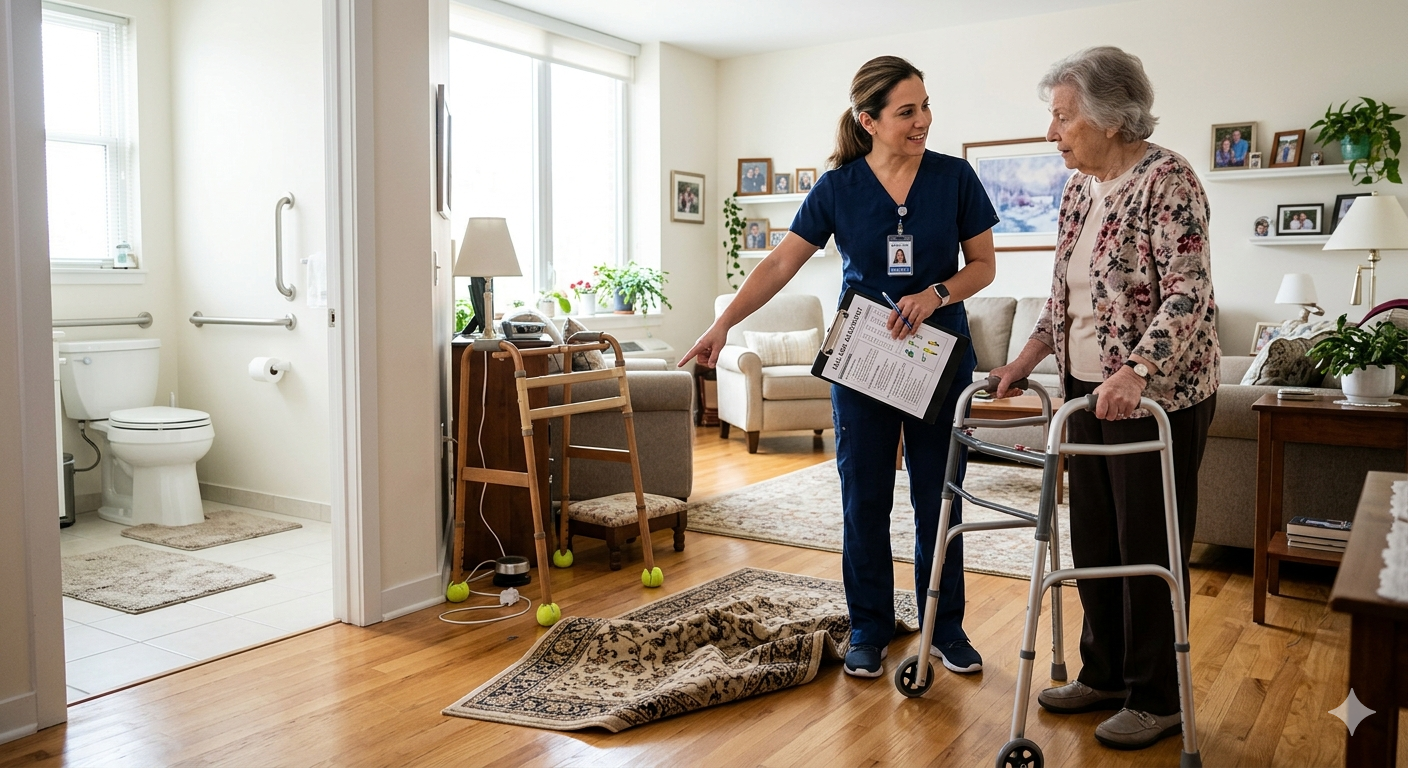
Environmental modification is the OT fall prevention intervention with the most immediate and durable impact, and as discussed in the home modification post, its effectiveness depends entirely on the specificity and individualization of the assessment and recommendations. The most important distinction in environmental fall prevention assessment is between identifying hazards and ensuring their removal. An audit that notes “area rug in living room — fall hazard” and a follow-up visit that confirms the rug was actually removed represents completed environmental fall prevention. An audit that identifies the same hazard but never confirms removal has documented a risk that continues to exist.
Fear of falling is a fall risk factor that is both highly prevalent and highly underaddressed in home health fall prevention practice. Fear of falling affects 40 to 60 percent of older adults, and the activity restriction it produces — reducing participation in the activities that maintain physical conditioning, balance, and gait quality — directly increases future fall risk, creating the self-reinforcing spiral in which fear of falling causes the deconditioning that makes falls more likely. PT and OT cognitive-behavioral approaches to fear of falling — combining graduated exposure to feared movement scenarios with education about fall risk and realistic assessment of functional capability — address the psychological component of fall risk that physical exercise and environmental modification alone cannot resolve.
Medical social work addresses the social and psychological dimensions of fall risk that PT and OT physical interventions cannot reach. Social isolation increases fall risk through mechanisms including depression, reduced motivation for physical activity, and the absence of the social support that provides both practical assistance and the emotional engagement that motivates self-care behavior. Depression itself is an independent fall risk factor. MSW identification and intervention on these modifiable psychological and social fall risk factors extends fall prevention beyond the physical and environmental domains that therapy traditionally addresses.
Humane Care Therapy Inc. provides OT, PT, and MSW staffing whose clinical approach to fall prevention reflects the evidence-based, individualized, multidisciplinary framework that produces meaningful fall risk reduction for the home health patients of agencies across Houston and Southeast Texas. Contact us at (281) 619-3771 or visit humanecaretherapy.com.
Related HCT staffing services: Occupational Therapy and Physical Therapy staffing in Houston.