A Strategic Look at the Clinical, Technological, and Policy Shifts That Will Shape Home Health Practice Over the Next Five Years
Home health is entering one of the most consequential periods of change in its history as a care delivery model. The demographic drivers that have always powered the sector — the aging of the US population, the preference for home-based care over institutional settings, and the chronic disease burden of an aging cohort with unprecedented survivorship — are accelerating rather than stabilizing. Simultaneously, the payment policy environment, the technological infrastructure of home-based care, the clinical scope of what home health can accomplish, and the workforce dynamics that determine whether agencies can meet expanding demand are all in active flux. Agencies that understand these trends and that are building the strategic capabilities to capitalize on them now are positioning for growth and quality leadership in a market whose most significant expansion is still ahead.
The aging population trajectory is the most predictable and most powerful demographic trend shaping home health’s future. The baby boom generation — approximately 73 million Americans born between 1946 and 1964 — is moving through the age ranges of highest home health utilization. The 85-and-older population, which has historically had the highest per-capita home health utilization, is projected to roughly triple between 2020 and 2050. In the Houston metropolitan area and throughout Southeast Texas, this demographic trajectory is compounded by the region’s high chronic disease burden, its ethnic and racial diversity, and its geographic distribution across urban, suburban, and rural settings that create access challenges that home health is specifically positioned to address. The demand for home health services in this market will grow substantially over the next decade regardless of policy changes that might accelerate or modulate that growth.
Hospital-at-home is the most significant emerging care delivery model adjacent to home health, and it represents both a competitive threat to agencies that are not positioned to participate in it and a partnership opportunity for those that are. Hospital-at-home programs — which deliver acute-level inpatient care for selected conditions entirely in the patient’s home — require the intensive, coordinated clinical presence that home health agencies are best positioned to provide among potential delivery partners. CMS’s Acute Hospital Care at Home waiver program has demonstrated the clinical and economic viability of this model, and its likely permanent authorization would create substantial new referral volume for the home health agencies that develop the clinical infrastructure, technological capability, and payer relationships to participate.
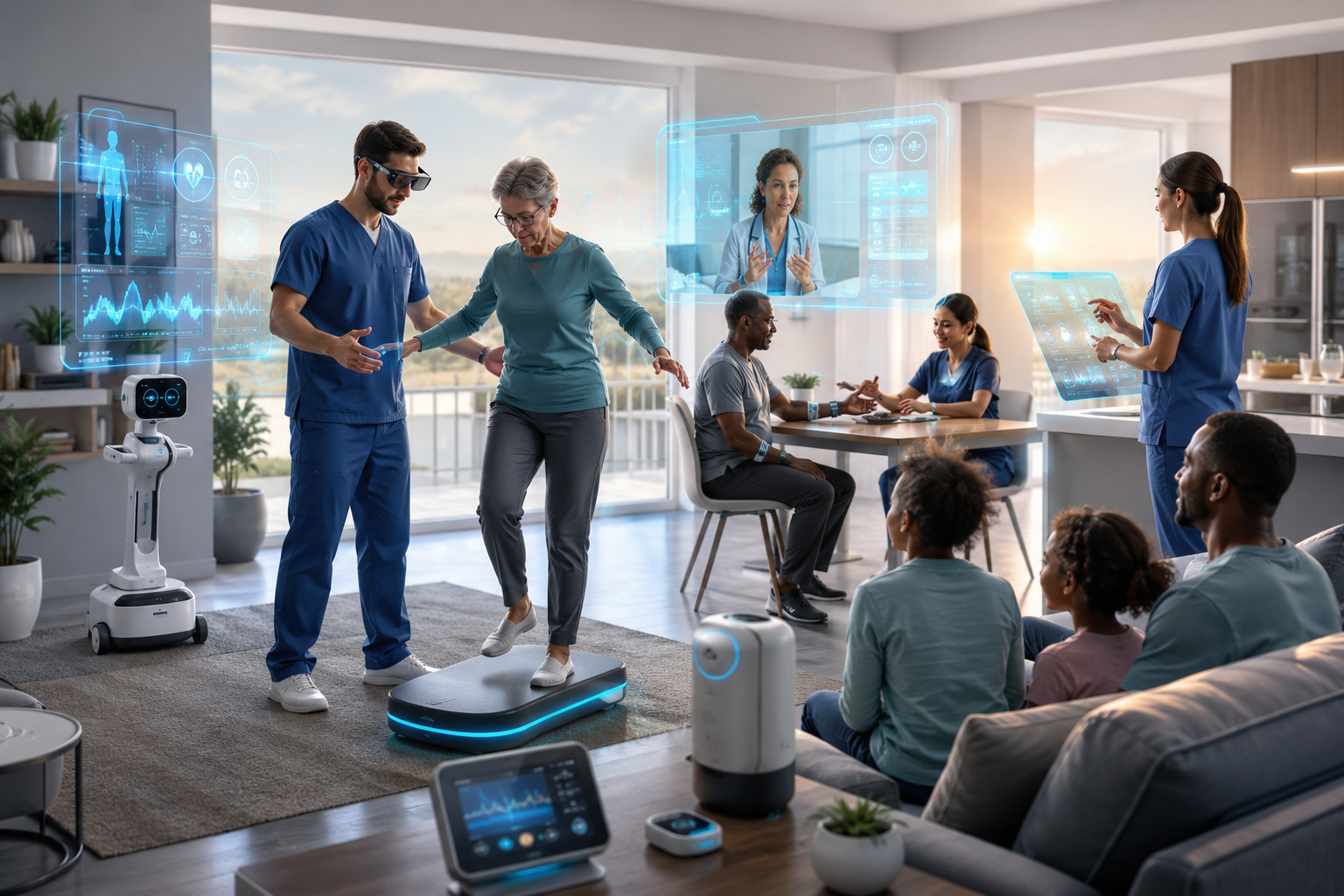
Remote patient monitoring integration with home health therapy is moving from a future consideration to a current implementation decision for forward-looking agencies. Continuous vital sign monitoring devices, activity trackers, glucose monitoring systems, and the AI-powered analysis platforms that identify clinically significant patterns in the data these devices generate are becoming sufficiently mature and sufficiently accessible that agencies can realistically implement them for selected patient populations now. The PT whose exercise prescription is calibrated by the patient’s daily step count and heart rate variability data, the OT whose fluid management education is reinforced by the daily weight monitoring system that the patient uses independently, and the MSW whose depression risk monitoring is supported by activity pattern data that indicates social withdrawal before the patient reports it are practicing a form of data-augmented clinical care that produces better between-visit surveillance and more responsive clinical adjustment than visit-based assessment alone can achieve.
Artificial intelligence applications in home health clinical practice are advancing beyond the documentation assistance tools of the early 2020s toward clinical decision support, predictive risk stratification, and care planning assistance tools that have the potential to meaningfully improve clinical quality when used appropriately. Predictive models that identify patients at elevated risk for readmission, functional decline, or fall events — flagging these patients for enhanced monitoring or adjusted visit frequency before the adverse event occurs — represent a genuine clinical quality advance. The ethical and practical requirements for AI clinical decision support in home health include validation of the AI model in populations similar to the agency’s patient population, clinician training in appropriate use and appropriate skepticism of AI recommendations, and the maintenance of clinical judgment as the final decision-making authority rather than treating AI recommendations as clinical directives.
Workforce development for the home health therapy pipeline is a strategic priority that forward-looking agencies are approaching proactively rather than reactively. The therapist shortage that currently drives contract therapy demand and compensation pressure in the Houston market reflects structural pipeline constraints — the supply of new PT, OT, SLP, and MSW graduates is not growing at a pace that matches the demographic demand acceleration — that will intensify over the next decade. Agencies that invest in clinical residency programs, clinical training site relationships with therapy education programs, career development pathways for early-career clinicians, and community health worker training programs that extend clinical capacity through task delegation are building workforce advantages that will become increasingly significant as competition for qualified therapy staff intensifies.
Health equity as a strategic and operational priority is becoming both a clinical and competitive imperative for home health agencies in diverse markets like Houston. CMS has introduced health equity measures into the Value-Based Purchasing framework, creating financial incentives for agencies to document and improve care quality for patients from historically underserved populations. Medicare Advantage plans and Medicaid managed care organizations are increasingly incorporating health equity performance into their network contracting criteria. And the demographic composition of Houston’s home health patient population makes health equity not an aspirational value but a practical clinical necessity — agencies that cannot serve the full diversity of Houston’s population cannot sustain referral volume from the diverse referral sources in the Houston market.
The agencies that will lead the Houston home health market over the next decade are building now — building the specialty clinical capability, the technology infrastructure, the health equity practice, the workforce development programs, and the payment model versatility that the market’s trajectory demands. The strategic investments that distinguish these agencies from those that are managing the present rather than building the future are visible in their clinical hiring decisions, their technology adoption priorities, their community relationships, and the quality of the clinical partnerships they build with staffing companies that take clinical excellence as seriously as they do.
Humane Care Therapy Inc. is building alongside the forward-looking agencies that are defining the future of home health in Houston and Southeast Texas. Our clinical staffing, our quality standards, and our partnership approach are designed for the agencies that take the long view. Contact us at (281) 619-3771 or visit humanecaretherapy.com.
Looking for a therapy staffing partner for your home health agency? Learn more about our therapy staffing services in Houston.