
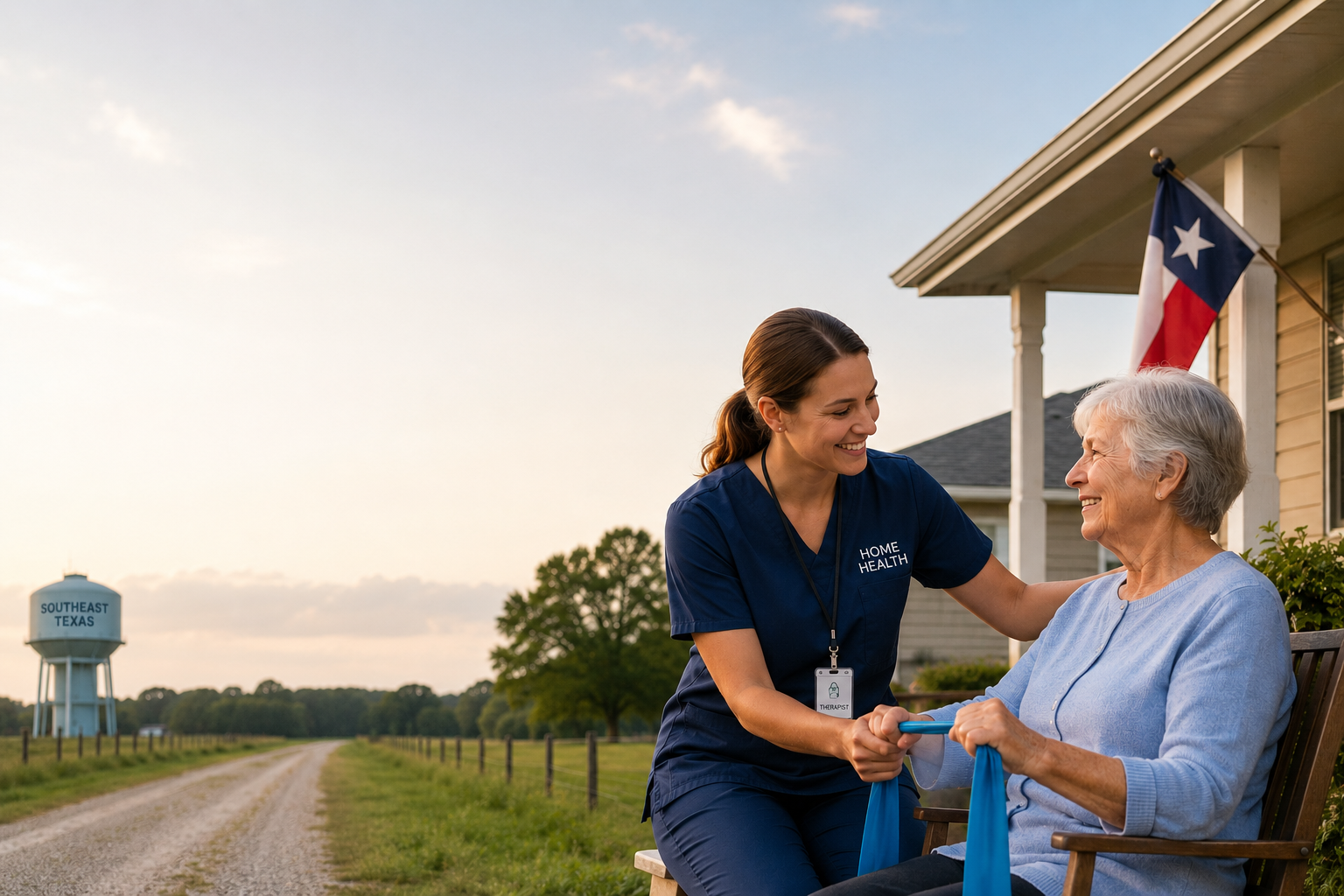
Why Agencies Serving Communities Beyond Houston’s Urban Core Need Specialized Staffing Support to Thrive
The Unique Landscape of Non-Urban Home Health in Southeast Texas
Houston’s home health industry is often discussed in the context of the city’s vast urban landscape — the Medical Center, the sprawling suburbs, and the dense residential communities that make up the nation’s fourth-largest metropolitan area. But a significant and growing portion of home health demand exists in the suburban, exurban, and rural communities that ring the Houston metropolitan area and extend throughout Southeast Texas. These communities represent both a significant challenge and a compelling opportunity for home health agencies that can solve the staffing puzzle.
Communities like Conroe, Huntsville, Beaumont, Victoria, Liberty, Dayton, Wharton, and Willis — along with the countless smaller towns and unincorporated areas throughout Fort Bend, Brazoria, Galveston, Montgomery, and surrounding counties — are home to aging populations with significant healthcare needs. Many of these communities have limited access to hospitals, outpatient rehabilitation facilities, and specialist physicians, making home health services an essential lifeline for patients who need skilled therapy and medical social work support. Without home health, many patients in these communities would face lengthy travel to distant facilities for services that could be delivered more effectively and conveniently in their own homes.
For home health agencies serving these non-urban communities, the therapy staffing challenge is considerably more acute than in Houston’s urban core, where a larger concentration of licensed therapists creates a deeper labor pool from which agencies can recruit. The fundamental difficulty is straightforward but difficult to overcome: most licensed therapists live in or near major urban areas where employment opportunities are concentrated, and many are reluctant to accept positions that require extensive travel to rural and suburban communities. This geographic mismatch between clinician supply and patient demand creates persistent staffing gaps that undermine agencies’ ability to serve their non-urban patient populations effectively and reliably.
The consequences of inadequate therapy coverage in non-urban areas are particularly severe because patients in these communities often have fewer alternative care options. When a patient in central Houston cannot receive timely therapy through one agency, there are dozens of other agencies that might provide coverage. When a patient in a rural community outside Beaumont, in Wharton County, or near Huntsville faces the same situation, the alternatives may be extremely limited — or nonexistent. For these patients, the availability of therapy staffing through their home health agency may literally determine whether they receive needed care.
Staffing Barriers Specific to Non-Urban Home Health Practice
Several factors combine to make therapy staffing in suburban and rural Southeast Texas uniquely challenging, creating barriers that standard recruitment approaches rarely overcome.
Travel distance and time represent the most obvious and impactful barrier to non-urban home health therapy staffing. A therapist based in Sugar Land who is assigned patients in communities 60 or 80 miles away faces hours of driving each day that reduce the number of patients they can see and substantially increase their frustration with the inefficiency of their schedule. This travel burden is not just inconvenient — it is a significant cost driver that affects both the therapist’s earning potential through reduced visit capacity and the agency’s per-visit economics through mileage reimbursement and reduced productivity. Over time, excessive travel demands lead to therapist dissatisfaction and turnover, perpetuating the staffing challenges.
Professional isolation affects clinician satisfaction and retention in non-urban settings in ways that are less visible but equally damaging. Therapists who practice primarily in rural and suburban areas may lack regular contact with professional peers, access to informal mentorship and clinical consultation, and opportunities for professional development and continuing education that are more readily available in urban practice environments. This isolation can accelerate burnout, reduce job satisfaction, and increase turnover — creating a self-reinforcing cycle where staffing difficulties in non-urban areas become progressively harder to solve.
Patient acuity in non-urban home health is often higher than in urban settings, adding clinical complexity that demands more experienced and skilled therapists. Patients in rural and suburban communities may have delayed accessing medical care due to distance from healthcare facilities, transportation barriers, limited health insurance coverage, or cultural factors. By the time they receive home health services, their conditions may be more advanced, more complex, and more challenging to manage than comparable patients in urban areas who had earlier access to care. This higher acuity demands more experienced, skilled therapists — exactly the clinicians who are hardest to recruit for non-urban practice.
Infrastructure limitations and logistical complexities in some non-urban communities across Southeast Texas create additional operational challenges for therapists that further reduce the attractiveness of these assignments and increase the difficulty of maintaining consistent service delivery. Spotty cellular coverage can affect electronic medical record access and communication with the agency office. Unpaved or poorly maintained roads complicate travel and increase vehicle wear. Limited availability of durable medical equipment suppliers may delay equipment-dependent interventions. These practical challenges, while individually manageable, combine to make non-urban practice feel more difficult and less supported than urban practice, contributing to recruitment and retention difficulties.
Strategic Approaches to Non-Urban Therapy Staffing
Home health agencies that serve non-urban Southeast Texas communities can employ several strategies to improve therapy coverage and quality in these underserved areas, moving beyond traditional recruitment approaches that have proven insufficient.
Developing geographic staffing clusters is one of the most effective approaches to improving non-urban coverage efficiency. Rather than assigning therapists to patients scattered across a wide area, agencies can group patient assignments by geographic proximity to minimize travel time and maximize the number of patients each therapist can see in a day. This clustering approach improves efficiency, reduces clinician frustration with excessive travel, creates more predictable daily schedules, and makes non-urban assignments more attractive to potential clinicians.
Recruiting clinicians who live in or near the communities being served eliminates the travel barrier entirely and creates the foundation for sustainable long-term coverage. While this approach requires targeted recruitment efforts that go beyond standard job postings, therapists who live in non-urban communities and prefer to practice close to home can be excellent long-term resources for agencies serving those areas. A staffing partner with deep roots in Southeast Texas and broad geographic reach can help agencies identify and connect with these locally based clinicians who might not be found through conventional recruitment channels.
Combining full-time local staff with contract coverage for surge capacity or hard-to-fill areas provides the flexibility agencies need to maintain consistent service delivery without the risk and expense of carrying excess staff. A base of local therapists handles the routine caseload, while contract clinicians from a staffing partner fill gaps during high-demand periods, cover geographic areas where local recruitment has been unsuccessful, and provide backup coverage during staff vacations or medical leaves.
Offering competitive mileage reimbursement and travel compensation for therapists serving non-urban areas is an important but often neglected component of staffing strategy. When travel costs and time are adequately compensated, the financial disincentive of non-urban practice is reduced, making these assignments more attractive to qualified clinicians. Agencies that invest in fair travel compensation find it easier to recruit and retain therapists for non-urban coverage, particularly when combined with the geographic clustering and scheduling optimization strategies described above.
Investing in technology solutions that reduce the documentation and administrative burden on therapists practicing in non-urban areas can significantly improve satisfaction and retention. Mobile-optimized EMR access, voice-to-text documentation tools, telehealth capabilities for consultations with clinical supervisors, and streamlined communication platforms help therapists work efficiently even in areas with limited infrastructure, making non-urban practice more manageable and less isolating.
The Growth Opportunity in Underserved Communities
While the staffing challenges in non-urban Southeast Texas are real and significant, they also represent a compelling growth opportunity for agencies that can solve them. Communities with limited access to therapy services represent underserved markets where agencies that can provide consistent, high-quality coverage will face less competition, build stronger referral relationships, and establish market positions that are difficult for competitors to challenge.
Hospitals and physician practices in non-urban areas are often eager to partner with home health agencies that can reliably serve their patients with comprehensive therapy services. Because options are limited in these communities, referral source loyalty tends to be stronger and more durable than in urban markets where referring providers have dozens of agency choices. Agencies that establish a reputation for reliable, high-quality service in non-urban communities can build referral pipelines that sustain growth for years and provide a stable foundation for business expansion.
The growth potential in non-urban Southeast Texas is further enhanced by demographic trends that are reshaping the region. Many of the fastest-growing communities in the Houston metropolitan area are suburban and exurban areas where new residential development is attracting young families, empty nesters, and retirees. As these communities mature and their populations age, the demand for home health services will continue to increase steadily, creating expanding market opportunities for agencies with the staffing capacity to serve them. Agencies that establish a presence in these growing communities now will be positioned to capture the increasing demand as the demographics shift.
Value-based purchasing considerations add another dimension to the opportunity in non-urban markets. Because patients in underserved communities often have higher acuity and greater psychosocial complexity, the functional improvement potential for these patients can be substantial. Agencies that deploy skilled therapists to serve these populations and achieve meaningful functional outcomes can generate quality metrics that enhance their overall VBP performance. This creates a virtuous cycle where serving underserved communities not only generates revenue and builds referral relationships but also strengthens the agency’s quality profile across its entire patient population.
The demographic and market dynamics in non-urban Southeast Texas strongly favor agencies that invest in the staffing infrastructure needed to serve these communities reliably. The combination of growing demand, limited competition, strong referral source loyalty, and quality metric advantages creates a compelling strategic case for agencies that are willing to solve the staffing challenge rather than avoid it. Agencies that establish strong non-urban coverage now will build the market position, clinician networks, and referral relationships that become increasingly difficult for late entrants to replicate.
Humane Care Therapy Inc. is committed to supporting home health agencies that serve communities throughout Southeast Texas, from the urban neighborhoods of Houston to the rural communities of East Texas and the Gulf Coast. Our clinician network spans more than 200 communities across the region, providing OT, PT, SLP, and MSW coverage in areas that many staffing providers consider too remote or too challenging to serve. Whether your agency needs therapy staffing for patients in the Woodlands, Galveston, Beaumont, Huntsville, Victoria, or anywhere in between, we have the geographic reach and operational expertise to help. Call (281) 619-3771 or visit humanecaretherapy.com to discuss your non-urban staffing needs today.
Looking for a therapy staffing partner for your home health agency? Learn more about our therapy staffing services in Houston.