
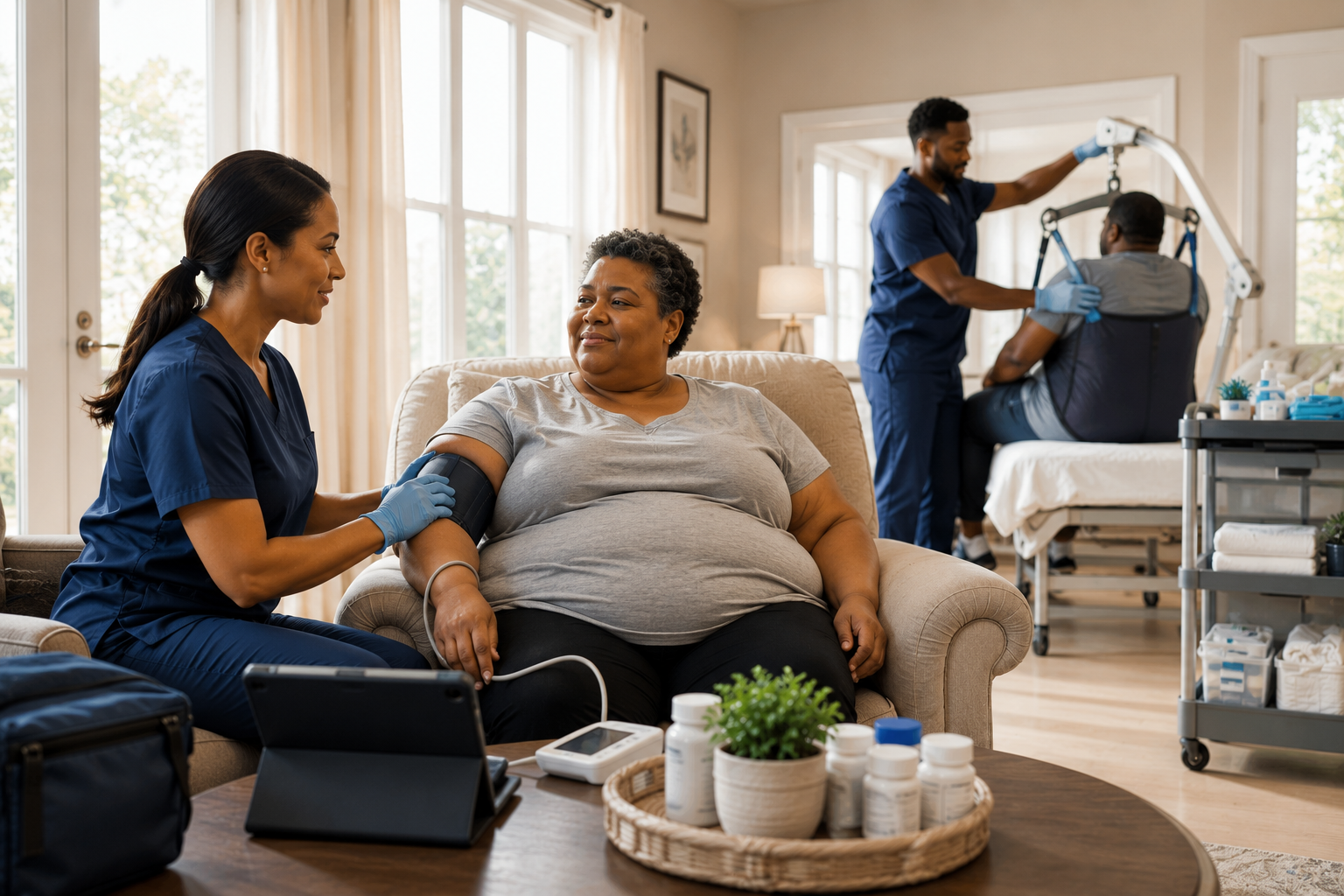
How OT, PT, and MSW Address the Functional, Safety, and Psychosocial Dimensions of Obesity-Related Home Health Care
Obesity is one of the most prevalent conditions in the Houston home health population and one of the most clinically significant modifiers of virtually every other diagnosis a patient carries — yet it is consistently undertreated in home health as a clinical concern in its own right, and its implications for the functional assessment, equipment planning, exercise prescription, and psychosocial care of every patient it affects are often inadequately addressed. Understanding obesity not as a background characteristic of the patient but as an active clinical variable that shapes every aspect of home health care produces a fundamentally different — and more effective — clinical approach.
The physiological dimensions of obesity that most directly affect home health therapy extend well beyond the mechanical effects of excess weight on mobility and joint loading. Obesity produces a chronic low-grade inflammatory state that contributes to fatigue, pain amplification, and impaired healing — clinical features that directly affect therapy tolerance, exercise response, and wound healing in ways that standard protocols designed for patients without significant obesity do not account for. Obesity is associated with sleep disordered breathing, which produces the sleep deprivation and daytime fatigue that reduce therapy participation capacity. Obesity-related metabolic syndrome — the cluster of insulin resistance, dyslipidemia, hypertension, and hyperglycemia that frequently accompanies significant obesity — generates multiple comorbidities that simultaneously affect exercise tolerance, fall risk, and the medical complexity of every home health episode.
Physical therapy exercise prescription for patients with obesity requires specific calibration that goes beyond reducing resistance and duration. The cardiorespiratory demand of weight-bearing exercise for patients with significant obesity is substantially higher than for patients without obesity at any given activity level, meaning that walking at a pace that produces light exertion for a 160-pound patient produces moderate-to-vigorous exertion for a 300-pound patient performing the same movement. PT calibration of exercise intensity using perceived exertion and vital sign response — rather than pace or distance benchmarks that assume average body weight — produces exercise prescriptions that are both safe and therapeutically effective rather than either inadequately challenging or physiologically excessive.
Joint loading considerations in exercise prescription for patients with obesity are specifically relevant for the large proportion of these patients who carry concurrent osteoarthritis, orthopedic conditions, or post-surgical recovery needs. Lower extremity weight-bearing exercise that would be appropriate for a patient without significant obesity may be contraindicated or require specific modification for a patient whose knee or hip articular surfaces are bearing the mechanical load of obesity-related joint stress. Aquatic therapy — one of the highest-value interventions for patients with obesity and concurrent musculoskeletal conditions — is not accessible in the home health setting, making PT skill at identifying and applying the non-weight-bearing and reduced-weight-bearing exercise alternatives that can be performed in the home environment a specific clinical competency for this population.
Functional mobility assessment for patients with obesity requires specific attention to the transfer mechanics, seating surfaces, and assistive device specifications that apply to higher-weight patients. Standard physical therapy transfer assessment assumes body weight ranges that many obesity-related home health patients exceed, and the adaptive techniques, equipment specifications, and caregiver assistance requirements for safe transfers at higher body weights differ substantially from standard transfer protocols. PT assessment of the patient’s specific transfer challenges — bed to standing, chair to standing, toilet transfers, vehicle transfers — with specific attention to the weight-related factors that modify technique and equipment requirements produces a functional mobility assessment that is accurate for this patient rather than generalized for an average patient the assessment tool was not designed for.
Occupational therapy for patients with obesity addresses the specific ADL barriers that result from the combination of body size, mobility limitations, and the functional reach, flexibility, and endurance constraints that obesity and its comorbidities produce. Self-care activities — particularly lower body dressing, bathing, and foot care — present specific challenges when reduced hip and spine flexibility combined with abdominal adiposity limit the range of motion required for standard ADL techniques. Adaptive equipment — long-handled sponges and shoehorns, dressing sticks, bath seats and shower bench specifications that match the patient’s weight and size — and adaptive techniques that achieve ADL independence within the patient’s actual mobility constraints are the OT contributions most directly valued by patients with obesity who are struggling with self-care independence.
Skin integrity and wound risk are elevated clinical concerns in the home health population with obesity because of the skin fold areas that develop in the presence of significant adiposity — areas that are prone to moisture accumulation, friction, and the maceration and fungal infection that create wounds in skin fold regions. OT and nursing skin integrity assessment for patients with obesity specifically examines these skin fold areas, assesses hygiene practices and skin care routines that protect skin fold integrity, and develops the adaptive strategies that allow patients to maintain skin fold hygiene independently or with caregiver assistance.
Medical social work for patients with obesity addresses the substantial stigma burden that many patients with obesity carry into healthcare interactions — including the weight bias that many patients with obesity have experienced from healthcare providers — and that directly affects their engagement with home health services, their willingness to discuss obesity-related health concerns, and their trust in the clinical team. MSW recognition of weight stigma as a clinical barrier, and the creation of a non-judgmental clinical environment in which the patient’s full health experience can be explored, is a specific psychosocial clinical contribution that improves engagement with the entire home health team.
Humane Care Therapy Inc. provides OT, PT, and MSW staffing that supports clinically competent home health care for patients with obesity across Houston and Southeast Texas. Contact us at (281) 619-3771 or visit humanecaretherapy.com.
Related HCT staffing services: Occupational Therapy and Physical Therapy staffing in Houston.