
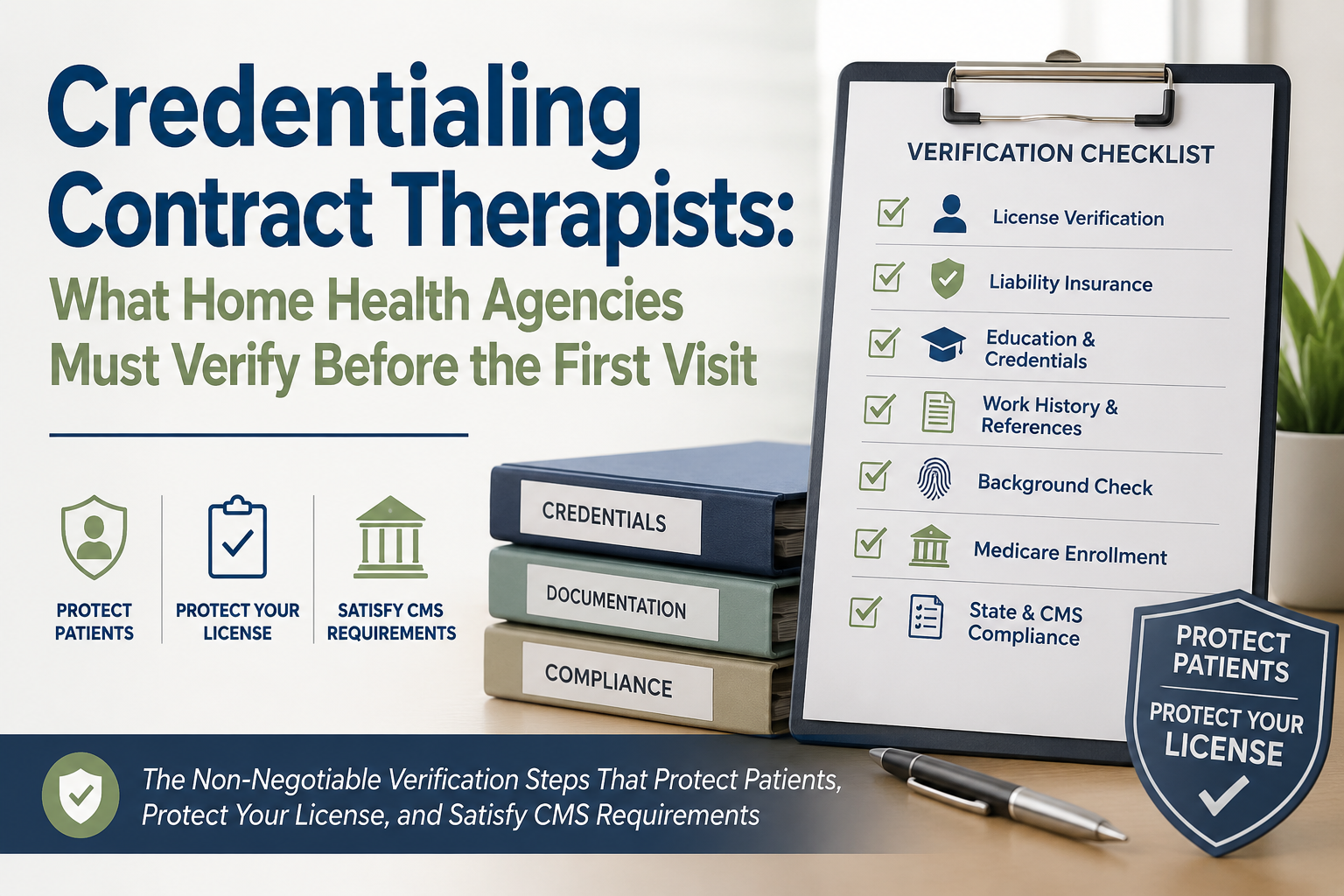
The Non-Negotiable Verification Steps That Protect Patients, Protect Your License, and Satisfy CMS Requirements
When a contract therapist walks into a patient’s home for the first time under your agency’s name, every credential they carry — or fail to carry — becomes your agency’s legal and clinical responsibility. The home health credentialing process is not a formality. It is the clinical and regulatory infrastructure that stands between your agency and potentially catastrophic liability exposure, CMS citation, and the patient safety failures that follow when an unqualified clinician provides skilled services your agency billed as compliant.
Most home health administrators understand that credentialing is required. Fewer have fully mapped what comprehensive credentialing actually includes, what commonly gets missed in the rush to fill a vacancy, and what the consequences look like when shortcuts taken under time pressure create compliance failures discovered weeks or months later during a survey or audit.
This guide covers the complete picture: what to verify, how to verify it, how often to re-verify, and what documentation to maintain to demonstrate credentialing compliance to CMS surveyors, malpractice carriers, and legal counsel when the question is not whether you credentialed adequately but whether you can prove that you did.
License verification is the first and most obvious step — but it is frequently done incompletely. Verifying that a therapist holds a license is not the same as verifying that the license is current, unrestricted, and in good standing. Every state therapy licensing board maintains an online verification database, and every verification should capture the license number, expiration date, and any board actions including restrictions, probation, reprimand, or suspension. A license that is technically active but subject to a practice restriction — prohibiting solo practice, prohibiting specific patient populations, requiring supervision — may not satisfy the staffing conditions under which the therapist will be deployed.
Frequency matters enormously. Verifying license status at the beginning of a contract engagement is necessary but insufficient. Licenses can lapse, face emergency suspension, or acquire restrictions at any point during the engagement. Monthly license status verification — automated through state board databases or commercial credentialing platforms — is the standard that comprehensive credentialing programs maintain. The agency that verified a license six months ago and has not re-verified is carrying unknown risk.
OIG exclusion screening is a credentialing step that agencies frequently underperform, and the consequences of employing or contracting with an OIG-excluded individual are severe. The Office of Inspector General maintains the List of Excluded Individuals and Entities, and any agency that employs, contracts with, or bills for services provided by an excluded individual faces mandatory repayment of all claims associated with that individual plus civil monetary penalties that can reach $10,000 per improperly submitted claim. These penalties apply regardless of whether the agency knew about the exclusion at the time of billing — the OIG exclusion database is publicly available, and agencies are expected to check it.
OIG exclusion screening must occur before any initial deployment and monthly thereafter. Exclusions can be added between checks, and a newly excluded individual who continues working under an agency that has not caught the exclusion through monthly re-screening creates ongoing liability with every claim submitted. Commercial credentialing platforms automate this re-screening, making monthly compliance a manageable operational process rather than a manual burden.
SAM.gov screening — the federal System for Award Management debarment list — is a parallel federal exclusion check that is frequently overlooked in agency credentialing programs. While the OIG LEIE covers Medicare and Medicaid exclusions specifically, SAM.gov covers broader federal debarment that may affect agency eligibility for certain funding sources and that is increasingly being referenced in compliance program requirements. Including SAM.gov screening alongside OIG exclusion checks completes the federal exclusion screening picture.
Background check requirements for home health personnel — including contract staff — are specified in CMS Conditions of Participation and in Texas state law, and the specifications are more detailed than a simple criminal history check. Texas requires criminal history checks through the Texas Department of Public Safety for all personnel who will have direct patient contact. This check must be completed before the first patient contact, not after. The check must use the DPS-approved process, not a commercial background check that may not capture Texas-specific criminal records. And the results must be evaluated against specific criteria — the types of convictions that disqualify individuals from patient contact positions are specified in statute and must be applied consistently.
Professional liability insurance verification is a credentialing component that differs for employed staff versus contract staff and that agencies frequently handle inconsistently for contract therapists. For directly employed therapists, the agency’s general and professional liability policies typically cover clinical activities. For contract therapists, the liability coverage picture is more complex — the contract therapist may carry their own professional liability policy, the staffing agency that deploys them may carry coverage, or both. The home health agency should verify the specific coverage that applies to each contract therapist’s activities, confirm that coverage limits are adequate for the scope of clinical services being performed, and obtain certificates of insurance naming the agency as an additional insured where appropriate.
Education and credential verification requires reviewing original documents or obtaining primary source verifications — not accepting copies provided by the therapist without independent verification. For OTs, PTs, SLPs, and MSWs, this includes degree verification from the degree-granting institution, professional examination passage confirmation from the relevant national examination board (NBCOT for OT, FSBPT for PT, PRAXIS for SLP, ASWB for MSW), and any specialty certification verification for clinical roles requiring specialty credentials.
Employment history verification — contacting previous employers or contracting agencies to confirm the positions held, dates of service, and the absence of termination for cause or resignation under investigation — is a credentialing component that many agencies treat as optional and that should be treated as essential for all clinical staff with direct patient contact. A therapist who was terminated from a previous home health agency for documentation fraud, patient abuse, or clinical incompetence will not volunteer this information on an application. Primary source employment verification is the mechanism that catches it.
Maintaining credentialing documentation in a format that demonstrates compliance to surveyors requires more than keeping files — it requires organized, dated, and complete documentation of each verification step, with evidence of re-verification at the required intervals. CMS surveyors reviewing personnel files want to see license verification dates, OIG check dates, background check results, and insurance certificates that are current and that document a consistent re-verification schedule. Files that contain initial verification documentation without evidence of ongoing monitoring are incomplete for compliance purposes.
Humane Care Therapy Inc. completes comprehensive credentialing for all OT, PT, SLP, and MSW clinicians in our network before any agency placement, including license verification with monthly re-verification, OIG and SAM exclusion screening, Texas DPS background checks, and professional liability coverage confirmation. Our credentialing documentation is available to partner agencies upon request. Contact us at (281) 619-3771 or visit humanecaretherapy.com.
Looking for a therapy staffing partner for your home health agency? Learn more about our therapy staffing services in Houston.