Clinical Knowledge That Makes OT and PT More Effective Partners in Managing Complex Respiratory Patients at Home
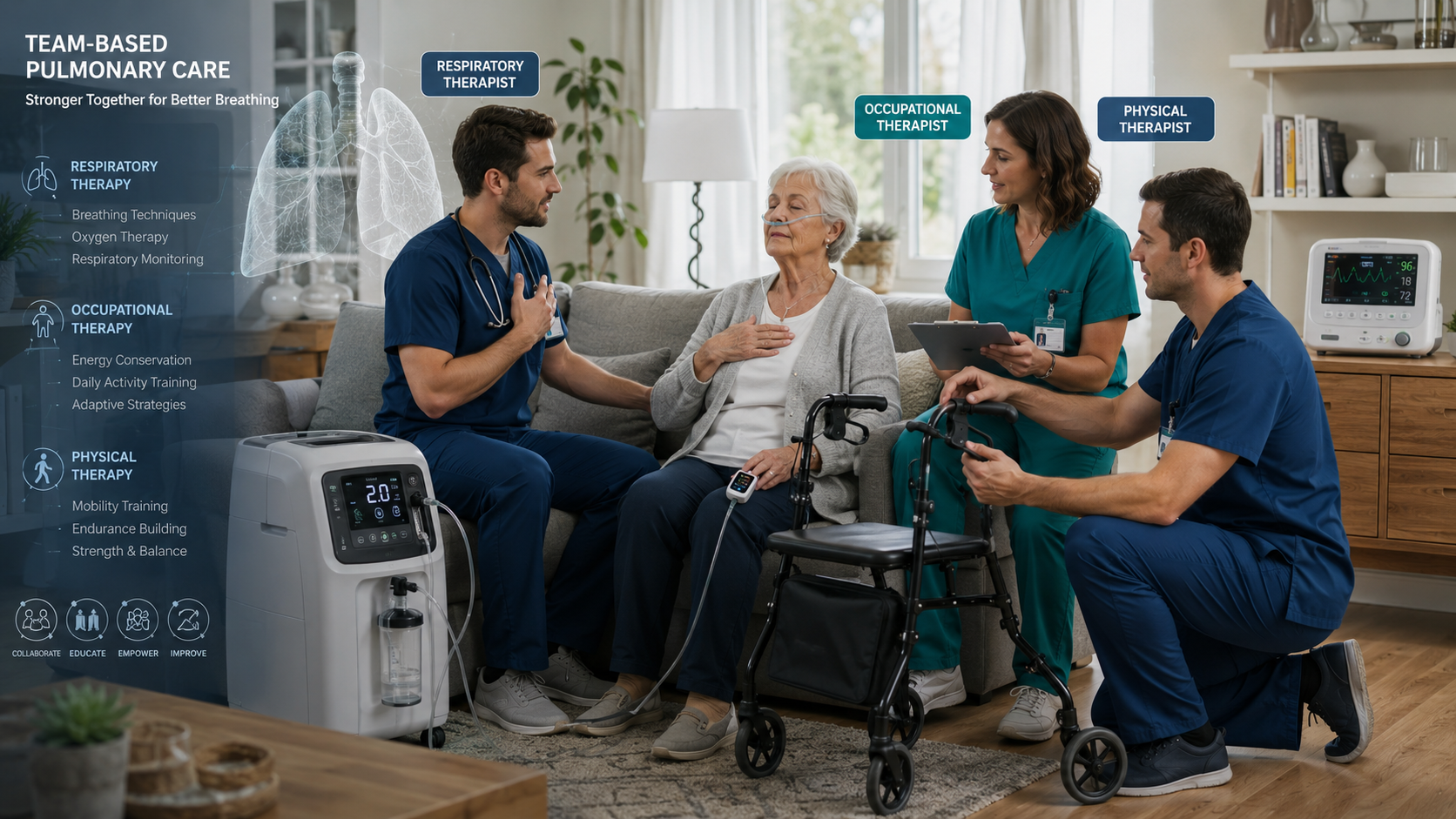
Respiratory conditions are among the most prevalent and most clinically complex diagnoses encountered in home health, and the effective management of patients with COPD, asthma, interstitial lung disease, post-COVID respiratory sequelae, and other pulmonary conditions requires that OT and PT clinicians bring more than general therapy knowledge to these encounters. Understanding the pulmonary physiology that underlies respiratory patients’ functional limitations, recognizing the clinical signs that require medical escalation, knowing how oxygen therapy affects activity and exercise prescription, and coordinating effectively with the nursing team around respiratory monitoring creates a therapy contribution that is qualitatively more effective for this patient population.
Pulse oximetry is the most important monitoring tool in home health therapy for respiratory patients, and its appropriate use goes well beyond simply reading the number on the display. Oxygen saturation measured by pulse oximetry reflects the percentage of hemoglobin molecules carrying oxygen, with normal values typically above 95 percent and values below 90 percent indicating clinically significant hypoxemia. In home health, the contexts in which therapists should be using pulse oximetry for respiratory patients include resting baseline before initiating activity or exercise, continuous monitoring during exercise or functional activity for patients with known or suspected exertional desaturation, and post-activity assessment to document recovery from any activity-related saturation decline.
Interpreting pulse oximetry values in clinical context requires understanding several limitations of the technology that affect clinical decision-making. Pulse oximetry is less reliable in patients with peripheral vascular disease, poor perfusion, or significant anemia — conditions common in the home health population — and the reading may overestimate true oxygen saturation in these contexts. Nail polish, particularly dark-colored polishes, can affect sensor function in ways that produce spuriously low readings. Poor waveform quality — indicated by the pulse waveform display on devices that show it — suggests that the reading may not be reliable. Clinicians who understand these limitations apply appropriate clinical skepticism to abnormal readings rather than accepting every SpO2 value at face value.
Activity-induced oxygen desaturation is a clinical finding with direct implications for therapy practice that every home health therapist serving respiratory patients must know how to identify and respond to. When a patient’s SpO2 drops significantly during activity — typically defined as a drop of 4 or more percentage points, or any drop below 88-90 percent — the clinical response depends on the magnitude of the desaturation, the patient’s symptoms, the activity being performed, and whether the patient is on supplemental oxygen. Mild desaturation during activity that recovers promptly with rest and that is expected given the patient’s condition may be monitored while the activity is modified. Significant desaturation that does not recover with rest, that is accompanied by respiratory distress, or that drops to levels below 85 percent warrants immediate activity cessation and nursing or medical notification.
Supplemental oxygen management during therapy requires understanding of oxygen delivery systems and their interaction with activity. Patients on continuous low-flow oxygen via nasal cannula typically continue their prescribed flow rate during therapy activity unless the prescribing physician has specified an activity flow rate. Patients on exertion-triggered oxygen — where the prescribed flow rate increases with activity — need the increased flow rate to be actually delivered during therapy; a patient who remains at their resting flow rate during exercise while experiencing activity-induced desaturation is not receiving the oxygen support their prescription specifies. Therapists who understand oxygen delivery systems and who ensure that prescribed oxygen delivery is actually occurring during therapy sessions protect patients from hypoxemic complications of exercise that adequate oxygen delivery would prevent.
Breathing techniques and their appropriate application across respiratory diagnoses is an area where OT and PT can both contribute, but where clinical knowledge of which techniques are appropriate for which patients is essential. Pursed lip breathing — useful for COPD patients experiencing exertional dyspnea — is not equally appropriate for all respiratory conditions. Diaphragmatic breathing techniques — helpful for patients with respiratory muscle weakness or dysfunctional breathing patterns — require different instruction than pursed lip breathing and serve different physiological purposes. Paced breathing during activity — timing breath cycles to activity rhythm during functional tasks or exercise — is applicable across respiratory conditions but requires individualization to the patient’s breathing pattern and activity demands. Clinicians who apply breathing technique instruction generically — teaching the same technique to all respiratory patients — are practicing at a lower clinical standard than those who match the technique to the patient’s specific respiratory physiology.
Inhaler technique observation and brief education is within the scope of home health PT and OT practice and represents a clinical contribution that significantly affects respiratory outcomes for patients whose inhaler technique is inadequate. Studies consistently demonstrate that the majority of patients using metered-dose inhalers make at least one critical technique error that substantially reduces the amount of medication that reaches the lower airway. While formal inhaler technique education is typically nursing and respiratory therapy domain, home health PTs and OTs who observe patients using inhalers and who notice obvious technique errors — inadequate breath hold, incorrect actuation timing, failure to shake before use — can identify these observations and communicate them to the nursing team without exceeding their scope by attempting to provide definitive inhaler technique correction.
Post-COVID respiratory sequelae represent an emerging clinical challenge that home health therapists increasingly encounter in patients who experienced COVID-19 illness and who continue to experience respiratory symptoms, exercise intolerance, dyspnea, and cognitive effects months or years after the acute infection. The “long COVID” population presents with a heterogeneous clinical picture that may include post-exertional malaise — worsening of symptoms following activity that persists for days — as a predominant feature in some patients. For patients with significant post-exertional malaise, standard graded activity approaches must be modified because activity that exceeds the patient’s energy envelope triggers symptom exacerbation rather than conditioning adaptation. Understanding this feature and calibrating activity accordingly is essential for therapists serving post-COVID patients and is a clinical distinction from standard pulmonary rehabilitation approaches.
Respiratory rate monitoring — counting respirations during activity and at rest — is a clinical observation that home health therapists should routinely incorporate for respiratory patients and that provides clinical information that pulse oximetry alone does not capture. Normal resting respiratory rate in adults is 12-20 breaths per minute; rates above 20-24 suggest increased respiratory effort. Respiratory rate during activity that significantly exceeds baseline, that does not recover promptly with rest, or that is accompanied by accessory muscle use, prolonged expiratory phase, or audible wheeze provides clinical information that should influence activity modification and may warrant nursing or medical communication.
Positioning for respiratory optimization is an OT and PT clinical contribution with specific applications for respiratory patients. Semi-recumbent positioning — head of bed elevation at 30-45 degrees — improves respiratory mechanics for patients with orthopnea or significant abdominal pressure compromising diaphragm excursion. High Fowler’s positioning during acute dyspnea provides maximal respiratory muscle efficiency. The tripod position — leaning forward with arms supported on a stable surface — recruits accessory muscles and reduces respiratory effort for some COPD patients during acute dyspnea. These positioning strategies are clinical tools that therapists apply during sessions and that they teach patients and caregivers to use independently during dyspnea episodes between sessions.
Humane Care Therapy Inc. provides OT and PT clinicians who bring pulmonary care knowledge to their home health practice, supporting more effective management of the respiratory patient population that constitutes a significant portion of Houston home health agency census. Contact us at (281) 619-3771 or visit humanecaretherapy.com.
Related HCT staffing services: Occupational Therapy and Physical Therapy staffing in Houston.