
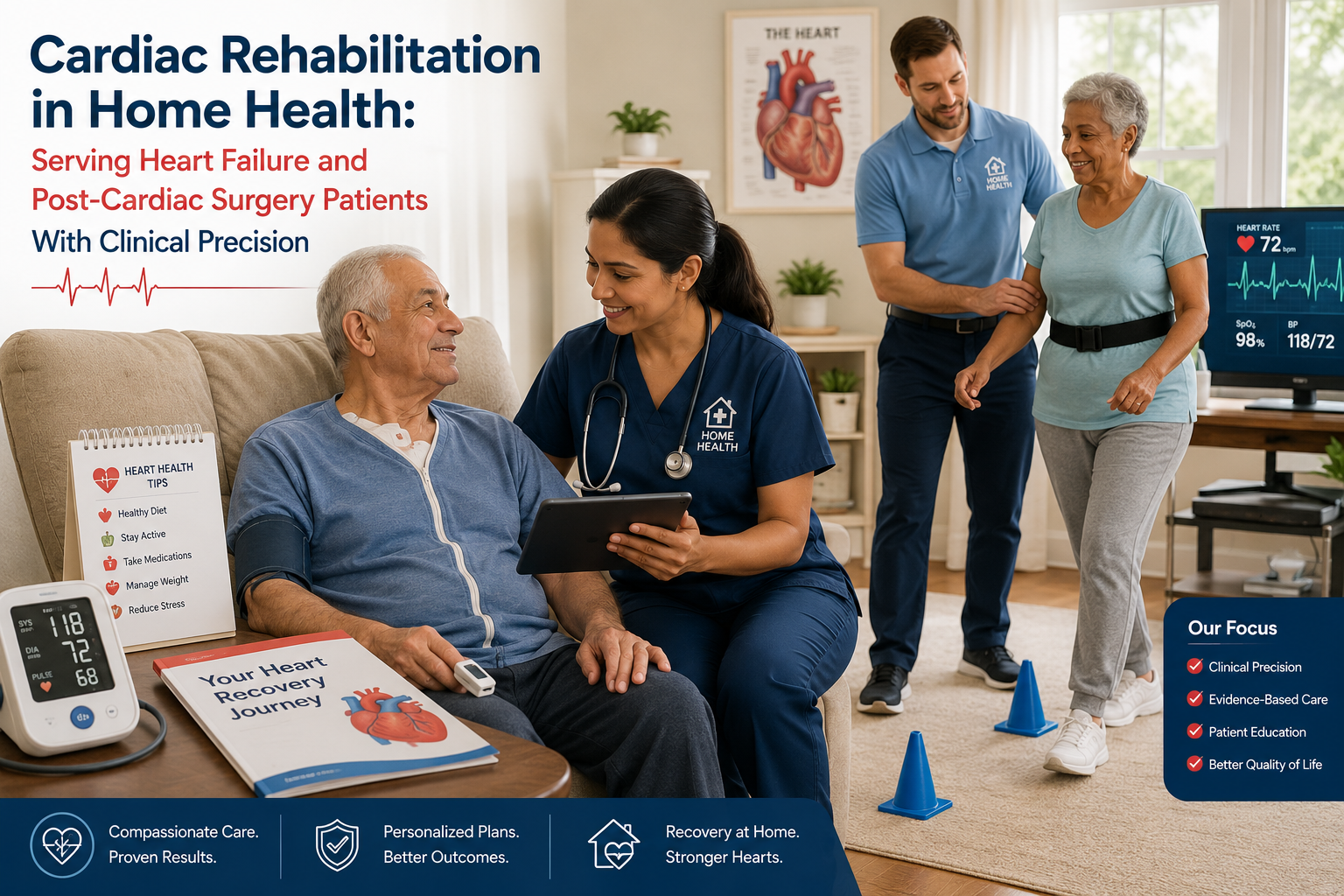
Evidence-Based OT, PT, and MSW Approaches for the Complex Cardiac Patient Population in Houston and Southeast Texas
Heart disease is the leading cause of death in the United States, and Houston’s home health population reflects this reality with a volume and severity of cardiac cases that demands clinical depth well beyond standard medical management knowledge. Patients with congestive heart failure, those recovering from coronary artery bypass grafting, valve replacement, or cardiac catheterization, and those living with implantable cardiac devices constitute one of the largest and most clinically complex segments of the home health census. Understanding how to serve these patients safely and effectively is not optional clinical knowledge for home health therapists in this market; it is foundational competency.
Heart failure physiology is the essential clinical foundation for every therapist serving cardiac patients in home health. Heart failure — whether reduced ejection fraction (HFrEF) or preserved ejection fraction (HFpEF) — produces a cascade of hemodynamic and neurohormonal adaptations that determine the patient’s exercise capacity, fluid status, symptom burden, and the safety parameters within which physical therapy and occupational therapy must operate. The therapist who understands that the dyspneic, fatigued heart failure patient is experiencing the physiological consequences of inadequate cardiac output, neurohormonal activation, and peripheral vasoconstriction calibrates clinical interventions in ways that are both safer and more effective than the therapist relying on generic exercise programming.
Vital sign monitoring during therapy sessions is non-negotiable for cardiac home health patients, and its clinical interpretation requires knowledge that goes beyond reading numbers on a display. Blood pressure, heart rate, respiratory rate, and oxygen saturation at rest and during activity provide the physiological data that determines whether activity is within safe tolerance or approaching parameters that require intervention. A heart failure patient whose systolic blood pressure drops 10 or more mmHg during low-intensity activity rather than rising appropriately is demonstrating hemodynamic compromise that should immediately halt activity and prompt nursing notification. A patient whose heart rate rises to 130 beats per minute during ambulation that previously produced 90 is exhibiting a physiological change requiring clinical attention regardless of whether subjective symptoms have worsened.
The Borg Rate of Perceived Exertion scale is the patient-reported outcome measure most practically useful for cardiac exercise intensity monitoring in home health, capturing the patient’s subjective experience of exertion in a standardized format that correlates reasonably with objective physiological indicators. Target RPE ranges for cardiac home health patients — typically 11-13 on the 6-20 Borg scale — provide a visit-by-visit clinical guide. Patients taught to self-monitor their exertion level and identify the RPE threshold at which symptoms require activity reduction develop a self-management skill that extends clinical benefit into the hours between visits.
Post-cardiac surgery patients present specific clinical considerations that distinguish them from medical heart failure patients. Sternotomy — the chest incision used for open heart surgery — imposes specific activity restrictions designed to protect sternal healing during the 6-12 weeks following surgery. The sternal precautions — restrictions on pushing, pulling, and lifting with the upper extremities, and on activities that produce separation of the sternum — directly affect virtually every ADL and must be incorporated into OT assessment in ways that identify functional workarounds for the specific activities the patient’s daily life requires. The OT who can analyze the patient’s actual daily routine and develop adapted techniques for dressing, bathing, meal preparation, and home management within sternal precaution parameters is providing clinical value that written instruction sheets cannot replace.
Cardiac rhythm device management — understanding the implications of pacemakers, implantable cardioverter-defibrillators, and cardiac resynchronization therapy devices — is specific clinical knowledge every therapist serving post-device patients must possess. Rate-responsive pacemakers alter heart rate in response to physical activity in ways that differ from normal cardiac chronotropic response, affecting how heart rate is interpreted as an exercise intensity indicator. ICD patients have specific activity restrictions following device implantation, arm movement limitations that protect lead integrity during the healing period, and activity parameters established by their electrophysiologist that the home health therapist must know and respect.
Fluid management education is an OT and nursing shared responsibility that directly affects heart failure readmission rates. Daily weight monitoring — the behavior most strongly correlated with early detection of fluid retention and most effective at preventing acute decompensation — requires patients and caregivers to understand why weight changes matter and what threshold requires clinical notification. OT assessment of the patient’s ability to access a scale safely, read it accurately, record the measurement, and communicate the result identifies the specific functional and cognitive barriers to daily weight monitoring adherence that counseling alone cannot address.
Metabolic equivalent-based OT activity grading provides a clinical framework for matching ADL participation to the patient’s current cardiac capacity. The newly discharged post-CABG patient whose cardiologist has cleared activities up to 3 METs has a specific parameter translating into real-world guidance: showering at approximately 2 METs, light meal preparation at 1-2 METs, and walking on level ground at 2-3 METs are within parameters, while climbing stairs at 4-5 METs may temporarily exceed them. OT graded activity planning based on MET levels produces clinical guidance that is directly actionable rather than generically cautious.
Medical social work for cardiac patients addresses the substantial psychosocial burden that accompanies serious cardiac disease — the depression and anxiety affecting 20-30% of heart failure patients that independently worsen cardiac outcomes, the financial implications affecting medication adherence, and the advance care planning conversations that many cardiac patients are ready for but no other care team member has initiated. MSWs who conduct systematic depression screening, facilitate advance care planning for patients approaching the limits of medical cardiac management, and support caregivers managing complex cardiac patients at home provide clinical services that directly improve both quality of life and quality of dying.
Humane Care Therapy Inc. provides OT, PT, and MSW staffing that supports evidence-based cardiac home health for agencies across Houston and Southeast Texas. Contact us at (281) 619-3771 or visit humanecaretherapy.com.
Related HCT staffing services: Occupational Therapy and Physical Therapy staffing in Houston.