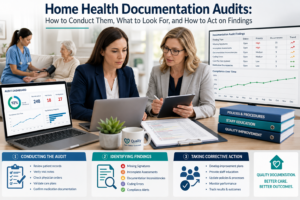

A Practical Guide to Survey Readiness, Surveyor Interaction, and Post-Survey Response for Home Health Agencies
The home health survey process is one of the most consequential regulatory events an agency faces — a comprehensive examination of clinical practice, documentation quality, administrative compliance, and patient outcome performance that can result in anything from a clean survey with minor deficiencies to a condition-level finding that threatens the agency’s certification and ability to bill Medicare and Medicaid. Yet most agencies approach survey preparation reactively — scrambling to organize documentation and brief staff when surveyors arrive rather than maintaining the continuous survey-readiness posture that would make the survey a fair representation of the agency’s actual ongoing performance rather than a snapshot of its crisis-management capability.
Understanding the survey framework that CMS uses is foundational to survey readiness. Home health surveys are conducted under the CMS Conditions of Participation — the federal regulatory standards that all Medicare and Medicaid-certified home health agencies must meet. Surveyors assess compliance with CoPs across several primary domains: patient rights, comprehensive assessment of patients, care planning and coordination, provision of care and services, clinical records, organizational environment, staffing and staff qualifications, and quality assessment and performance improvement. Each domain has specific standards and interpretive guidelines that describe what compliant practice looks like and what surveyors are examining during agency review. Agency leadership and clinical staff who understand the specific standards in each domain — and who practice against those standards continuously rather than preparing for them pre-survey — maintain a survey-ready posture that produces survey performance reflecting genuine ongoing compliance.
Medical record review is the central activity of most home health surveys, and the quality of the clinical documentation the agency maintains in the ordinary course of care determines the quality of the survey record review experience. Surveyors examine a sample of patient records — typically 10 to 20 patient records for a standard survey — looking for compliance across CoP requirements: comprehensive assessment completion within required timeframes, care plans that reflect assessment findings and are updated when patient condition changes, documentation of skilled need that justifies each visit, evidence of physician communication and order management, OASIS accuracy that matches the clinical status documented in visit notes, and coordination between disciplines that reflects integrated care planning. Agencies whose clinical documentation consistently meets these standards in the ordinary course of care have records that withstand survey scrutiny. Agencies whose documentation has systematic deficiencies — untimely completion, generic skilled need justification, OASIS scores inconsistent with visit note clinical descriptions — produce survey records that generate deficiency citations.
Staff interviews are a survey tool that many agencies prepare for inadequately. Surveyors conduct individual interviews with clinical staff — asking about orientation and training, clinical protocols and practices, emergency procedures, patient rights, and the agency’s quality and compliance processes — and use staff responses to assess whether the agency’s documented policies and procedures reflect actual practice. The clinical staff member who cannot describe the agency’s fall reporting protocol, who is unsure of the OASIS assessment timeframe requirements, or who describes clinical practices that differ from documented agency policies gives the surveyor evidence of the gap between what is written and what is practiced that produces deficiency citations. Agencies that invest in ongoing staff education about CoP requirements — not just pre-survey briefings — produce staff interview responses that demonstrate the genuine, continuously maintained compliance that surveyors are designed to assess.
The surveyor interaction during an active survey requires specific clinical and administrative skill from the agency staff the surveyor engages. Agency leaders who are transparent, responsive, and organized in their interactions with surveyors — who can quickly locate requested records, who respond to surveyor questions with factual precision rather than defensive elaboration, and who acknowledge when a practice or record does not meet the standard the surveyor has identified rather than arguing a deficient finding — produce surveyor interactions that are both professionally respectful and strategically effective. Defensiveness, disorganization, and factual inaccuracy in surveyor interactions escalate the surveyor’s scrutiny rather than reducing it and produce a more adversarial survey dynamic than the situation requires.
The Plan of Correction is the formal written response to survey deficiency findings that the agency must submit to CMS within ten days of receiving the Statement of Deficiencies. A well-written Plan of Correction addresses each deficiency finding with four specific components: what corrective action was taken for the specific patient(s) identified in the finding, what systemic corrective action was taken to address the cause of the deficiency across the agency’s operations, how the agency will monitor ongoing compliance with the corrected practice, and the timeframe within which correction will be completed. Plans of Correction that address all four components with specificity and credibility produce faster survey resolution and demonstrate to CMS that the agency has genuinely addressed the identified compliance gap rather than cosmetically responding to the deficiency.
Continuous survey readiness — the operational posture that makes survey preparation unnecessary because the agency’s ongoing practice is always survey-ready — requires the same internal monitoring, documentation standard maintenance, staff education cadence, and compliance culture investment that effective compliance programs in other domains require. Agencies that conduct quarterly internal record reviews using the same standards that surveyors apply, that track their OASIS accuracy and documentation timeliness metrics in real time, that brief clinical staff on regulatory updates as they occur rather than pre-survey, and that address clinical practice deficiencies when internal monitoring identifies them rather than hoping surveyors don’t identify them first maintain the continuous survey-readiness posture that produces consistently clean survey outcomes.
Humane Care Therapy Inc. is therapist-owned and OT-operated — with an in-house Quality Assurance Reviewer who reviews clinical notes before submission. Our OT-owned clinical leadership knows exactly what a deficient therapy note looks like on a surveyor’s desk. Call (281) 619-3771, email info@humanecaretherapy.com, or visit humanecaretherapy.com.
Looking for a therapy staffing partner for your home health agency? Learn more about our therapy staffing services in Houston.