
Why Post-Fracture Home Health Differs From Elective Joint Replacement — and What OT, PT, and MSW Must Address in This High-Mortality-Risk Population
Hip fracture in frail older adults is a fundamentally different clinical population from the elective total hip arthroplasty patient, even though both populations arrive at home health with a hip that has been surgically addressed. The elective THA patient is typically healthier, better nourished, and more physiologically resilient at baseline than the hip fracture patient, whose fracture frequently occurs against a backdrop of osteoporosis, sarcopenia, multiple comorbidities, and the frailty syndrome that makes a fall often from standing height or lower sufficient to break a bone that a healthier skeleton would have withstood. The one-year mortality rate following hip fracture in older adults ranges from 20 to 30 percent in published research, a mortality risk that exceeds many cancers and that makes hip fracture home health a genuinely high-stakes clinical encounter rather than a routine post-surgical rehabilitation episode.
Understanding why hip fracture carries this mortality risk shapes the home health clinical approach in ways that generic post-surgical protocols do not capture. The hip fracture patient’s mortality risk is driven substantially by the cascade of complications that immobility, deconditioning, and the physiological stress of both the fracture and the surgical repair produce in an already frail physiological system, pneumonia, pressure injuries, venous thromboembolism, delirium, and the profound functional decline that can render a previously independent older adult permanently dependent. Home health’s clinical mission with this population is not simply functional restoration but active mitigation of this complication cascade, making early, safe mobilization and comprehensive complication surveillance the central organizing principles of hip fracture home health rather than secondary considerations.
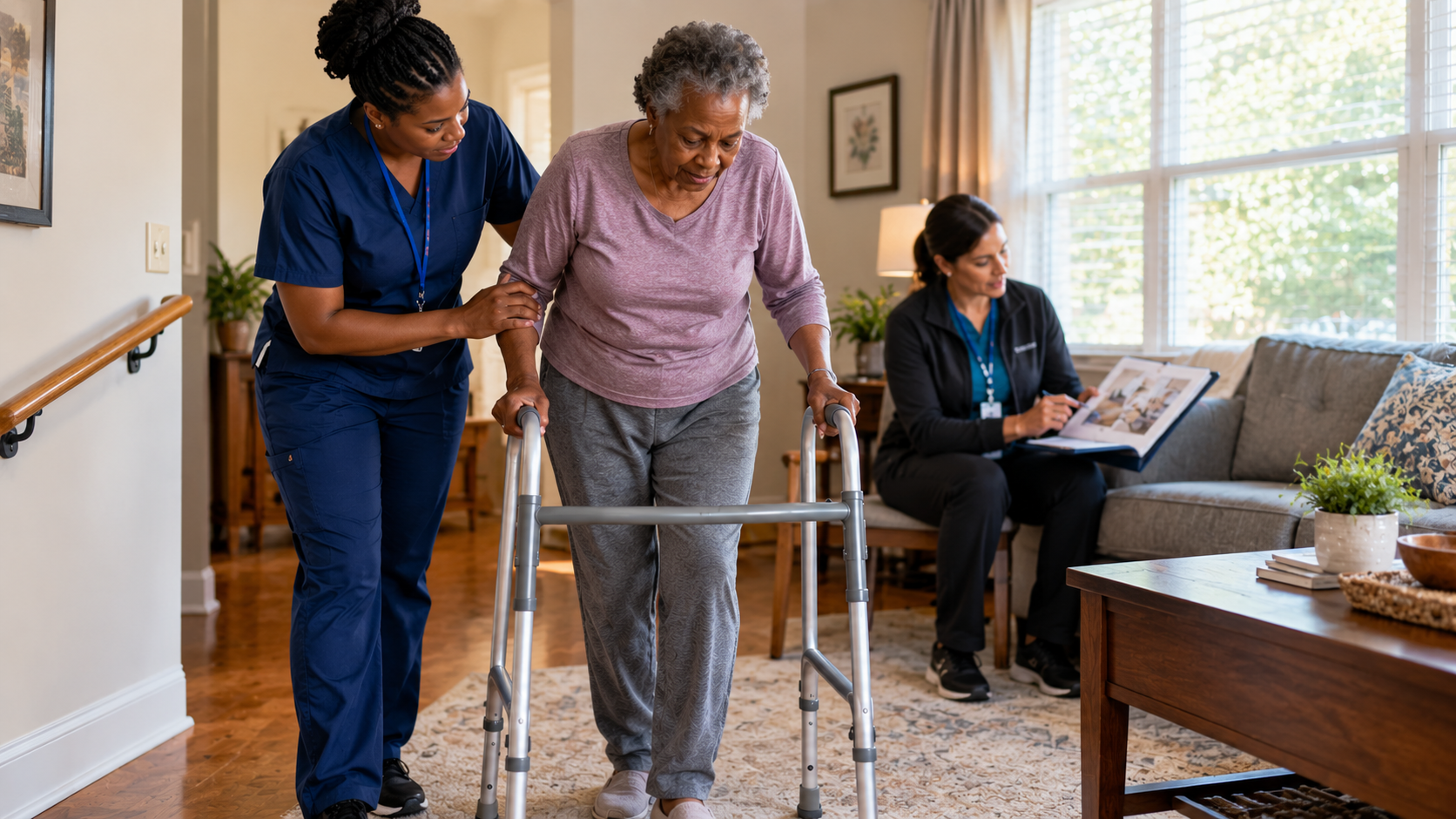
Physical therapy for hip fracture patients begins with a fall history and fear-of-falling assessment that most PT evaluations for elective surgical patients do not require with the same urgency, because the hip fracture patient has, by definition, already fallen once and carries both the physiological risk factors that produced that fall and the psychological fear of falling again that frequently produces activity avoidance and further deconditioning. PT intervention that addresses fall risk factors directly, strength deficits, balance impairment, gait abnormalities, and the specific circumstances of the index fall when they can be identified, alongside the standard post-surgical rehabilitation protocol addresses the recurrence risk that hip fracture patients face at rates substantially higher than the general older adult population, with second hip fractures carrying even higher mortality risk than the first.
Osteoporosis management, while primarily a medical management responsibility, is a clinical domain that home health therapy should actively support because osteoporosis treatment initiation following hip fracture remains substantially underutilized in clinical practice despite strong evidence that osteoporosis pharmacotherapy reduces subsequent fracture risk. The home health team that confirms osteoporosis treatment has been addressed with the patient’s physician, that supports adherence to prescribed osteoporosis medications, and that reinforces the fall prevention behaviors that complement pharmacological fracture prevention is closing a treatment gap that research consistently documents as inadequately addressed in usual post-fracture care.
Delirium recognition is a specific clinical competency that every discipline serving hip fracture patients must possess, because postoperative delirium affects a substantial proportion of older adults following hip fracture surgery and because delirium whether hyperactive, hypoactive, or mixed both signals acute medical instability requiring prompt physician notification and independently worsens functional and mortality outcomes when unaddressed. The home health clinician who recognizes the subtle hypoactive delirium presentation, a patient who has become unusually quiet, withdrawn, or difficult to engage rather than agitated and who does not mistake this presentation for simple fatigue or depression provides a clinical safety contribution with direct mortality risk implications.
Occupational therapy for hip fracture patients addresses the ADL independence that fear of falling and physical deconditioning both threaten, with particular attention to the specific ADL domains where fall risk during task performance is highest, bathing, toileting, and the transfers that these activities require. OT functional assessment that identifies the specific adaptive equipment, environmental modification, and technique training needed to restore safe ADL independence, combined with the psychological support that addresses fear-of-falling avoidance behavior, produces functional outcomes that address both the physical and psychological dimensions of post-fracture recovery.
Nutritional status deserves specific clinical attention in hip fracture home health because malnutrition is both a contributor to the sarcopenia and bone fragility that predisposed the patient to fracture and a barrier to the wound healing, muscle recovery, and functional rehabilitation that post-fracture recovery requires. OT and MSW identification of nutritional risk factors, inadequate protein intake, unintentional weight loss, poor appetite and the dietary consultation or nutritional supplementation referral that addresses identified deficits support the physiological substrate that functional recovery depends on.
Medical social work for hip fracture patients addresses the discharge planning complexity and family system stress that a sudden, catastrophic functional event produces for patients who were often living independently before the fracture and whose families face urgent decisions about ongoing care needs, home safety, and the possibility that independent living is no longer safely sustainable. MSW facilitation of these conversations, connection with home safety modification resources, and support for the family navigating a sudden shift in their older family member’s care needs addresses the psychosocial dimension of an event that frequently represents a permanent inflection point in an older adult’s functional trajectory and independence.
Humane Care Therapy Inc. is therapist-owned and OT-operated and our clinical leadership understands hip fracture as the distinct, high-mortality-risk population it clinically is, requiring an approach that differs meaningfully from elective orthopedic rehabilitation. We provide OT, PT, and MSW staffing with hip fracture-specific clinical training for home health agencies across Houston and Southeast Texas. Call (281) 619-3771, email info@humanecaretherapy.com, or visit humanecaretherapy.com.