
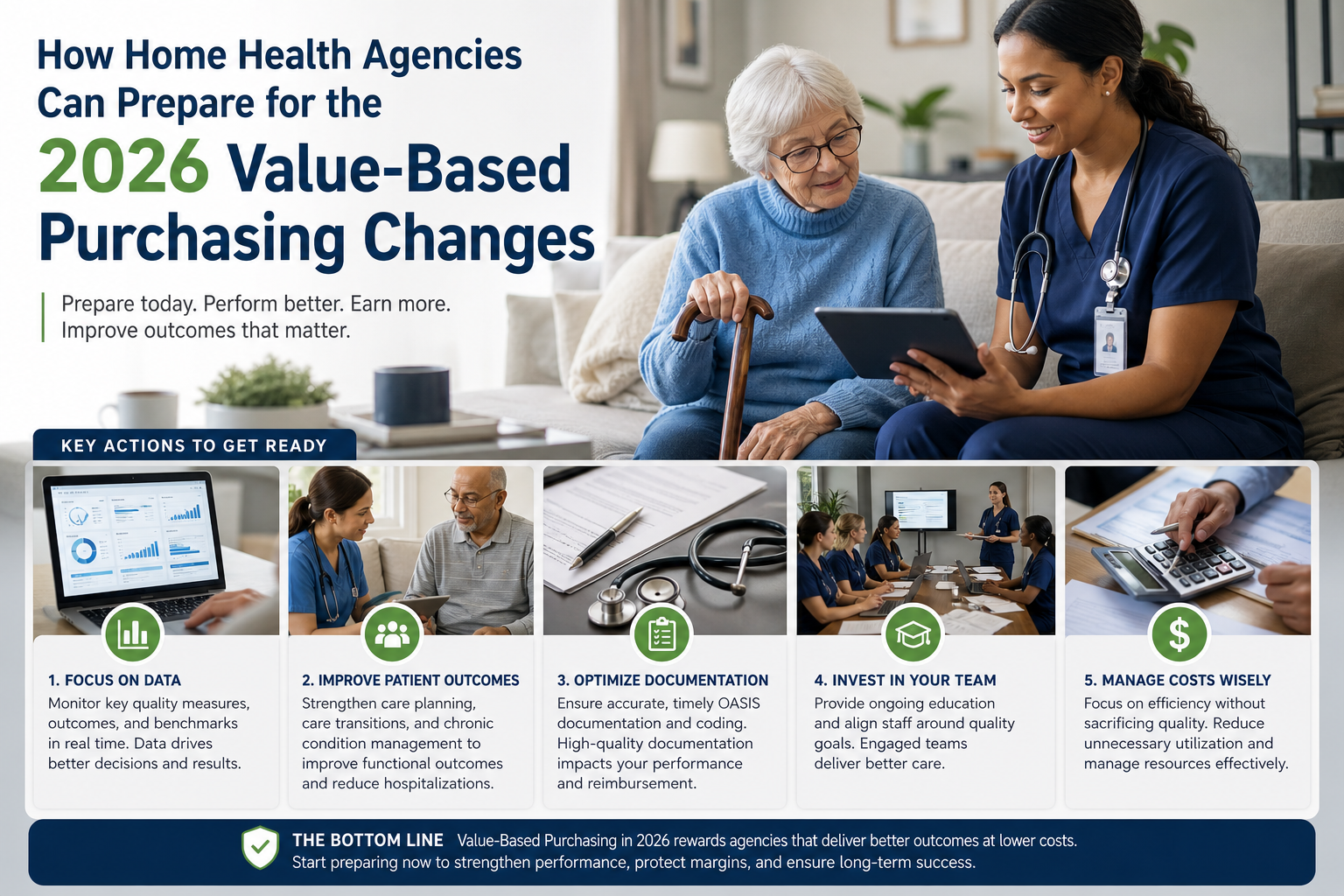
Why Therapy Staffing Quality Will Make or Break Your Agency’s Reimbursement Under the New CMS Rules
The Shift from Patient Satisfaction to Functional Outcomes
The landscape of home health reimbursement is undergoing a fundamental transformation, and the proposed 2026 changes to the Home Health Value-Based Purchasing program represent the most significant shift yet. For years, agencies could perform reasonably well on quality measures that emphasized patient satisfaction and process compliance. The new framework changes the equation dramatically by placing far greater weight on hard clinical outcomes — particularly those tied to functional progress and measurable patient improvement.
This shift is intentional and strategic on the part of CMS. Functional outcome measures are far more difficult to manipulate than patient experience surveys and process measures. They reflect the actual quality of clinical care being delivered, and they directly correlate with the outcomes that matter most to patients: improved mobility, greater independence in daily activities, restored communication abilities, and successful transitions back to community living. CMS has signaled clearly that the future of home health reimbursement will reward agencies that deliver demonstrable clinical results, not merely agencies that provide services and document activities.
For home health agencies, this evolution has profound implications for how they think about therapy staffing. Physical therapists, occupational therapists, and speech-language pathologists are the clinicians most directly responsible for driving the functional outcomes that will increasingly determine reimbursement rates. The quality, experience, and availability of these therapy professionals will become one of the most important factors in an agency’s financial performance — potentially more important than marketing, referral development, or operational efficiency.
Agencies that have relied on minimally qualified or inconsistently available therapy staff will find themselves at a significant competitive and financial disadvantage under the new framework. The new measures reward agencies that achieve meaningful functional improvement in their patients — improvement that requires skilled, experienced clinicians who can design effective treatment plans, implement evidence-based interventions, and accurately document progress in ways that OASIS assessments capture. This is not work that can be done by any licensed therapist — it requires clinicians with specific expertise in home health practice and a commitment to clinical excellence.
The Critical Role of Therapy in Driving Quality Metrics
Under the evolving Value-Based Purchasing framework, several categories of quality measures are directly influenced by the quality and consistency of therapy services. Understanding these connections is essential for agency leaders who want to optimize their performance under the new rules and protect their reimbursement from the penalties that will accompany substandard quality performance.
Functional improvement measures assess whether patients demonstrate measurable progress in areas such as ambulation, transfers, bathing, dressing, and other activities of daily living during the home health episode. Physical therapists and occupational therapists drive these outcomes through individualized treatment plans that target specific functional deficits, progressive exercise programs, adaptive equipment recommendations, and patient and caregiver education. The therapist’s ability to set appropriate goals, select effective interventions, and accurately measure progress determines whether the agency’s functional improvement scores meet or exceed the benchmarks that drive value-based payment adjustments.
Hospitalization measures track whether patients require emergency department visits or inpatient readmissions during or shortly after their home health episode. These measures carry significant weight in the VBP calculation, and they are directly influenced by therapy service quality. Effective therapy services reduce hospitalization risk by improving patients’ physical function, balance, and safety awareness; by training caregivers in proper transfer and mobility techniques; and by identifying early warning signs of clinical deterioration that might otherwise lead to preventable hospital visits. Speech-language pathologists contribute to hospitalization prevention through dysphagia management, which reduces the risk of aspiration pneumonia — one of the most common causes of preventable hospitalization among elderly home health patients.
OASIS accuracy is the foundation on which all quality measurement rests, and it deserves special attention in the context of value-based purchasing preparation. When therapists complete OASIS assessments, the accuracy and consistency of their scoring directly determines how the agency’s quality performance is calculated. Experienced therapists who understand the nuances of OASIS scoring — and who are given adequate time and support to complete assessments carefully — produce data that accurately reflects patient acuity and progress, leading to fair quality scores and appropriate reimbursement. Conversely, inaccurate OASIS scoring, whether due to clinician inexperience, time pressure, or inadequate training, can distort quality metrics in either direction, creating compliance risks and unreliable performance data.
Medical social workers contribute to quality outcomes by addressing the psychosocial barriers that can undermine therapy effectiveness. When patients are struggling with depression, anxiety, financial stress, inadequate social support, or difficulty navigating community resources, their ability to participate fully in therapy and achieve functional goals is compromised. MSW services help remove these barriers, creating the conditions for successful rehabilitation and the functional improvement that quality measures capture.
Staffing Strategies That Support Value-Based Performance
Preparing for the 2026 Value-Based Purchasing changes requires home health agencies to rethink their approach to therapy staffing at a strategic level. Several key principles should guide this planning, and agencies that adopt them proactively will be far better positioned than those that wait until the financial impact of the new measures becomes apparent in their reimbursement.
Prioritize clinical quality over cost minimization in staffing decisions. The temptation to reduce therapy costs by hiring less experienced clinicians, using the lowest-cost staffing providers, or reducing visit frequencies will backfire under a system that rewards functional outcomes. Agencies need therapists who have the clinical expertise to drive measurable improvement in complex patients and the documentation skills to capture that improvement accurately in OASIS assessments. The marginal savings from lower-cost staffing solutions are dwarfed by the potential reimbursement reductions that result from substandard quality performance.
Ensure consistent therapy coverage to avoid gaps in service delivery that undermine treatment plan integrity. Inconsistent visit patterns — caused by staffing shortages, excessive therapist turnover, or over-reliance on per diem staff who are not consistently available — reduce the likelihood of achieving meaningful functional improvement. Patients need regular, predictable therapy sessions delivered by clinicians who understand their treatment plans and can build on previous sessions. A reliable contract therapy staffing partner can provide the consistency that supports optimal outcomes even when internal staffing fluctuates.
Invest in therapist mentorship and clinical oversight to ensure documentation quality and clinical decision-making meet the standards required for value-based success. Even experienced therapists benefit from regular clinical supervision, case conferencing, and feedback on documentation quality. Agencies should establish processes for reviewing OASIS assessments, auditing therapy documentation, and providing constructive feedback that helps clinicians improve their clinical and documentation skills over time. These quality improvement processes should apply to both employee and contract clinicians to ensure consistent standards across the entire therapy team.
Integrate medical social work services proactively rather than reactively, recognizing that psychosocial barriers to recovery can undermine even the most skilled therapy interventions. MSW services should be available early in the episode to assess and address factors like depression, caregiver stress, financial barriers to medication adherence, and social isolation that could interfere with rehabilitation progress. Waiting until problems become crises is both clinically suboptimal and strategically unwise under a system that measures overall episode outcomes.
Develop data-driven staffing models that align clinician capacity with referral volume and patient acuity. Agencies should track functional outcome performance by individual therapist, by service area, and by patient population to identify where additional staffing, training, or supervision is needed to maintain quality standards. This analytical approach to workforce management enables agencies to allocate resources strategically and address quality gaps before they impact reimbursement.
Partnering for Quality: How the Right Staffing Provider Makes the Difference
In the value-based purchasing environment, the quality of an agency’s therapy staffing partner is directly linked to financial performance in ways that were less apparent under previous payment models. Agencies cannot afford to work with staffing providers who send marginally qualified clinicians, who lack quality assurance processes, or who treat home health therapy staffing as a commodity business where the only differentiator is price. The financial stakes under VBP are simply too high to accept staffing arrangements that prioritize convenience or cost savings over clinical quality and documentation excellence.
The distinction between a staffing partner that enhances VBP performance and one that undermines it comes down to several key factors. Clinical competency of the deployed therapists determines whether patients achieve the functional improvement that measures capture. Documentation quality determines whether that improvement is accurately reflected in OASIS scores and quality calculations. Consistency of coverage determines whether treatment plans are executed with the frequency and continuity needed to produce optimal results. And compliance oversight determines whether the agency is protected from the regulatory risks that can compound financial pressures in a value-based environment.
Humane Care Therapy Inc. was founded on the principle that therapy staffing quality and patient outcomes are inseparable. As an OT-owned and operated company with deep roots in the Houston home health community since 2018, Humane Care Therapy understands the clinical demands of home health practice and recruits therapists who are not only licensed and experienced but also committed to the kind of patient-centered care that drives superior functional outcomes. The company’s leadership brings direct clinical experience to every aspect of the staffing operation, from clinician recruitment and credentialing to quality assurance and performance monitoring.
Every clinician deployed through Humane Care Therapy undergoes rigorous credentialing and screening that goes beyond basic license verification. The company’s quality assurance protocols ensure that home health documentation complies with Medicare, Medicaid, and private insurance requirements, protecting agencies from the compliance risks that can undermine quality scores and reimbursement. And because Humane Care Therapy’s clinicians are experienced with WellSky (formerly Kinnser) electronic medical records, they integrate seamlessly into agency workflows from day one, maintaining documentation quality and care coordination continuity.
The 2026 Value-Based Purchasing changes represent both a challenge and an opportunity for home health agencies across Houston and Southeast Texas. Agencies that invest in high-quality therapy staffing will be rewarded with stronger quality scores and enhanced reimbursement, creating a competitive advantage that compounds over time. Those that cut corners on therapy staffing will face financial penalties that erode already thin margins and make it increasingly difficult to compete for referrals and talent. The choice is clear — and the time to act is now, before the new measures take effect and the financial consequences become unavoidable.
The agencies that begin preparing now — by strengthening their therapy staffing capacity, investing in comprehensive documentation quality programs, building relationships with quality-focused staffing partners, developing the data infrastructure needed to monitor and improve functional outcomes, and aligning their clinical culture with the outcome-driven expectations of the new payment environment — will emerge from the VBP transition in a position of significant competitive strength. Those that delay will find themselves playing catch-up in an environment where the financial penalties for underperformance make recovery increasingly difficult.
Learn how Humane Care Therapy Inc. can help your agency prepare for value-based purchasing success. Call (281) 619-3771 or visit humanecaretherapy.com today to discuss your staffing needs and develop a partnership strategy that positions your agency for financial and clinical excellence.
Looking for a therapy staffing partner for your home health agency? Learn more about our therapy staffing services in Houston.