Why Cultural Awareness, Language Access, and Culturally Responsive Clinical Practice Are Clinical Necessities in the Houston Market
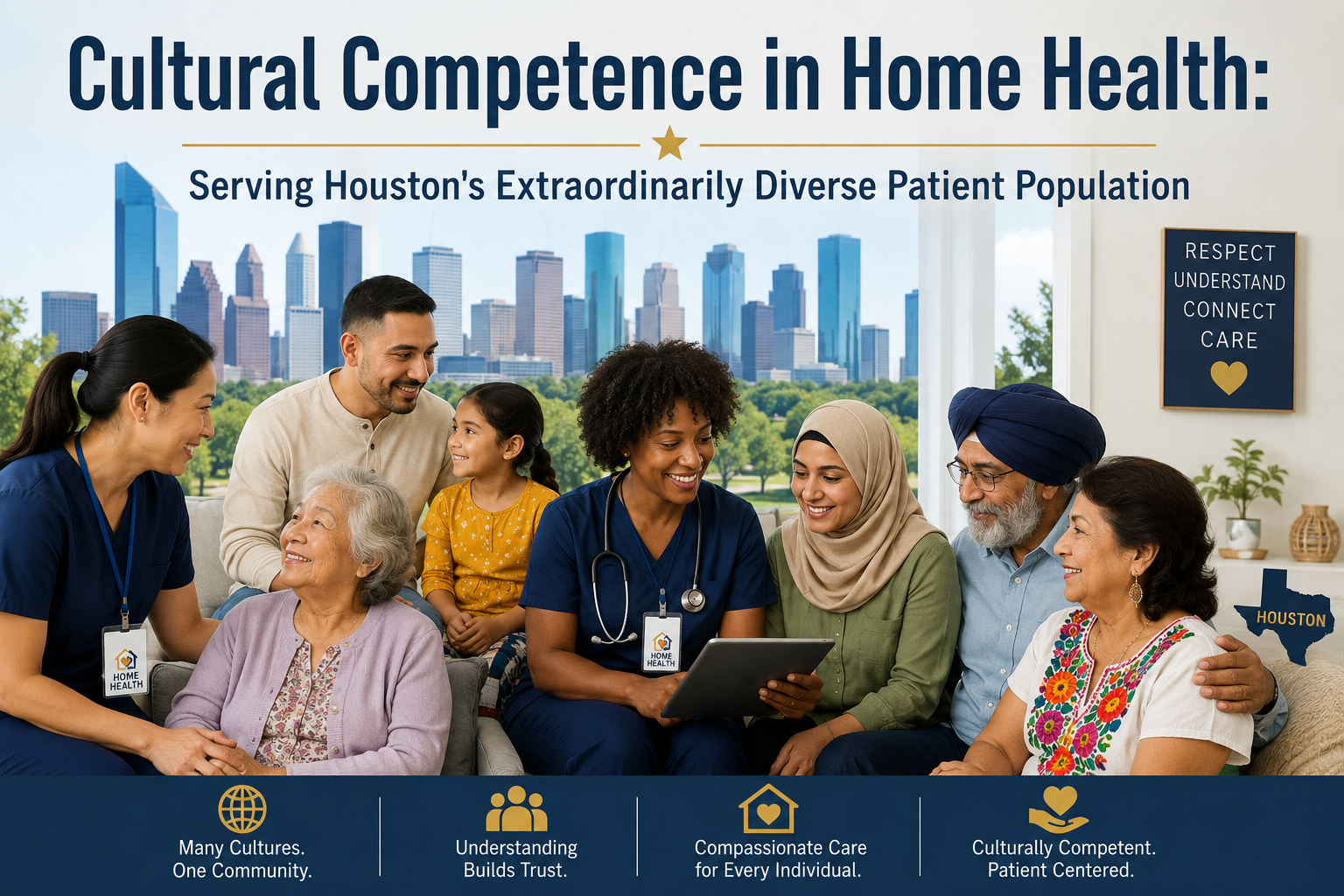
Houston is one of the most ethnically and linguistically diverse cities on Earth. The Houston metropolitan area is home to residents from more than 145 countries, speaking more than 145 languages. Its immigrant population includes large communities from Mexico, El Salvador, Vietnam, India, China, Nigeria, and dozens of other nations. Its African American community is one of the largest in the South. Its Vietnamese community, centered in the Midtown area, is the largest outside of California. Its South Asian population in the Sugar Land and Katy corridors is among the most concentrated in Texas. And its Latino population — diverse in its own right, encompassing Mexican, Central American, and South American communities with distinct cultural identities — accounts for more than 43 percent of Harris County residents.
For home health agencies serving this population, cultural competence is not a soft value — it is a clinical necessity. Patient outcomes in home health are profoundly shaped by the quality of the therapeutic relationship between clinician and patient, and the therapeutic relationship is fundamentally affected by cultural factors that influence how patients understand illness, communicate about their health, relate to healthcare providers, make healthcare decisions, and engage with treatment recommendations. Clinicians who lack cultural awareness, who approach culturally different patients with assumptions derived from a majority-culture clinical training, and who fail to account for language barriers in their clinical communication are providing demonstrably inferior care — care that produces worse outcomes, lower patient satisfaction, and higher readmission risk than culturally responsive practice.
Language access is the most immediately consequential cultural competence issue for home health agencies in Houston, and its clinical implications go well beyond patient comfort. Communication is the medium through which every clinical interaction occurs — every assessment question asked, every instruction given, every caregiver education session conducted, and every safety concern raised. When this communication is impaired by a language barrier and the agency has not arranged adequate interpreter services, the clinical quality of every interaction is compromised in ways that directly affect patient safety and clinical outcomes.
The legal framework for language access in healthcare is clear and applies directly to home health agencies. Title VI of the Civil Rights Act of 1964 prohibits discrimination on the basis of national origin — which the Department of Health and Human Services has interpreted to require that recipients of federal financial assistance, including Medicare and Medicaid home health agencies, provide meaningful access to services for patients with limited English proficiency. CMS conditions of participation require that agencies ensure effective communication with patients, and the Joint Commission’s standards for home health similarly require language access planning.
Family members as interpreters — a common informal approach to language access in home health — is inadequate for clinical purposes and creates specific risks. Family members may lack the medical vocabulary to accurately interpret clinical content. They may soften bad news, edit information they believe will upset the patient, or add their own opinions to clinical instructions in ways the patient and clinician cannot detect. They may be simultaneously managing their own emotional response to the patient’s health situation while trying to interpret. Children should never be used as interpreters for parents in clinical contexts — the role reversal is inappropriate and the child lacks the vocabulary, emotional regulation, and clinical context for accurate medical interpretation.
Professional medical interpreter services — telephonic, video remote, or in-person — are the appropriate approach to language access for clinical encounters. In home health, telephonic and video interpretation is the most practical modality for most encounters, and agencies that establish relationships with qualified medical interpretation services and provide clinicians with easy access to these services during home visits ensure that language access is available for every patient encounter where it is needed. The incremental cost of professional interpretation is minimal relative to the clinical and legal risk created by inadequate language access.
Cultural health beliefs significantly influence how patients from various cultural backgrounds understand their health conditions, interpret their symptoms, relate to healthcare providers, and make decisions about their treatment. Many cultural traditions include explanatory models for illness that differ fundamentally from the biomedical model that dominates Western healthcare — explanations involving spiritual causation, energy imbalance, environmental factors, or relational dynamics that patients from these traditions experience as clinically real and clinically relevant even when healthcare providers from the majority culture have no training in engaging with them.
Clinicians who encounter culturally divergent health beliefs with dismissal — “that’s not how this works” — damage the therapeutic relationship and typically fail to change the patient’s beliefs, producing instead a patient who continues to hold the beliefs but no longer shares them with the clinician. Clinicians who encounter these beliefs with curiosity and respect — “tell me more about how you understand what’s happening with your health” — build the trust that allows collaborative clinical planning that incorporates both biomedical treatment and the patient’s own understanding and meaning-making.
Decision-making authority and family involvement patterns vary substantially across cultural contexts in ways that home health clinicians must navigate thoughtfully. In many cultural traditions, healthcare decisions are made collectively by the family or by specific family members — typically male elders, spouses, or adult children — rather than individually by the patient as Western bioethical frameworks assume. Clinicians who communicate exclusively with the individual patient while ignoring the family decision-making structure may produce treatment plans that no one with actual authority has agreed to. Clinicians who engage family decision-makers appropriately — while also maintaining the patient’s right to participate in decisions about their own care — produce care plans that are both ethically sound and practically implementable.
Pain expression and the communication of symptoms vary considerably across cultural contexts, with implications for assessment accuracy. Patients from cultural traditions that emphasize stoicism and the avoidance of complaint may significantly underreport pain and symptom severity to healthcare providers they wish not to burden or displease. Patients from traditions with more expressive communication norms may express symptoms in ways that clinicians from different backgrounds interpret as dramatic or exaggerated. Both errors in interpretation compromise clinical assessment accuracy, affecting treatment planning and the recognition of clinical deterioration that requires intervention.
Food and dietary practices are culturally specific in ways that affect the dietary counseling provided to patients with conditions requiring dietary management. Heart failure sodium restriction, diabetic carbohydrate management, renal diet compliance, and COPD nutritional management all involve dietary modifications that must be integrated with the patient’s actual cultural food practices to be implementable. A sodium restriction counseling session that focuses on processed foods and restaurant meals as the primary sodium sources fails the Vietnamese patient whose primary sodium source is fish sauce, or the South Asian patient whose diet relies heavily on pickled and fermented foods. Culturally competent dietary counseling begins with understanding the patient’s actual dietary culture, not with assuming the standard American dietary pattern.
Building organizational cultural competence — not just individual clinician awareness — requires agency-level investment in interpreter service relationships, community health worker programs, culturally diverse staffing, community liaison relationships with the cultural communities the agency serves, and leadership commitment to equity as an organizational priority. Agencies that reflect the diversity of the communities they serve — that employ clinicians who share cultural backgrounds with patient populations, that communicate with patients in their preferred languages, and that demonstrate genuine respect for cultural difference in their clinical practices — build the trust that generates the community referrals and patient loyalty that sustain long-term growth in Houston’s diverse market.
Humane Care Therapy Inc. recruits and deploys OT, PT, SLP, and MSW clinicians who reflect the linguistic and cultural diversity of Houston’s home health patient population, and we support partner agencies in developing language access and culturally responsive practice infrastructure. Contact us at (281) 619-3771 or visit humanecaretherapy.com.
Looking for a therapy staffing partner for your home health agency? Learn more about our therapy staffing services in Houston.