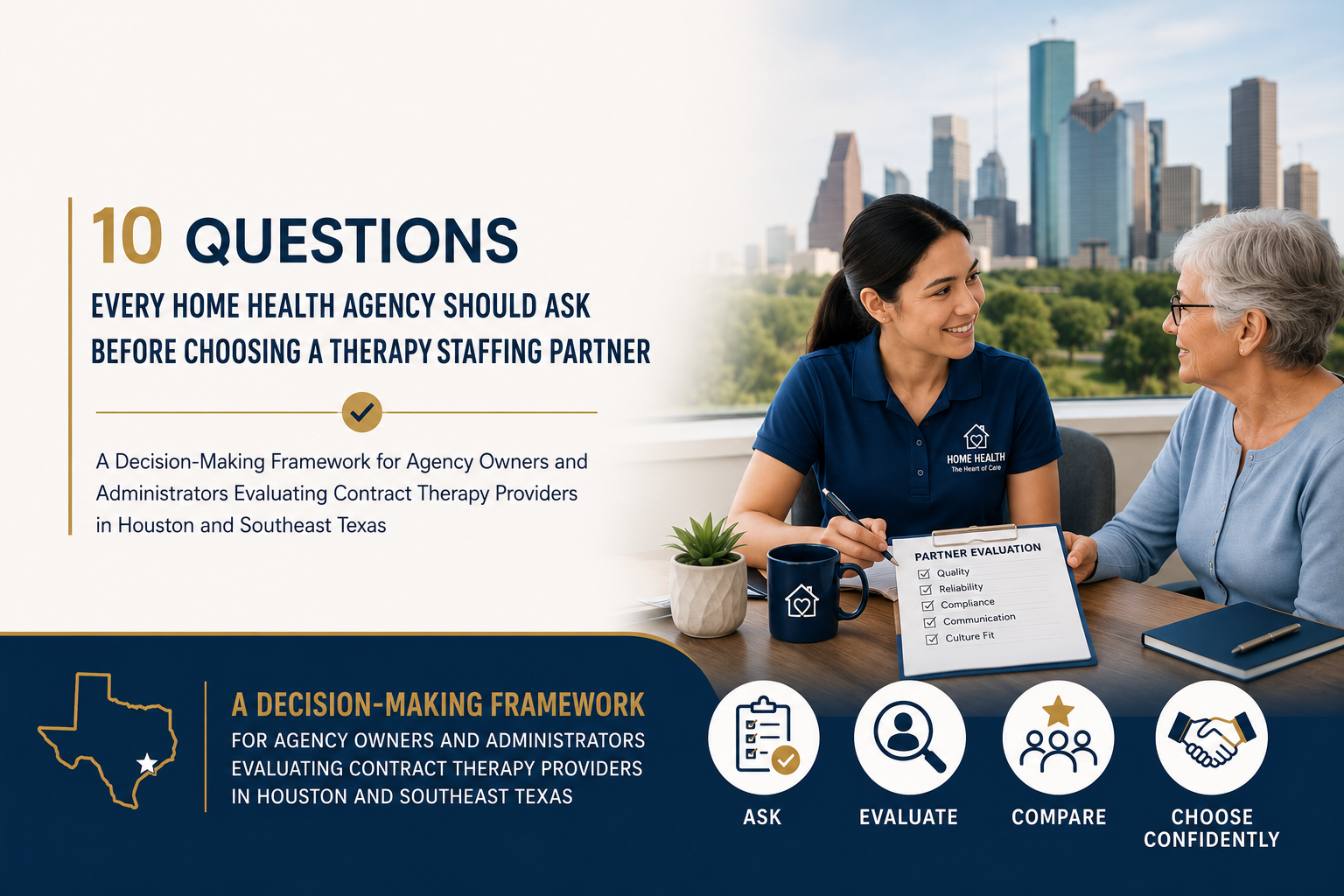
A Decision-Making Framework for Agency Owners and Administrators Evaluating Contract Therapy Providers in Houston and Southeast Texas
Why the Right Staffing Partner Matters More Than Ever
Choosing a therapy staffing partner is one of the most consequential decisions a home health agency can make, with implications that extend far beyond the immediate staffing need. The clinicians who interact with your patients carry your agency’s name and reputation into every home they enter. Their clinical skills, professionalism, documentation quality, communication abilities, and bedside manner directly shape patient outcomes, quality metrics, referral source perceptions, and the overall reputation that sustains your business. A strong staffing partner strengthens every aspect of your agency’s performance. A poor one can create clinical, financial, and reputational liabilities that take months or years to repair.
Yet many home health agencies make this critical decision based on limited information, often defaulting to the staffing provider that offers the lowest per-visit rate or the fastest initial response without thoroughly evaluating the factors that determine long-term value and compatibility. This approach is understandable given the urgency that typically drives staffing decisions — agencies often seek staffing partners when they are already experiencing coverage gaps and need solutions quickly. But the cost of choosing poorly far exceeds the time saved by not conducting adequate due diligence.
The following ten questions are designed to help agency owners and administrators move beyond surface-level comparisons and evaluate staffing partners on the dimensions that actually determine whether the relationship will succeed: clinical quality, compliance reliability, operational compatibility, geographic reach, responsiveness, and cultural alignment with the agency’s values and standards. Taking the time to ask these questions — and to evaluate the answers carefully — is an investment that pays dividends throughout the life of the staffing partnership.
Question 1: What Is Your Credentialing and Screening Process?
The first and most fundamental question addresses the basic assurance that every clinician deployed by the staffing partner is qualified, safe, and suitable for home health practice. A thorough credentialing process should include verification of current state licensure with the appropriate regulatory board, review of professional certifications and specialty training, comprehensive criminal background checks including multi-state screening, drug screening, professional reference checks from supervisors and colleagues, verification of relevant professional liability insurance coverage, and confirmation of eligibility to participate in Medicare and Medicaid programs.
Beyond the mechanics of credentialing, agencies should probe deeper into the staffing company’s standards for clinical experience and competency. Does the company deploy new graduates who have never practiced independently in home health, or does it require a minimum level of relevant clinical experience? How does the company evaluate clinical competency beyond paper credentials — are there clinical interviews, practical assessments, case scenario evaluations, or probationary periods that help ensure clinicians are genuinely prepared for the demands of independent home-based practice? What ongoing monitoring occurs to ensure that clinicians maintain their qualifications and professional standards throughout their engagement?
Humane Care Therapy Inc. maintains rigorous credentialing and screening processes that ensure every clinician deployed to partner agencies meets the highest standards of professional qualification and personal integrity. As an OT-owned and operated company, Humane Care Therapy brings clinical expertise to the credentialing process — evaluating not just whether clinicians meet minimum regulatory requirements but whether they possess the clinical judgment, independence, and professionalism needed to excel in the unique environment of home health practice.
Question 2: What Quality Assurance Protocols Do You Have in Place?
Credentialing ensures that clinicians are qualified at the point of initial engagement. Quality assurance ensures that they maintain high standards throughout their ongoing work with the agency’s patients. These are fundamentally different functions, and agencies should evaluate both independently. A staffing partner with thorough credentialing but no ongoing QA is leaving clinical quality to chance after the initial screening is complete.
Agencies should ask staffing partners about their ongoing QA processes in detail, including documentation review procedures and frequency, clinical oversight and supervision mechanisms, processes for identifying and addressing performance issues, feedback systems that support continuous clinician improvement, and escalation procedures for significant quality concerns. Specifically, agencies should understand how the staffing company monitors the quality of home health documentation — the single most important quality indicator for contract therapy services.
Are therapy notes reviewed for clinical completeness, medical necessity documentation, OASIS accuracy, regulatory compliance, appropriate goal-setting, and treatment plan consistency? How frequently are reviews conducted — on every note, on a sample basis, or only when concerns are raised? What happens when quality issues are identified — is there a structured improvement process, or is the clinician simply replaced? Quality assurance should also extend to ongoing compliance monitoring, ensuring that clinicians’ licenses remain current, continuing education requirements are met, and any changes in certification or regulatory status are identified and addressed promptly.
Question 3: What EMR Systems Are Your Clinicians Experienced With?
As discussed extensively in our companion blog post on EMR compatibility, the proficiency of contract clinicians with the agency’s electronic medical record system is a critical operational factor that directly impacts documentation quality, billing accuracy, care coordination, and onboarding speed. Agencies should specifically ask about their clinicians’ experience with WellSky (formerly Kinnser), Homecare Homebase, Axxess, MatrixCare, and other platforms commonly used in home health.
Beyond general platform familiarity, agencies should ask whether the staffing company provides EMR-specific orientation or training for clinicians who will be working with systems they have not used extensively. Even experienced home health therapists may need guidance on agency-specific documentation templates, workflow preferences, clinical pathway protocols, and reporting requirements within the EMR. Understanding how the staffing partner addresses this need helps agencies assess the realistic timeline from clinician deployment to productive, independent patient care.
Question 4: What Is Your Geographic Coverage Area and Clinician Network Depth?
Home health agencies in Houston and Southeast Texas often serve patients across a wide geographic footprint that spans multiple counties and hundreds of communities. Agencies should confirm that the staffing partner has clinicians available throughout their entire service area, including the suburban and rural communities where staffing is typically most challenging. Coverage claims should be specific and verifiable, not vague assurances.
Agencies should also ask about the staffing company’s ability to scale coverage in response to changing needs. If referral volume increases suddenly in a specific geographic area, can the staffing partner rapidly deploy additional clinicians to that area? What is the actual depth of the clinician network in various parts of the service region — are there areas where coverage is robust and others where it is thin? How does the company manage seasonal demand fluctuations and temporary surges in staffing requests?
Humane Care Therapy Inc. serves agencies across more than 200 communities throughout Southeast Texas, including Houston and all surrounding areas, Fort Bend County, Harris County, Brazoria County, Galveston County, Montgomery County, and extending to communities in Beaumont, Huntsville, Victoria, Wharton, and beyond. Our geographic reach is backed by an actively growing clinician network that enables us to provide responsive coverage across the full spectrum of urban, suburban, and rural service areas.
Question 5: How Quickly Can You Deploy Clinicians Without Compromising Quality?
Speed of deployment is often the primary driver of the decision to use contract staffing — agencies typically seek staffing partners when they need coverage quickly and cannot wait for the lengthy timeline of direct recruitment. Understanding the staffing partner’s typical turnaround time from request to clinician deployment is essential for setting realistic expectations and planning accordingly.
Equally important — and often overlooked — is the quality of rapid deployments. A staffing company that can send a clinician quickly but cannot guarantee that the individual is properly credentialed, oriented to the agency’s expectations, proficient with the relevant EMR system, and prepared for the specific patient population is not providing a genuine solution. Speed without quality creates new risks while ostensibly addressing the original staffing gap. Agencies should ask how the staffing partner balances the urgency of rapid deployment with the need to ensure quality and safety standards are maintained.
Questions 6 Through 10: Completing the Comprehensive Evaluation
Question 6: What therapy disciplines do you staff, and can you provide comprehensive coverage? Agencies should confirm that the staffing partner can provide all four core home health therapy disciplines — occupational therapy, physical therapy, speech-language pathology, and medical social work — rather than specializing in only one or two. Having a single staffing partner for all therapy disciplines simplifies vendor management, ensures consistent quality standards across disciplines, and provides the convenience of a single point of contact for all therapy staffing needs. Agencies should also ask about the depth of the clinician network in each discipline, as some staffing providers may have strong PT coverage but limited SLP availability.
Question 7: How do you handle clinician performance issues or agency concerns? No staffing relationship is immune to occasional performance issues, and how the staffing company addresses these situations reveals a great deal about its values and operational maturity. Agencies need to understand the process for reporting concerns, the timeline for resolution, whether clinicians can be replaced quickly if performance issues cannot be corrected, and how the staffing company handles complaints from patients or agency staff. A partner with a clear, responsive escalation process demonstrates the kind of accountability that builds trust over time.
Question 8: What are your compliance protections, insurance coverage, and risk management practices? Agencies should verify that the staffing company maintains appropriate professional liability insurance with adequate coverage limits, workers’ compensation coverage for all deployed clinicians, and other protections that shield the agency from liability related to contract clinician performance. Agencies should request certificates of insurance, understand the specific limits and terms of coverage, and confirm that the staffing partner’s insurance coverage remains current and adequate throughout the engagement.
Question 9: Can you provide references from other home health agencies you currently serve? Reputable staffing companies should be willing and able to provide references from current or recent home health agency clients who can speak to their experience working with the provider. Speaking directly with other agency owners or administrators who have firsthand experience with the staffing partner offers insights about reliability, quality, responsiveness, and partnership culture that cannot be obtained through marketing materials, sales presentations, or online reviews.
Question 10: What makes your company genuinely different from other therapy staffing providers? This open-ended question gives the staffing company an opportunity to articulate its unique value proposition and helps agencies distinguish between providers who offer differentiated value and those who compete primarily on price. Agencies should listen for specifics rather than generic claims about quality and reliability. Does the company have specialized expertise in home health therapy? Is it owned or operated by clinicians who understand the industry from the inside? Does it have particular EMR expertise? Does it offer geographic coverage that others cannot match? Does it provide quality assurance processes that go beyond basic credentialing?
Making the Right Choice for Your Agency’s Future
The answers to these ten questions will provide a comprehensive picture of each staffing partner’s capabilities, values, operational maturity, and suitability for your agency’s specific needs. While no staffing relationship is without challenges, agencies that invest the time to conduct thorough evaluations before committing to a partnership are far more likely to find partners who add genuine value, enhance clinical quality, protect compliance, and support growth rather than creating new problems that consume management attention and agency resources.
Humane Care Therapy Inc. welcomes the opportunity to answer every one of these questions — and any others your agency may have — with the transparency and specificity that informed decision-making requires. As an OT-owned and operated therapy staffing company serving home health agencies across Houston and more than 200 communities throughout Southeast Texas since 2018, we have built our business on the principles of clinical excellence, operational reliability, compliance rigor, and transparent partnership. These are not marketing slogans — they are the operational standards that guide every aspect of our work.
Our clinicians are fully credentialed and screened to the highest standards, experienced in home health practice, and proficient with WellSky electronic medical records. Our quality assurance protocols ensure documentation compliance with Medicare, Medicaid, and private insurance requirements through ongoing review and clinician feedback processes. Our geographic reach spans the full Southeast Texas service area, including urban, suburban, and rural communities. And our commitment to compassionate, patient-centered care reflects our founding belief that exceptional staffing is the foundation of exceptional patient outcomes.
We invite you to evaluate us against the highest standards — the same standards you apply to your own agency’s clinical operations. Contact Humane Care Therapy Inc. at (281) 619-3771 or visit humanecaretherapy.com to begin the conversation. Let us show you why home health agencies across Southeast Texas trust Humane Care Therapy with their therapy staffing needs — and why we would welcome the opportunity to earn your trust as well.
Looking for a therapy staffing partner for your home health agency? Learn more about our therapy staffing services in Houston.