Why Clinical Mentorship Is the Most Important Investment Home Health Agencies Make in Clinical Quality — and How to Build It
Clinical mentorship in home health is the infrastructure investment that most directly determines whether the new or early-career therapist who joins an agency becomes an excellent home health clinician or a mediocre one — and whether they stay with the agency long enough for that clinical development to benefit both the patients they serve and the agency that invested in their growth. Yet most home health agencies invest in clinical mentorship inadequately — because the distributed, independent practice model of home health makes co-observation difficult, because productivity pressure leaves supervisors little time for the clinical coaching that genuine mentorship requires, and because the assumption persists that licensed clinicians should be able to perform competently without ongoing structured supervision.
Understanding what excellent clinical mentorship in home health actually requires — as distinct from administrative supervision and compliance monitoring — is the starting point for agencies that want to build mentorship as a genuine clinical development infrastructure rather than a regulatory compliance function. Clinical mentorship focuses on the development of clinical reasoning — the cognitive process by which the therapist moves from clinical observation to assessment to clinical decision — rather than the documentation of compliant clinical activities. The mentor who observes a new therapist’s patient visit and asks ‘what were you thinking when you decided to focus on standing balance instead of gait training this visit?’ is conducting clinical mentorship. The supervisor who reviews the same visit note for OASIS scoring accuracy and documentation completeness is conducting administrative supervision. Both are necessary. Neither replaces the other.
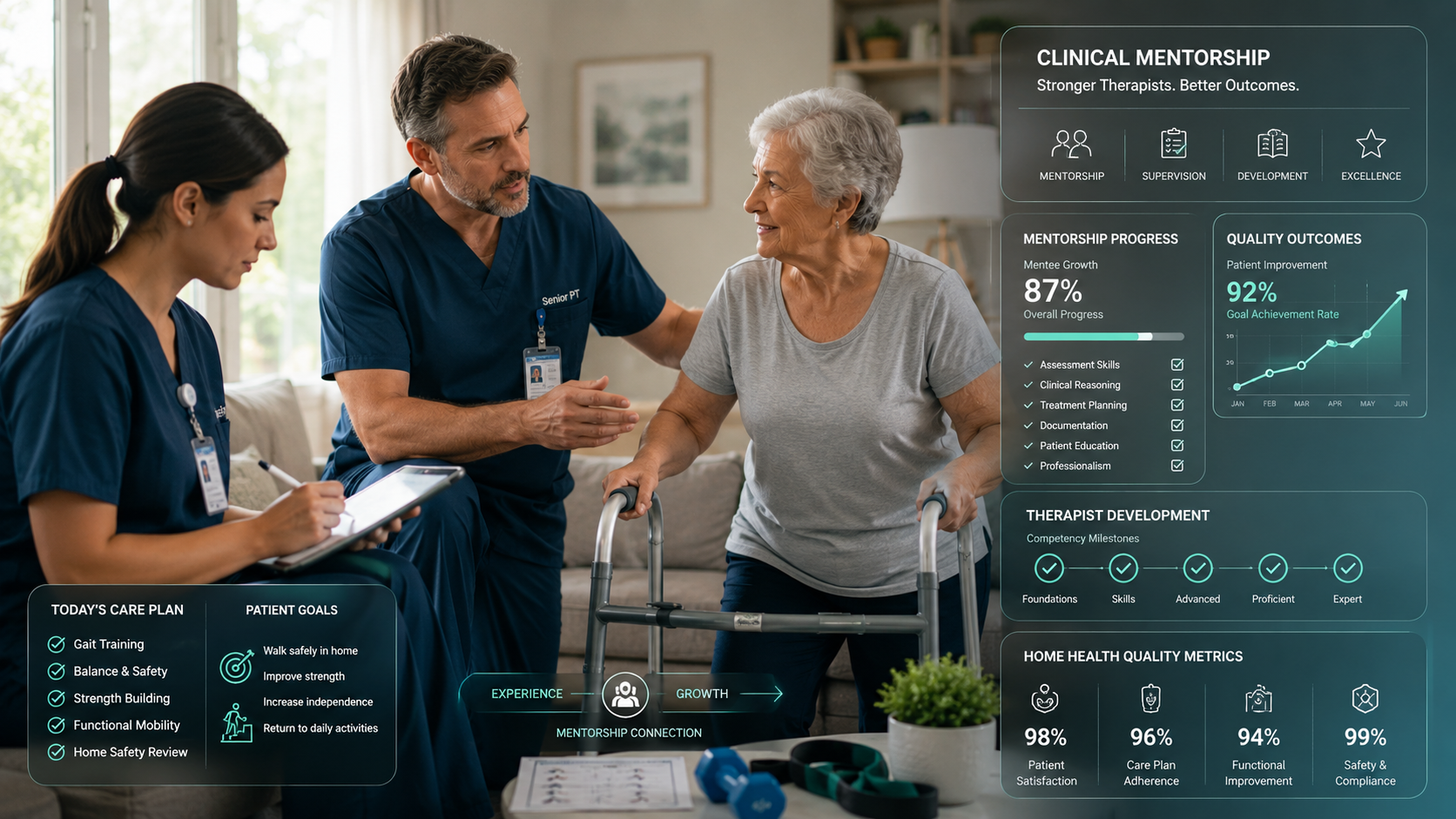
The supervisory visit — the required co-observation of the therapist in the clinical setting with a patient — is the clinical mentorship tool that is most consistently underutilized as a genuine clinical development opportunity. Regulatory requirements for supervisory visits establish minimum frequencies but do not specify the clinical content of what happens during those visits. Most supervisory visits default to observation and compliance documentation — did the therapist perform the assessment correctly, is the documentation being completed in the expected format — rather than the clinical teaching dialogue that converts a supervisory visit into a genuine clinical development experience. The mentor who uses the supervisory visit to observe the therapist’s clinical interaction, to model advanced clinical reasoning by thinking aloud through the clinical decisions being made, to identify specific clinical development targets for the next supervisory visit, and to debrief the visit with the therapist in a coaching dialogue that explores the clinical reasoning behind the choices made produces clinical development that observation alone cannot generate.
Case consultation — the structured clinical discussion of a specific patient case between the therapist and their clinical mentor, without co-presence at the patient’s home — is a high-leverage mentorship tool that most home health agencies implement poorly or not at all. For the home health therapist working in clinical isolation without the immediate colleague consultation access that institutional settings provide, the case consultation with a clinical mentor is the primary mechanism for accessing the specialized knowledge and broader clinical perspective that the isolated practitioner cannot self-generate. Structured case consultation that begins with the therapist presenting their clinical reasoning — what they have assessed, what they have concluded, and why they have chosen the intervention approach they are using — and that the mentor responds to with specific clinical input, alternative perspectives, and guidance toward evidence-based resources produces clinical development that is simultaneously applied to a real patient the therapist is actively treating.
Competency development planning — the identification of specific clinical knowledge and skill gaps for each therapist and the structured development plan that addresses those gaps — is a mentorship function that transforms ad hoc supervision into systematic clinical development. The early-career PT who has strong foundational musculoskeletal skills but limited experience with neurological conditions, complex cardiac patients, and wound care observation requires a competency development plan that specifically targets these knowledge gaps through supervised clinical exposure, recommended continuing education resources, and the structured case consultation and supervisory visit agenda that addresses these specific development targets. The therapist whose competency development is planned specifically and monitored progressively develops clinical breadth more rapidly and more reliably than the therapist whose clinical development is left to accumulate through unstructured clinical exposure.
Peer mentorship — the structured pairing of experienced clinicians with newer colleagues for clinical support, shared learning, and professional community within the home health team — is a mentorship infrastructure component that addresses the professional isolation that home health practice produces without requiring the time investment of formal supervisory mentorship for every peer interaction. Peer mentors provide a different category of clinical support than formal supervisory mentors: they share the practical experience of managing the specific challenges of the agency’s patient population and geographic area, they provide the social connection and professional belonging that reduces the early-career attrition that isolation drives, and they model the professional culture of clinical excellence and patient-centered care that new clinicians are still forming. Agencies that structure peer mentorship deliberately — matching experienced and new clinicians, providing protected time for peer mentorship interactions, and recognizing peer mentors for their contribution to team development — produce clinical cultures that retain clinicians and grow clinical excellence organically.
Feedback quality is the clinical mentorship variable that most directly determines whether mentorship produces clinical growth or simply documents supervisory compliance. Feedback that is specific — identifying the exact clinical behavior observed, the standard or evidence base it is measured against, and the specific change that would improve performance — produces the targeted behavioral change that vague positive or negative feedback cannot. Feedback that is timely — delivered close to the clinical event being addressed while both the mentor and the therapist can recall the specific clinical details — is actionable in a way that delayed feedback is not. Feedback that is balanced — acknowledging specific clinical strengths alongside specific development targets — maintains the emotional safety that allows the therapist to receive critical feedback as clinical growth information rather than personal criticism that triggers defensiveness.
Humane Care Therapy Inc. is OT-owned and operated — and our founder’s clinical background means every clinician we deploy receives documentation orientation, clinical consultation access, and in-house QA review before submission. Clinical support built in, not bolted on. Call (281) 619-3771, email info@humanecaretherapy.com, or visit humanecaretherapy.com.