A Reflection on What OT, PT, SLP, MSW, and Home Health Agency Leaders Share Across the Disciplines and Roles That Home Health Requires
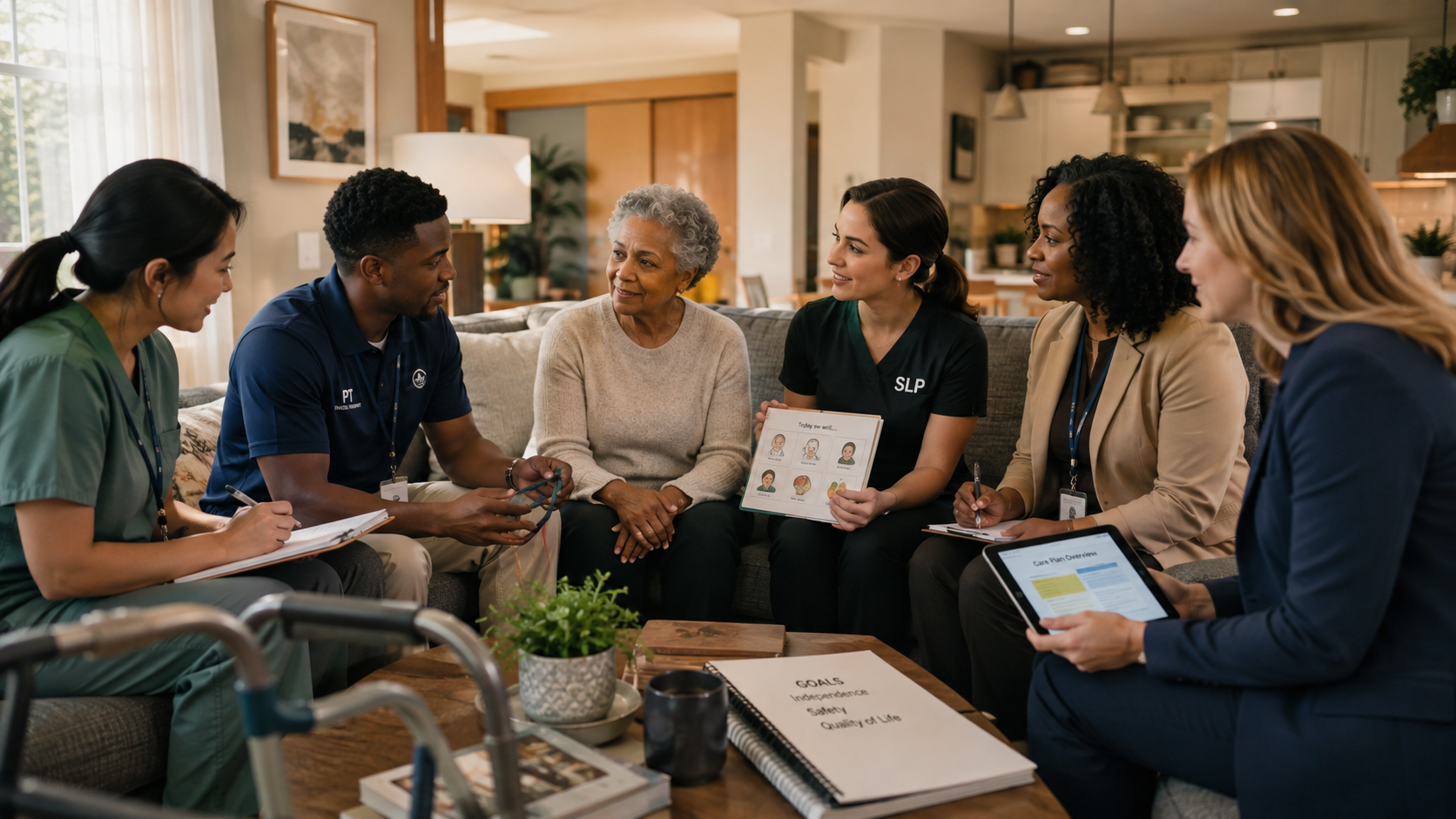
Home health practice creates a professional identity that cuts across the disciplinary boundaries that organize most of healthcare — a shared identity built not from shared training or shared scope of practice but from shared context: the context of entering people’s homes, encountering people in the full complexity of their actual lives, and practicing clinical care in the most intimate and most authentic setting that healthcare occupies. The OT and the PT and the SLP and the MSW and the home health nurse who work with the same patient in the same home across the weeks of an episode share a clinical relationship with that patient and with each other that institutional healthcare settings produce at lower intensity. Something about doing this work — about the access to actual human lives that home-based practice provides, and about the professional responsibility that access carries — creates a recognizable shared identity among people who do it well.
The shared professional identity of home health practice is built from several common experiences that practitioners across disciplines recognize in each other. The experience of clinical isolation — of practicing without the immediate colleague consultation and the multidisciplinary proximity that institutional settings assume — is common across every discipline and role in home health, and produces both the clinical breadth that isolation demands and the specific need for the professional community that makes the isolation sustainable. The experience of entering human vulnerability — of being trusted into the most private spaces of people’s lives at moments of physical limitation, fear, and dependency — is qualitatively common across disciplines even as its clinical expression varies. And the experience of witnessing the specific kind of courage that patients with serious illness and disability demonstrate in the daily work of living — the courage that home health practitioners observe and that is not visible from the same angle in any other healthcare setting — creates a shared appreciation that practitioners who have experienced it recognize in each other.
The leadership and administrative community of home health — the agency owners, clinical directors, quality managers, and billing administrators who make the organizations that enable clinical practice function — shares a version of this professional identity that is distinct from but connected to the clinical community. The agency owner who built their organization around a genuine commitment to clinical quality, who experiences the regulatory and financial pressures of home health administration as obstacles between their organization and the quality of care they are trying to provide, who measures success in patient outcomes alongside revenue and who takes the agency’s clinical reputation as personally as its financial performance — this person shares the professional identity of the home health community in a way that the administrator who views their agency as a business in healthcare rather than a healthcare organization with business requirements does not.
The home health community across Houston and Southeast Texas is a professional community that functions better when it functions as a community — when agencies, staffing companies, clinical educators, regulatory advocates, and professional associations work together on the shared challenges that affect every participant: workforce development, regulatory burden, payer relationships, clinical quality advancement, and the public recognition of home health’s clinical value that the broader healthcare system still significantly underestimates. The competitive dynamics that agencies naturally experience in the referral market do not require abandonment of the professional community investments that collectively advance the home health field — and the agencies that participate in professional associations, contribute to clinical education programs, advocate for home health policy in regulatory forums, and maintain collegial relationships with peer agencies even in competitive markets build the broader professional ecosystem that sustains the entire industry.
Clinical excellence in home health is not a destination that individual agencies and individual clinicians reach and then maintain — it is a continuous practice of learning, adaptation, feedback integration, and honest self-assessment that the most experienced home health practitioners will tell you never feels complete. The clinical complexity of the populations home health serves is continuously evolving as medicine advances and as survivor populations age with conditions that were previously fatal. The regulatory environment that home health operates in is continuously shifting in ways that require ongoing compliance and quality infrastructure adaptation. The technology that enables home health practice is advancing faster than most agencies can fully integrate. And the workforce that carries the clinical work is continuously changing as experienced clinicians retire, as early-career clinicians enter the field, and as the generational values and professional expectations of the workforce evolve.
The 60 posts in this series represent a snapshot of what clinical excellence in home health looks like from one vantage point, at one moment in the development of this field, in one market that is simultaneously representative of broader home health challenges and shaped by the specific geography, demography, regulatory environment, and clinical complexity of Houston and Southeast Texas. The topics that are not covered in these 60 posts — because the clinical breadth of home health extends further than any finite series can reach — are as numerous as the topics that are covered. And the topics covered here will be superseded by clinical evidence advances, regulatory changes, and practice evolution as the field continues to develop.
What does not change — what the clinical community of home health practice has always shared and will continue to share regardless of regulatory cycles, payment model revisions, and technological disruption — is the fundamental quality of the work: the access to human lives at their most vulnerable and their most courageous, the clinical responsibility that access carries, and the professional privilege of contributing to the recovery, the function, and the dignity of the people who accept us into their homes. This is what the home health community shares. And it is worth building and sustaining and defending with the full measure of clinical excellence that the patients who trust us deserve.
Humane Care Therapy Inc. — OT-owned, therapist-operated, built from inside home health practice — is honored to serve as your staffing partner. To the home health community of Houston and Southeast Texas: the patients who trust you into their homes deserve your best. Thank you for giving it. Call (281) 619-3771, email info@humanecaretherapy.com, or visit humanecaretherapy.com.