
Why Untreated Hearing Loss Gets Mistaken for Confusion, Noncompliance, and Dementia, and What Therapists Can Do About It
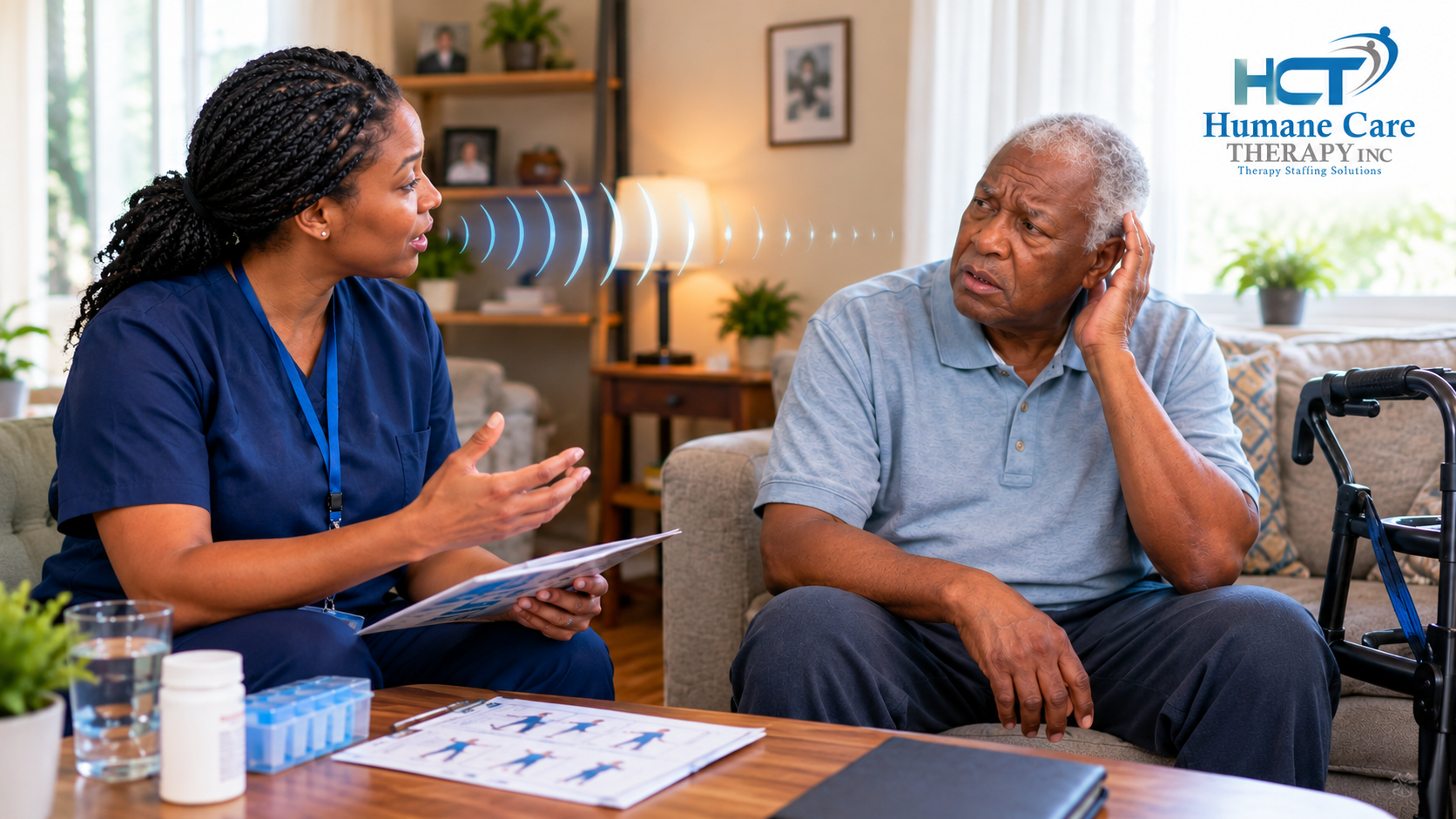
Hearing loss is among the most common chronic conditions of older adulthood, affecting roughly two out of three adults over 70, and it is one of the most frequently overlooked problems in home health. Patients rarely announce it. They nod, smile, answer a different question than the one asked, or withdraw from conversation, and clinicians may interpret the behavior as confusion, disinterest, or noncompliance. A patient who cannot hear the instruction cannot follow it, cannot report a symptom accurately, and cannot give meaningful consent to a plan of care. Recognizing and accommodating hearing loss is therefore a matter of clinical accuracy, patient safety, and basic respect, and it belongs in every therapist’s routine.
The connection between hearing loss and cognition deserves attention. Research has linked untreated hearing loss in midlife and later life with faster cognitive decline and a higher risk of dementia, and it is also associated with social isolation, depression, and falls. The relationship is not fully understood, but the practical lesson is clear. Before concluding that a patient has memory impairment, confirm that the patient can hear the questions. Cognitive screening delivered to someone who cannot hear it produces a misleadingly poor score and can lead to an inaccurate record. Earlier posts in this series discussed delirium and low vision as confounders of cognitive assessment, and hearing belongs on the same list. A patient who performs far better when you face them, speak slowly, and write key words down may be hearing impaired rather than cognitively impaired.
Simple communication techniques make an enormous difference and cost nothing. Reduce background noise before you begin by turning off the television and moving away from running fans or air conditioners. Face the patient at eye level in good light, so that lip movements and facial expressions are visible, and do not cover your mouth or wear a mask that muffles speech without considering a clear option when appropriate. Speak clearly at a natural pace and a slightly lower pitch rather than shouting, since shouting distorts speech and many people with hearing loss hear low-pitched voices better. Rephrase rather than repeat the same words. Confirm understanding with teach-back, asking the patient to show you or explain in their own words, rather than accepting a nod. Written instructions in large print and demonstration reinforce the message, and home exercise programs should always be written and illustrated.
Hearing aids are only as useful as their condition. Many patients own devices that sit in a drawer because the batteries are dead, the tubing is blocked, the wax guard is clogged, or the device is lost, uncomfortable, or too complicated. Check at the start of the visit whether the patient is wearing the aids, whether they are turned on, and whether they work. Occupational therapy can help with insertion, cleaning, battery changes, and storage routines, and with the fine motor and vision demands that make small devices hard to handle. Rechargeable models can simplify care, and a designated place for the devices, such as a small dish by the bed, prevents loss. If a device is broken or the fit is poor, the nurse or physician can arrange audiology follow-up. Since 2022, certain over-the-counter hearing aids have been available for adults with mild to moderate hearing loss, which may lower cost barriers for some patients, though an evaluation is still appropriate when loss is sudden, one-sided, or accompanied by dizziness or ear pain.
Sudden hearing loss is an urgent concern. Hearing that drops over hours or a few days, especially in one ear, can be sudden sensorineural hearing loss, and early medical treatment improves the chance of recovery. Fluid or ear infection, impacted wax, medication effects, and, less commonly, tumors and strokes can also cause changes. A therapist who learns that a patient’s hearing has changed abruptly, or who observes new ringing, fullness, ear drainage, or vertigo, should report it to the nurse or physician the same day. Certain medications, including some diuretics, antibiotics, and chemotherapy agents, can harm hearing, and a patient who reports new tinnitus after starting a drug should be flagged.
Safety is the practical stakes. A patient with hearing loss may not hear a smoke alarm, a doorbell, a telephone, a car approaching, or a caregiver calling from another room. Home assessment should include visual and vibrating smoke and carbon monoxide alarms, flashing doorbell signalers, amplified or captioned telephones, and bed-shaker alarms. Texas offers programs through the Health and Human Services Commission and its Deaf and Hard of Hearing Services that can provide information and, in some cases, equipment, and the medical social worker can help families navigate them. Loop systems and pocket talkers can help patients in therapy sessions, and captioned telephone services allow patients to use the phone independently again. Telehealth visits require extra planning, since audio quality, captions, and a well-lit camera determine whether the visit succeeds.
Communication is also dignity. Patients who cannot follow conversation often stop trying, and families may unintentionally exclude them from decisions. Speech-language pathology can provide communication strategies, auditory training, and family education, and the social worker can address isolation and depression. Ask patients how they prefer to communicate, ensure that interpreters are used for patients who are Deaf and use sign language, and never speak about a patient as though they cannot understand. Humane Care Therapy Inc. is therapist-owned and OT-operated, and our clinicians are trained to screen for communication barriers before they interpret behavior. We supply licensed physical therapists, occupational therapists, speech-language pathologists, and medical social workers to home health agencies across Houston and Southeast Texas. Call (281) 619-3771, email info@humanecaretherapy.com, or visit humanecaretherapy.com.