How Home Health Agencies Can Build the Language Access Infrastructure and Cultural Competency That Houston’s Diversity Requires
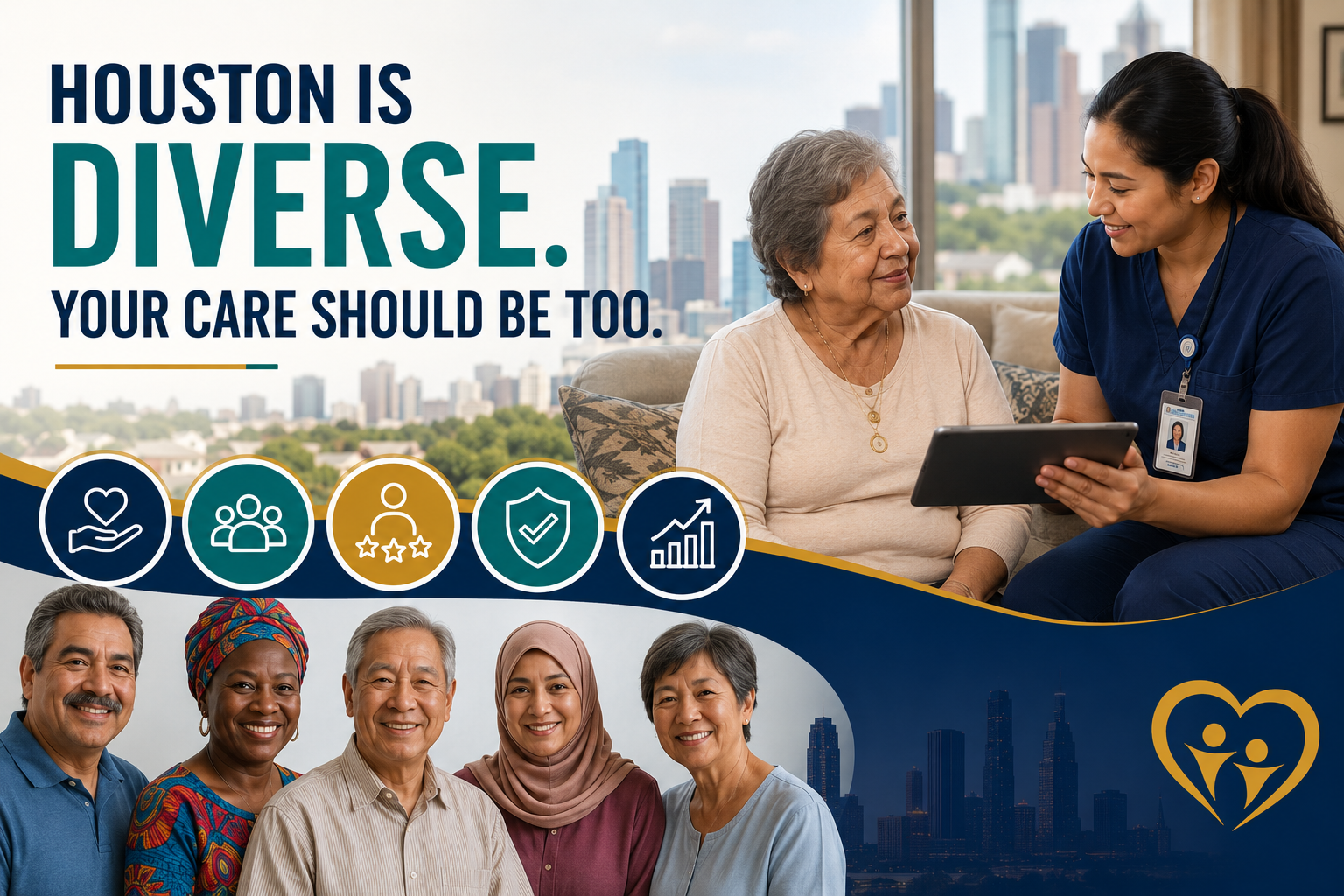
Houston is one of the most linguistically diverse cities in the United States — a metropolitan area where more than 145 languages are spoken, where Spanish is the primary language of approximately 43 percent of the population, where Vietnamese, Chinese, Arabic, Tagalog, and dozens of other languages are the primary languages of established community populations, and where each year brings new immigrant and refugee populations from countries as diverse as Nigeria, Venezuela, El Salvador, Myanmar, and Afghanistan. This linguistic diversity is fully reflected in Houston’s home health patient population — and it creates specific obligations for home health agencies under federal civil rights law as well as specific clinical quality imperatives that agencies that are not meeting these obligations and imperatives are providing genuinely inferior care to a substantial proportion of their patients.
Federal law is clear on the language access obligations of healthcare entities that receive federal funding — including home health agencies that bill Medicare or Medicaid. Title VI of the Civil Rights Act of 1964 prohibits discrimination on the basis of national origin in programs receiving federal financial assistance, and CMS has explicitly interpreted this to require that Medicare-certified home health agencies provide meaningful language access to patients with limited English proficiency. The obligation is to provide competent translation and interpretation services — not to rely on family members or bilingual staff members whose translation competency has not been assessed — and to provide these services in a way that does not impose costs or burdens on the patient that English-speaking patients do not face. The home health agency that relies on the patient’s family member to interpret clinical assessments, medication instructions, and informed consent discussions without a plan for patients who do not have bilingual family available is failing its legal obligation and its patients simultaneously.
Clinical quality implications of inadequate language access in home health are specific and serious. OASIS assessment conducted through an inadequate interpreter — a bilingual family member who lacks medical terminology knowledge, who filters or edits the patient’s responses based on their own judgment, or who interposes their own clinical assessment rather than accurately conveying the patient’s words — produces OASIS data of compromised accuracy that affects both clinical grouping and the care planning that depends on accurate assessment. Patient education delivered without genuine comprehension verification — through teach-back that the patient cannot meaningfully complete if they do not understand the language of instruction — produces medication adherence, self-management, and early warning sign recognition failures that generate the avoidable adverse events that language-appropriate care prevents.
Building the language access infrastructure that Houston’s diversity requires involves both technological and human solutions. Professional medical interpretation services — telephone interpretation, video remote interpretation, and in-person medical interpreter services — are available and accessible for the languages spoken by the largest home health patient populations in the Houston market. Telephone interpretation services that connect within minutes are appropriate for clinical visits where real-time interpretation is needed for assessment and instruction. Video remote interpretation is preferable for visits involving complex clinical assessment, informed consent discussions, and patient education that benefit from visual communication. In-person medical interpreter services are the highest-quality option for complex clinical encounters and for patient situations where the relationship quality of interpretation is clinically significant — though they require advance scheduling that telephone and video interpretation do not.
Bilingual clinical staff are the most valuable language access resource for the languages they cover, because they combine clinical expertise with language capability in a way that interpretation services cannot replicate — and because the clinical relationship quality in the patient’s primary language is qualitatively different from the quality achieved through interpretation. Agencies that recruit and retain bilingual clinicians for the primary languages of their patient population — Spanish, Vietnamese, Mandarin, Tagalog, and others depending on the specific communities they serve — provide a clinical quality advantage for those patients that is both clinically significant and competitively differentiating in communities where bilingual clinical staff are scarce.
Cultural competency for immigrant and refugee communities extends beyond language to the specific healthcare beliefs, family decision-making structures, help-seeking patterns, and historical relationships with healthcare institutions that shape how patients from different cultural backgrounds engage with home health services. The Mexican immigrant patient whose healthcare beliefs include both biomedical and traditional medicine frameworks, the Vietnamese patient whose family structure means that the elder family members rather than the patient are the primary decision-makers about healthcare choices, and the Somali refugee patient whose historical experience includes healthcare systems weaponized by oppressive governments each brings a cultural framework for engaging with healthcare that the clinician who assumes a standard biomedical patient engagement model will misread and mismanage. MSW cultural assessment and the interdisciplinary communication of culturally relevant patient information produces the clinical team awareness that enables culturally responsive care.
Translated clinical materials — OASIS patient communication materials, plan of care documentation, patient education materials, emergency contact protocols, and advance directive forms — in the primary languages of the patient populations served are a practical requirement for genuine language access that cannot be replaced by ad hoc interpretation alone. Agencies that invest in professionally translated clinical materials that are reviewed for medical accuracy and cultural appropriateness — rather than machine-translated documents that may contain medical terminology errors — provide language access support for the patient’s independent review of their own clinical information that interpretation services during visits cannot replicate.
Humane Care Therapy Inc. is therapist-owned and OT-operated. We provide bilingual Spanish-speaking OTs, PTs, SLPs, and MSWs and actively support partner agencies in building language access infrastructure for the linguistically diverse communities of Houston and Southeast Texas. Call (281) 619-3771, email info@humanecaretherapy.com, or visit humanecaretherapy.com.