
Clinical Guidance for OT and PT Providing Home Health Therapy After the Most Common Orthopedic Procedures in the Houston Market
Total joint replacement — hip arthroplasty, knee arthroplasty, and to a growing extent reverse total shoulder arthroplasty — constitutes one of the highest-volume referral streams for home health therapy in the Houston metropolitan area. The Houston market’s extensive orthopedic surgical infrastructure, its large and aging population, and its high rates of the osteoarthritis and degenerative joint conditions that generate arthroplasty referrals produce a consistent, predictable stream of post-orthopedic home health patients whose therapy requirements demand specific orthopedic knowledge that generic functional rehabilitation does not adequately address.
Total hip arthroplasty precautions are the first and most critical clinical knowledge requirement for home health therapists seeing post-THA patients. Posterior approach total hip replacement — still the most common surgical approach — generates hip precautions designed to prevent prosthetic dislocation: avoiding hip flexion beyond 90 degrees, avoiding internal rotation of the operative extremity, and avoiding adduction of the operative extremity past the body’s midline. These precautions apply to virtually every ADL — toilet transfers requiring raised toilet seat and grab bars, getting in and out of vehicles, donning and doffing footwear and lower extremity clothing, and sleeping positions. The OT who analyzes each ADL against the specific precaution parameters and develops adapted techniques for each affected activity is practicing the clinical specificity that post-THA home health requires.
Anterior approach total hip replacement has largely eliminated the posterior precautions that have historically defined THA home health management, and home health therapists must verify the specific surgical approach and surgeon’s specific precaution orders — not assume precautions based on procedure type alone. Anterior approach THA patients typically have limited precautions focused primarily on extension and external rotation during the early healing period. The therapist who applies posterior approach precautions to an anterior approach patient is providing unnecessarily restrictive guidance that delays functional recovery without clinical justification. Always verify the surgical approach before applying any precautions.
Total knee arthroplasty home health management focuses primarily on range of motion restoration, pain and swelling management, and functional mobility progression. The ROM targets that orthopedic surgeons typically specify — 90 degrees of flexion by two weeks, progressive improvement thereafter — provide the clinical benchmarks against which PT intervention is calibrated. Swelling management through ice application, elevation, and compression directly affects ROM by reducing the joint effusion that mechanically limits motion. PT coordination with the nursing team around swelling management ensures this physiological barrier to ROM progression is addressed across all visit types. Gait training for TKA patients progresses through assistive device weaning as pain tolerance, strength, and confidence improve — guided by observed gait quality, not fixed time-based protocols.
Reverse total shoulder arthroplasty has its own specific home health clinical requirements that differ substantially from THA or TKA management. RTSA requires specific post-operative immobilization and range of motion restrictions — typically four to six weeks of sling immobilization with limited active motion — followed by a staged progression of passive, active-assisted, and ultimately active range of motion that PT and OT guide within the surgeon’s specific protocol. The home health RTSA patient requires OT assessment of ADL adaptation during the immobilization phase — one-handed dressing, bathing, grooming, and meal preparation — and PT management of the range of motion progression that begins when immobilization ends.
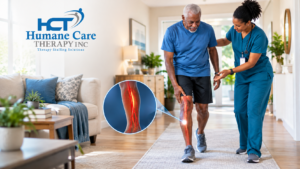
DVT awareness and prevention is a clinical responsibility that home health therapists share with the nursing team for all post-orthopedic patients, because deep vein thrombosis is the most serious post-operative complication of lower extremity arthroplasty. Calf pain, tenderness on palpation of the calf, unilateral lower extremity swelling significantly exceeding the bilateral swelling expected in the early post-operative period, and warmth and erythema in the affected leg — particularly in the calf and popliteal region — are DVT warning signs that require immediate nursing and physician notification and session cessation. Knowing when to stop the therapy session and make the notification is a clinical safety competency as important as any technical therapy skill.
Wound and incision monitoring for post-orthopedic patients is a nursing clinical responsibility that home health PT and OT contribute to through clinical observation and communication. Signs of post-surgical wound complication — increasing erythema, warmth, and drainage beyond what is normal for the healing stage, or any purulent wound discharge — observed during therapy visits require prompt nursing notification and documentation. The therapist who observes wound changes and does not communicate them to the nursing team because wound care is outside their scope has failed the patient through inaction on a clinical observation they are obligated to communicate.
Pain management navigation is an increasingly complex clinical dimension of post-orthopedic home health in the era of opioid stewardship. Orthopedic surgeons and pain management programs have significantly reduced opioid prescribing for post-surgical pain in recent years, shifting management toward non-pharmacological approaches — ice, elevation, TENS, activity modification. PT understanding of appropriate ice and elevation protocols for post-surgical swelling and pain, the activity pacing that prevents overexertion-related pain exacerbation, and the exercise intensity calibration that produces therapeutic benefit without exceeding pain tolerance provides both clinical treatment and pain management education that directly reduces discomfort and improves therapy engagement.
Humane Care Therapy Inc. provides OT and PT staffing that supports post-orthopedic home health therapy for agencies across Houston and Southeast Texas. Contact us at (281) 619-3771 or visit humanecaretherapy.com.
Related HCT staffing services: Occupational Therapy and Physical Therapy staffing in Houston.