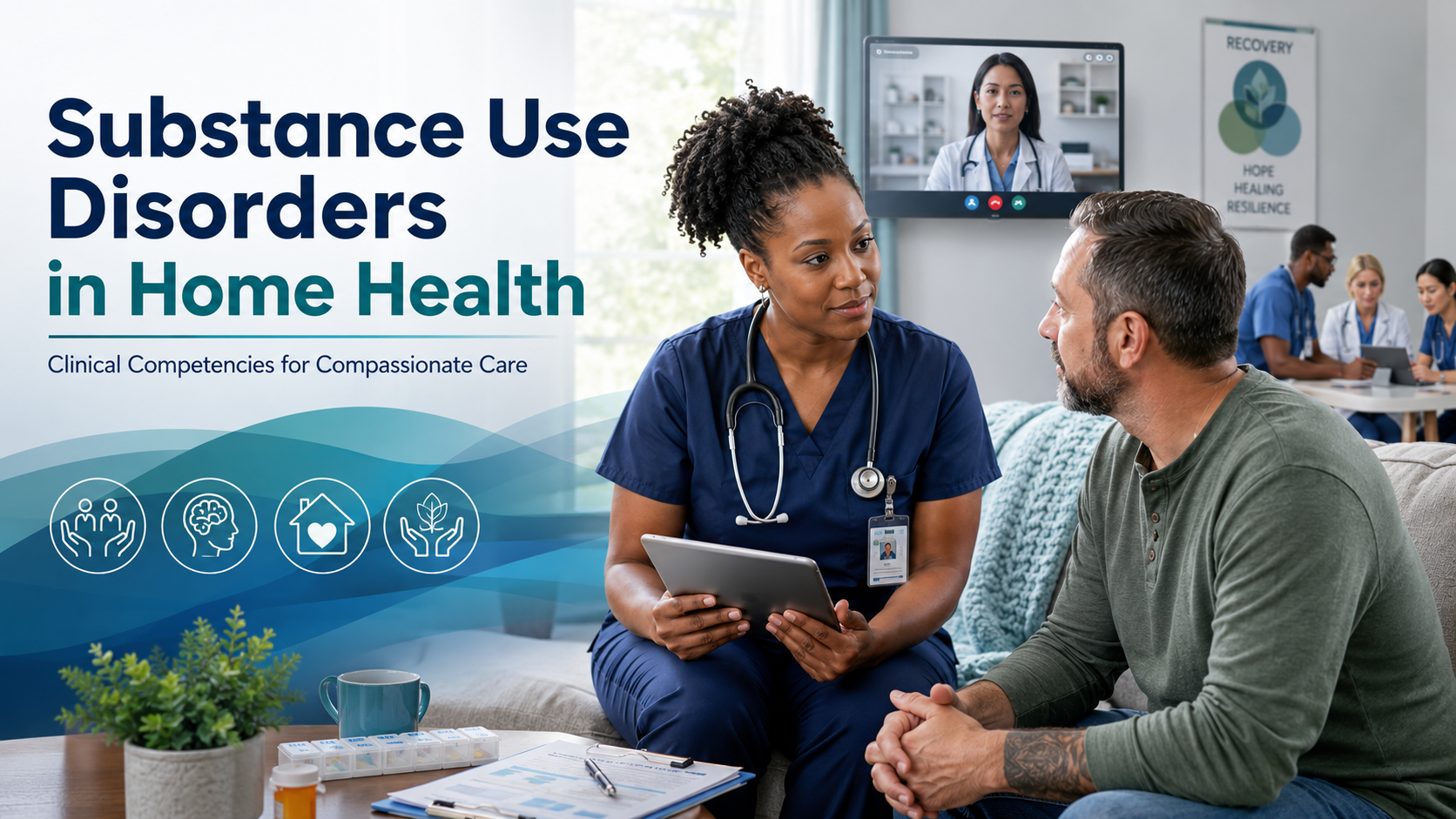
How Home Health Clinicians Can Serve Patients With Substance Use Disorders More Effectively — and More Equitably
Substance use disorders are among the most prevalent and most underidentified conditions in the home health population. Alcohol use disorder affects approximately 10 percent of adults over 65 — and is rising as the baby boom generation ages with higher lifetime alcohol use rates than preceding generations. Opioid use disorder and prescription medication misuse affect a substantial proportion of the chronic pain population that constitutes a large share of home health referrals. Cannabis use is increasing rapidly in older adult populations as legalization expands and as older adults adopt cannabis for pain and sleep management in ways that interact with medications and clinical management. Yet the home health clinical encounter frequently fails to address substance use directly — because clinicians are not trained to assess it, because clinical culture treats it as outside therapy scope, or because the assumption persists that older adult patients with chronic illness do not have substance use concerns.
The clinical consequences of unidentified and unaddressed substance use disorders in home health are concrete and significant. Alcohol use disorder in older adults produces fall risk through balance impairment, cognitive effects, and the medication interactions that occur when alcohol is combined with the polypharmacy that most home health patients carry. It produces sleep disruption that amplifies pain, fatigue, and cognitive impairment. It impairs wound healing and recovery from illness and surgery. And it contributes to the medication non-adherence that undermines the medical management of every chronic condition that the home health episode is supposed to address. The home health episode that does not identify and address alcohol use disorder in a patient for whom it is clinically relevant is providing a fundamentally incomplete clinical service.
Opioid use disorder and prescription opioid misuse in the chronic pain home health population presents specific clinical challenges because the line between appropriate opioid use for legitimate chronic pain, physical opioid dependence without problematic use, and opioid use disorder that requires specific clinical attention can be difficult to distinguish and because the clinical relationship between pain and opioid use is one that patients frequently manage with complex and sometimes stigmatized strategies. Home health clinicians who approach opioid use in chronic pain patients with the disease-model framework for opioid use disorder — understanding it as a chronic brain disease with genetic, developmental, and environmental contributors — rather than a moral failure framework produce clinical interactions that are more accurate, more effective, and more likely to identify the patients who would benefit from addiction medicine referral.
Clinical assessment for substance use in home health requires a structured approach that goes beyond asking whether the patient drinks alcohol. The AUDIT-C — a three-item screen for alcohol use disorder with validated sensitivity and specificity in older adult populations — provides a brief, validated assessment tool that can be incorporated into the MSW start-of-care assessment. The DAST-10 provides a parallel brief screen for drug use disorders. The CAGE questionnaire remains one of the most widely used alcohol screening tools in primary care settings and is appropriate for initial screening in home health. Brief motivational interviewing techniques that the MSW applies when screening identifies concerning substance use — expressing empathy, developing discrepancy between current use and the patient’s own health goals, rolling with resistance, and supporting self-efficacy — are evidence-based approaches to substance use clinical engagement that home health MSWs can apply without formal addiction treatment training.
Physical therapy clinical management of patients with active substance use disorders requires specific adaptation of standard exercise and functional rehabilitation approaches. The patient who is actively using alcohol at problematic levels has impaired balance, coordination, and reaction time that directly affects fall risk assessment and fall prevention interventions. The patient in opioid use disorder whose pain management is complicated by opioid tolerance and opioid-induced hyperalgesia — the paradoxical increase in pain sensitivity that prolonged opioid use can produce — requires a pain management approach that incorporates non-pharmacological pain management strategies with specific understanding of how opioid physiology modifies the pain experience. The patient in recovery from substance use disorder may have specific clinical considerations related to their recovery program — medications for addiction treatment, recovery support engagement, and the stress management approaches that support sustained recovery — that the PT integrates into exercise and rehabilitation programming.
Occupational therapy for patients with substance use disorders addresses the functional life domains that substance use most directly affects — daily routines and habits, social participation, sleep, work and productive activity — and the adaptive strategies that support functional recovery alongside addiction treatment. The patient in early alcohol use disorder recovery who is restructuring their daily routine around sobriety maintenance requires OT support for the routine restructuring and habit formation that sustains functional participation without the alcohol use that previously structured their daily life. The patient with opioid use disorder who is managing pain with non-opioid strategies supported by addiction treatment requires OT support for the functional activity modification and energy conservation that manages pain through behavioral means.
Harm reduction is a clinical and ethical framework that home health clinicians working with patients with substance use disorders must understand and apply — particularly in situations where abstinence is not the patient’s current goal or near-term possibility. Harm reduction approaches focus on reducing the health and social harms associated with substance use for patients who are not ready, willing, or able to achieve abstinence. For the home health patient who is not ready to address their alcohol use disorder but who is at high fall risk from alcohol-related balance impairment, harm reduction might involve fall risk counseling and environmental modification that reduces fall consequences, medication reconciliation that identifies the alcohol-medication interactions most dangerous for this patient, and the non-judgmental clinical engagement that keeps the patient engaged with home health services that provide benefit even in the absence of substance use behavior change.
Humane Care Therapy Inc. provides OT, PT, SLP, and MSW staffing that brings substance use disorder clinical competency to home health agencies across Houston and Southeast Texas. Contact us at (281) 619-3771 or visit humanecaretherapy.com.
Related HCT staffing services: Occupational Therapy and Medical Social Work staffing in Houston.