What Every Home Health Clinician Must Know About Cognitive, Physical, and Behavioral Rehabilitation Following TBI
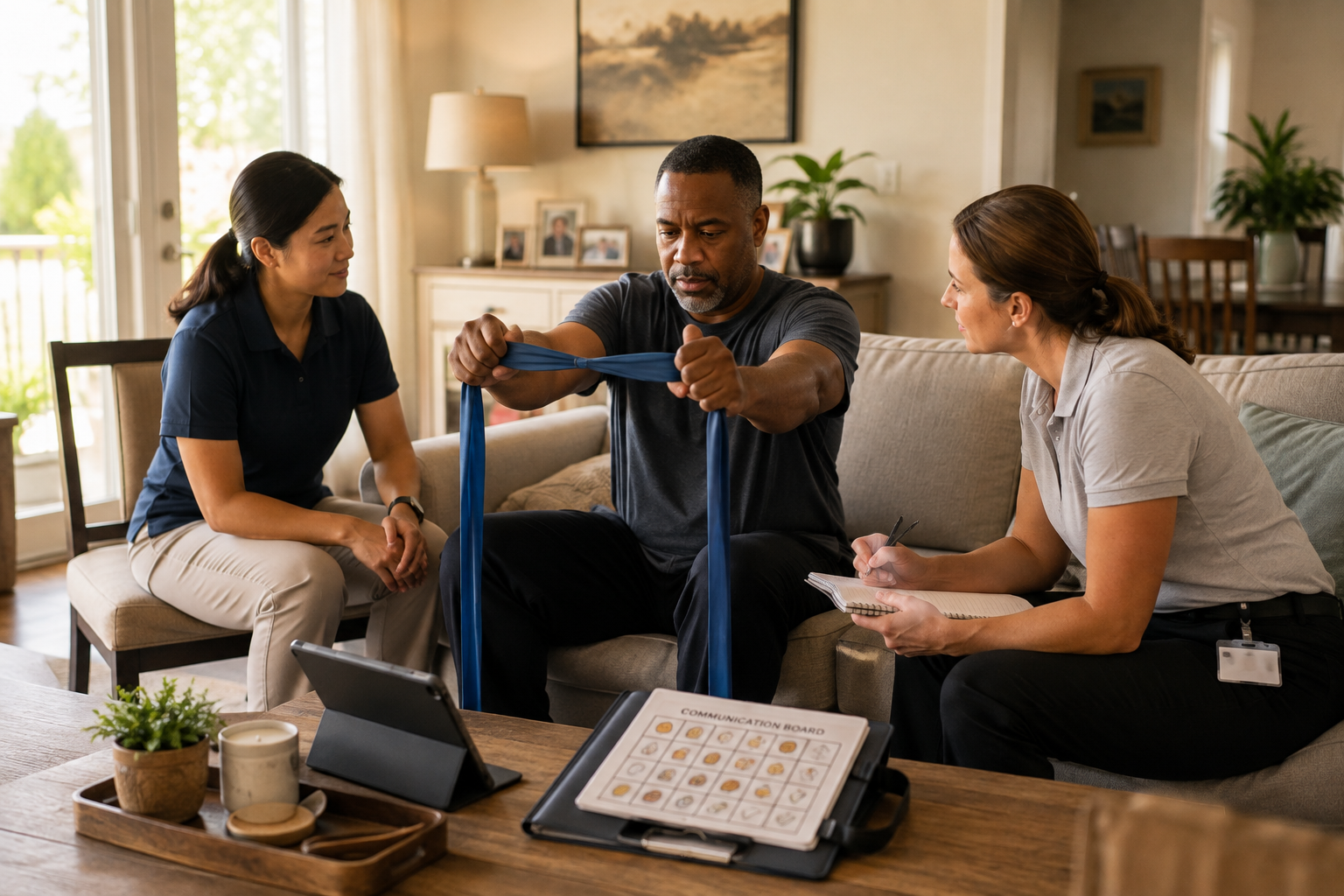
Traumatic brain injury produces one of the most heterogeneous and clinically demanding patient populations in home health — a population in which two patients with the same Glasgow Coma Scale score at time of injury can present with entirely different functional, cognitive, and behavioral profiles months later. Houston’s trauma infrastructure and its high rates of motor vehicle collisions, workplace falls, and assault-related injuries generate a consistent stream of TBI survivors who transition from acute and inpatient rehabilitation to home-based care and who require a level of TBI-specific clinical sophistication that general home health training does not systematically build. As an OT-owned and operated staffing company, Humane Care Therapy Inc. understands that TBI home health done well requires clinicians who can hold physical, cognitive, and behavioral complexity simultaneously — because our founder has practiced with exactly this population.
Understanding TBI severity classification and its limitations is foundational for every therapist serving this population. Mild, moderate, and severe TBI classifications — based on Glasgow Coma Scale score, duration of loss of consciousness, and duration of post-traumatic amnesia at time of injury — provide a starting framework, but severity at injury correlates imperfectly with functional outcome months or years later. The home health therapist who treats a patient’s TBI severity classification as a fixed predictor of current functional capacity, rather than assessing the patient’s actual current presentation, misses the individualized clinical picture that effective TBI rehabilitation requires. Diffuse axonal injury, focal contusion, and the specific neuroanatomical pattern of injury each produce distinct functional profiles that require individualized assessment rather than classification-based assumption.
Cognitive rehabilitation is the domain of TBI care most likely to be under-addressed in home health, because cognitive deficits are frequently less visible than physical deficits and because the home health referral pattern for TBI patients often emphasizes physical rehabilitation needs over the cognitive deficits that may be more functionally limiting. Attention deficits, processing speed reduction, executive function impairment — planning, organization, judgment, and impulse control — and memory impairment each require specific cognitive rehabilitation approaches. OT and SLP cognitive rehabilitation in the home setting has a distinctive advantage over clinic-based cognitive rehabilitation: cognitive strategies can be trained and practiced in the actual functional contexts where the patient needs them, using the patient’s actual daily schedule, actual medication regimen, and actual household management tasks as the training material.
Physical rehabilitation for TBI patients addresses the motor deficits — hemiparesis, ataxia, spasticity, and balance dysfunction — that accompany TBI in patterns that overlap with but are not identical to the motor deficits seen in stroke. PT assessment of the specific motor pattern, the presence and distribution of spasticity, and the balance and coordination deficits that TBI produces guides an individualized rehabilitation approach. Vestibular dysfunction is particularly common following TBI, especially TBI involving direct head impact, and PT vestibular assessment and rehabilitation — including canalith repositioning maneuvers when BPPV is identified and habituation exercises for other vestibular dysfunction patterns — addresses a specific and often undertreated contributor to the dizziness and balance impairment that many TBI patients experience.
Behavioral and emotional changes following TBI are among the most challenging clinical presentations for home health teams and among the most distressing for families, because personality change, emotional lability, disinhibition, irritability, and impulsivity following TBI can feel to families like the loss of the person they knew even when physical recovery is substantial. MSW and the full interdisciplinary team benefit from understanding that these behavioral changes are neurological sequelae of the injury — frontal and temporal lobe damage in particular produces the behavioral dysregulation that families experience as personality change — rather than willful behavior, and that behavioral intervention approaches must be calibrated to this neurological understanding rather than applied as though the patient retains full behavioral self-regulation capacity.
Communication deficits following TBI span a spectrum from the frank aphasia that focal left-hemisphere injury can produce to the more diffuse cognitive-communication deficits — disorganized discourse, difficulty with abstract language, impaired pragmatic communication, and the social communication deficits that accompany executive dysfunction — that are more characteristic of diffuse TBI. SLP assessment that distinguishes these different communication deficit patterns and that addresses cognitive-communication deficits with the specific intervention approaches they require — rather than applying standard aphasia treatment protocols to a cognitive-communication presentation — provides the clinical specificity that TBI communication rehabilitation demands.
Family and caregiver education for TBI is a clinical priority with unique urgency, because the family who does not understand the neurological basis of the personality and behavioral changes they are witnessing experiences a grief and confusion that compounds the practical caregiving burden. MSW facilitation of family education about TBI’s neurological and behavioral sequelae, connection with TBI-specific family support resources including the Brain Injury Association of Texas, and support for the family’s own grief process — the grief of loving someone who survived but who is different than they were before — addresses the psychosocial dimension of TBI care that physical and cognitive rehabilitation alone does not reach.
Return to community participation — driving evaluation referral, vocational rehabilitation connection, and the graduated return to the social and occupational roles that gave the patient’s pre-injury life its structure and meaning — is the functional endpoint that comprehensive TBI home health rehabilitation works toward. MSW vocational rehabilitation referral, OT community reintegration planning, and the interdisciplinary team’s shared understanding of the patient’s community participation goals produce rehabilitation that is oriented toward the patient’s actual life rather than isolated impairment-level improvement.
Humane Care Therapy Inc. is therapist-owned and OT-operated — built by a clinician who understands TBI home health from firsthand clinical practice. We provide OT, PT, SLP, and MSW staffing with TBI clinical training for home health agencies across Houston and Southeast Texas. Call (281) 619-3771, email info@humanecaretherapy.com, or visit humanecaretherapy.com.
Related HCT staffing services: Occupational Therapy, Physical Therapy, Speech-Language Pathology, and Medical Social Work staffing in Houston.