How OT, PT, SLP, and MSW Adapt Their Practice Across the Trajectory of a Relentlessly Progressive Neurodegenerative Disease
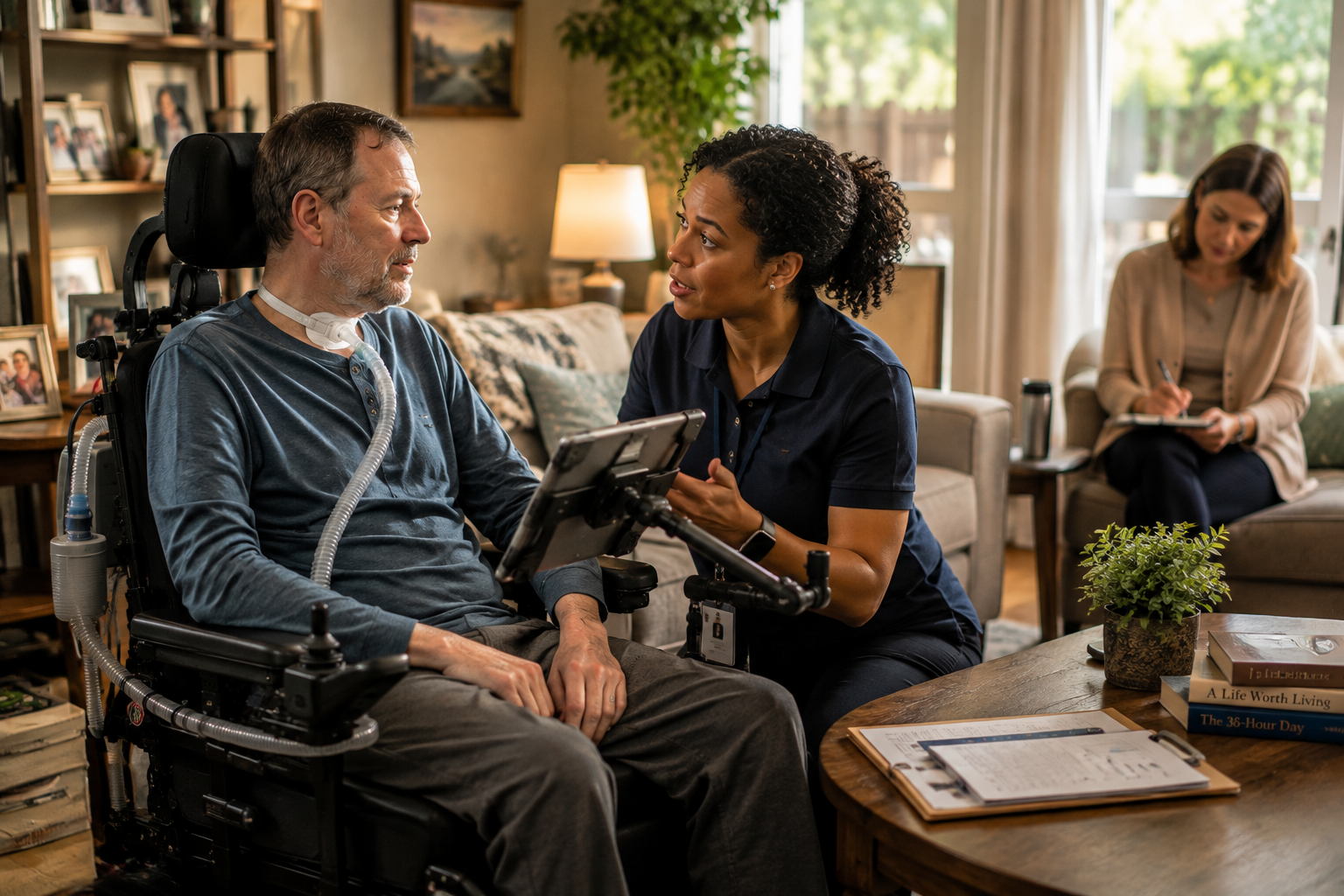
Amyotrophic lateral sclerosis presents home health therapy with a clinical challenge unlike almost any other diagnosis: a relentlessly progressive disease in which the therapeutic goal is never restoration of function, and in which every discipline’s clinical approach must continuously adapt to a trajectory of loss that is predictable in its direction even when its pace varies from patient to patient. ALS home health requires clinicians who can hold two things simultaneously — genuine therapeutic engagement with the patient’s current functional capacity, and honest anticipation of the functional losses ahead — without either abandoning present-moment clinical value or pretending that decline is not coming. At Humane Care Therapy Inc., our OT-owned leadership brings the clinical perspective that this particularly demanding population requires.
Physical therapy for ALS shifts its clinical orientation over the disease course in ways that distinguish it from PT for most other neurological conditions. Early-stage ALS PT focuses on maintaining strength, range of motion, and functional mobility through moderate, non-fatiguing exercise — evidence suggests that excessive exercise intensity in ALS may accelerate motor unit loss, making exercise prescription calibration a specific clinical skill rather than a generic strengthening protocol. As the disease progresses, PT’s role shifts toward contracture prevention through range of motion maintenance, equipment provision and adaptation — canes, walkers, wheelchairs, and eventually power mobility — timed to the patient’s actual functional trajectory rather than delayed until crisis, and caregiver training in the transfer and positioning techniques that become increasingly necessary as motor function declines.
Respiratory management is the ALS clinical domain with the most direct relationship to survival and quality of life, because respiratory failure is the most common cause of death in ALS and because the timing and quality of respiratory intervention directly affects both survival duration and the patient’s quality of life during the disease course. PT and respiratory therapy collaboration on breathing exercises, and specifically on the cough assistance techniques and devices that compensate for the expiratory muscle weakness that impairs the ALS patient’s ability to clear secretions, addresses a modifiable contributor to the respiratory infection risk that accelerates respiratory decline. Home health clinicians who monitor for the early signs of respiratory decline — orthopnea, morning headaches, daytime fatigue, and declining forced vital capacity — and who communicate these findings promptly to the physician support the timely non-invasive ventilation initiation that meaningfully extends both survival and quality of life in ALS.
Occupational therapy for ALS addresses the progressive functional independence loss across every ADL domain with an adaptive equipment strategy that must be sequenced to the patient’s actual functional trajectory — introducing adaptive equipment before the patient’s functional loss makes an activity unsafe or impossible, without introducing equipment so far ahead of need that the patient experiences it as a premature marker of loss they are not yet ready to accept. This sequencing judgment — balancing safety, independence, and the patient’s psychological readiness for each adaptive step — is a clinical skill specific to progressive disease management that OT training in static or improving conditions does not fully prepare clinicians for.
Speech-language pathology for ALS addresses both the dysarthria that affects the majority of ALS patients over the disease course and the dysphagia that develops as bulbar motor neurons are affected. Early and honest introduction of augmentative and alternative communication — well before speech becomes unintelligible — is among the most consequential SLP clinical decisions in ALS care, because AAC systems introduced and mastered while the patient retains some natural speech and fine motor control preserve a communication capacity that becomes far more difficult to establish after those capacities are lost. Dysphagia management in ALS similarly requires forward-looking clinical planning — including honest, values-based conversations about feeding tube placement timing that respect the patient’s autonomy while providing the clinical information needed for an informed decision made before a nutritional crisis forces the decision under worse circumstances.
Medical social work for ALS patients and families addresses psychosocial dimensions with a particular intensity that reflects the disease’s unique combination of preserved cognition — in the majority of ALS patients — with progressive and total loss of motor function. The ALS patient who retains full cognitive awareness while experiencing progressive paralysis faces an existential and psychological challenge that MSW support, advance care planning facilitation, and connection with ALS Association resources specifically addresses. Family caregiver support carries particular urgency in ALS given the caregiving demands that a totally dependent patient with preserved cognition and communication needs creates, and given the anticipatory grief that both patient and family navigate across a disease course whose end point, while not always precisely predictable in timing, is not in doubt.
Interdisciplinary coordination in ALS home health is essential because the disease’s multi-system progression means that PT, OT, SLP, and MSW clinical decisions are interdependent in ways that require genuine team communication rather than parallel discipline-specific care. The equipment and adaptive strategy sequencing that OT manages, the respiratory monitoring that PT contributes to, the communication planning that SLP leads, and the psychosocial and advance care planning support that MSW provides all depend on shared, current understanding of where the patient is in their disease trajectory and what their expressed goals and values are for the phase of disease ahead.
Humane Care Therapy Inc. is therapist-owned and OT-operated — built by a clinician who understands what ALS home health demands of every discipline across a genuinely difficult disease trajectory. We provide OT, PT, SLP, and MSW staffing with ALS and progressive neurodegenerative disease clinical training for home health agencies across Houston and Southeast Texas. Call (281) 619-3771, email info@humanecaretherapy.com, or visit humanecaretherapy.com.
Related HCT staffing services: Occupational Therapy, Physical Therapy, Speech-Language Pathology, and Medical Social Work staffing in Houston.