What OT and PT Must Know to Serve Burn Survivors Safely and Effectively After Discharge From Specialized Burn Care
Burn injury rehabilitation in home health serves a patient population that has typically already received specialized care at a dedicated burn center. Houston’s medical infrastructure includes such specialized burn care capacity before transitioning to home health for the extended rehabilitation phase that burn recovery requires, a phase that frequently continues for months to years after the acute injury as scar maturation, contracture risk, and functional adaptation continue to evolve well beyond the wound closure that marks the end of acute burn treatment. Home health OT and PT serving this population require specific clinical knowledge that general wound care or orthopedic rehabilitation training does not provide.
Scar management is a central clinical priority in burn rehabilitation because hypertrophic scarring and keloid formation, which occur at substantially elevated rates following burn injury compared to other wound types, produce both functional limitation through the scar tissue’s reduced elasticity and pull across joints, and the cosmetic and psychosocial impact that visible scarring produces. Pressure garment therapy, custom-fitted compression garments worn for extended daily periods over healing burn wounds and maturing scars remains a cornerstone scar management intervention with evidence supporting its role in reducing hypertrophic scar formation, and OT clinical monitoring of pressure garment fit, wear schedule adherence, and skin tolerance is a specific clinical competency that burn-experienced home health OT provides.
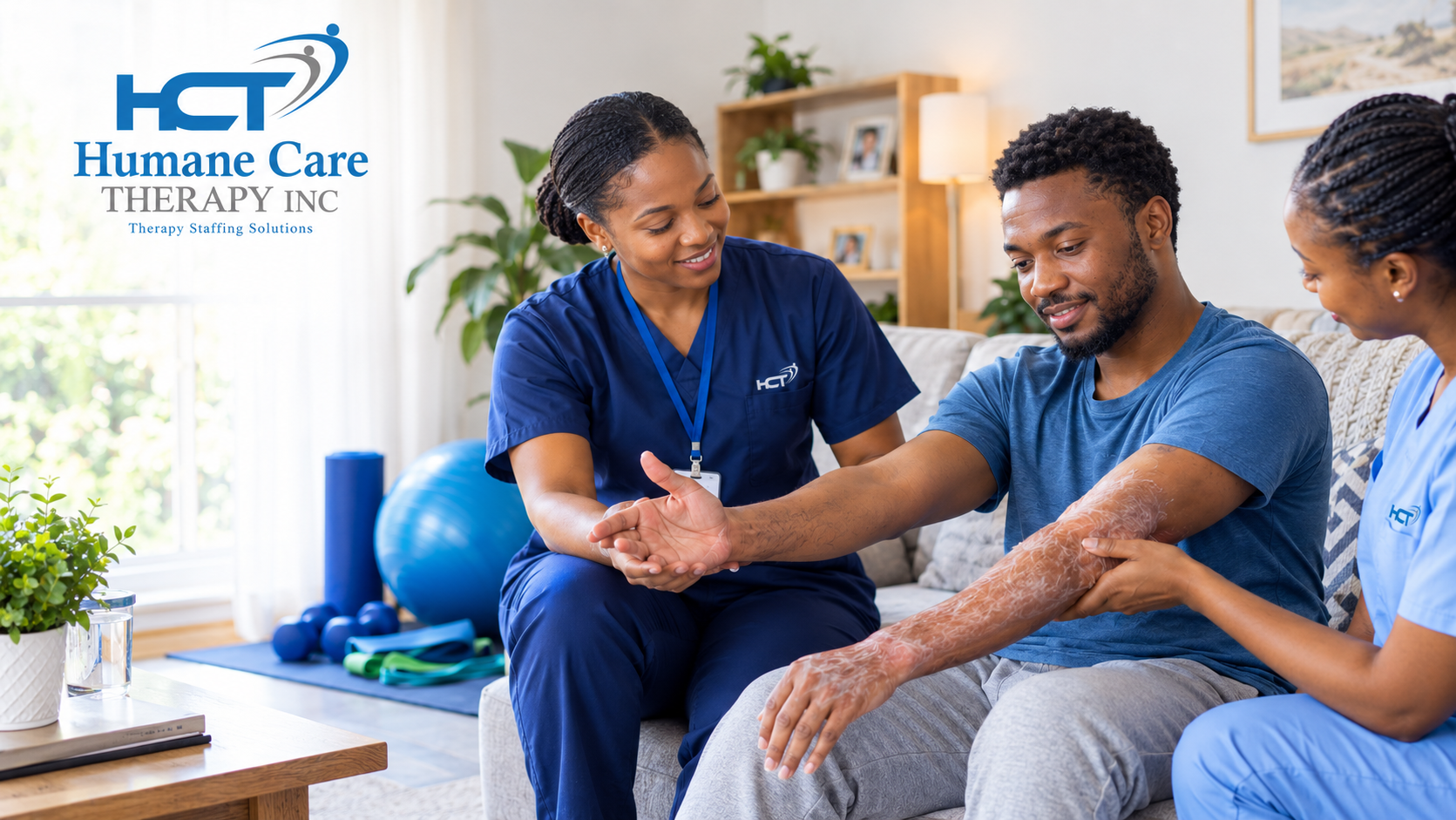
Contracture prevention deserves the most urgent clinical priority in burn rehabilitation because burn scar tissue’s reduced elasticity, combined with the tendency for burns crossing joints to contract during the healing and scar maturation process, creates a contracture risk that, once established, is substantially more difficult to reverse than to prevent. PT and OT positioning protocols specific to the burn location including the specific anti-contracture positions for burns of the neck, axilla, elbow, hand, and other joint-crossing locations that differ by burn site combined with the range of motion exercise and splinting that maintains joint mobility throughout the scar maturation process, address a window of contracture prevention opportunity that narrows considerably once mature scar contracture has developed.
Hand burns deserve particular clinical attention because the hand’s complex anatomy and critical functional importance make hand burn contractures especially functionally devastating, and because hand burn rehabilitation requires the kind of detailed anatomical knowledge and splinting expertise that specialized hand therapy training provides. OT with hand therapy training addressing the specific positioning, splinting, and exercise progression that hand burns require protecting the intrinsic plus position that prevents the claw-hand deformity pattern that inadequately managed hand burns can produce represents a specialized clinical contribution with direct functional independence implications for a body part essential to nearly every ADL and vocational activity.
Itch management deserves specific clinical attention because pruritus is one of the most common and most distressing symptoms burn survivors report during the healing and scar maturation process, driven by the nerve regeneration and histamine release that occurs during wound healing, and because the scratching that severe itch produces can damage healing or newly healed skin and worsen scarring. OT patient education about itch management strategies including appropriate use of moisturizers, cool compresses, and the desensitization techniques that reduce hypersensitivity in healing skin addresses a symptom with substantial quality of life impact that burn rehabilitation must specifically address rather than treating as an unavoidable and untreatable aspect of the healing process.
Desensitization therapy for the hypersensitivity that newly healed burn skin commonly exhibits where light touch that would be unremarkable on unburned skin produces significant discomfort or pain is a specific OT intervention using graduated tactile stimulation with different textures to gradually normalize sensory processing in healed burn areas, addressing a sensory dimension of burn recovery that affects the patient’s ability to tolerate clothing, participate in ADLs involving touch, and engage in normal tactile social interaction.
Psychosocial adjustment following burn injury deserves substantial MSW clinical attention because burn injuries, particularly those involving visible areas including the face and hands, carry body image and social reintegration challenges that few other injuries produce with comparable intensity, alongside the trauma processing that the burn injury circumstances whether accidental, occupational, or in some cases intentional frequently require. MSW support addressing body image, social anxiety about visible scarring, potential post-traumatic stress related to the burn incident itself, and connection with burn survivor peer support resources including the Phoenix Society for Burn Survivors addresses psychosocial dimensions of burn recovery that physical rehabilitation alone does not reach.
Sun protection education deserves specific clinical attention because newly healed burn scars have significantly increased sensitivity to sun exposure and elevated risk of hyperpigmentation and further scar changes from UV exposure during the extended scar maturation period, making sun protection education sunscreen use, protective clothing, and sun avoidance during peak exposure periods, a practical and important component of long-term burn scar management that particularly matters in the sun exposure conditions of the Houston and Gulf Coast region.
Humane Care Therapy Inc. is therapist-owned and OT-operated and our clinical leadership understands burn rehabilitation as a specialized clinical domain requiring knowledge beyond general wound care training. We provide OT and PT staffing with burn rehabilitation clinical training for home health agencies across Houston and Southeast Texas. Call (281) 619-3771, email info@humanecaretherapy.com, or visit humanecaretherapy.com.