
How the Rapid Growth of Medicare Advantage Is Reshaping Home Health Referrals, Authorizations, and Clinical Standards in Houston
Medicare Advantage — the private plan alternative to traditional Medicare that now enrolls more than half of all Medicare-eligible Americans — has fundamentally altered the home health business environment in ways that agencies whose administrative and clinical practices were designed for traditional Medicare are struggling to adapt to. In Texas, Medicare Advantage penetration is high and growing, with major markets including Houston seeing rates that exceed national averages driven by the aggressive plan offerings of major insurers and the demographic preferences of the large and growing Medicare-eligible population in Southeast Texas.
Understanding Medicare Advantage as a home health payer — what makes it different from traditional Medicare, how it creates administrative challenges that traditional Medicare does not, and what clinical standards it expects from preferred provider relationships — is essential knowledge for any agency that wants to compete effectively in the 2026 Houston home health market.
The fundamental difference between traditional Medicare and Medicare Advantage home health coverage is that Medicare Advantage plans are private insurance plans that contract with CMS to provide Medicare benefits, and each plan designs its own coverage rules within the boundaries that CMS establishes. Traditional Medicare has uniform coverage rules that apply equally to all beneficiaries enrolled in the program. Medicare Advantage plans have rules that vary across hundreds of plans — different prior authorization requirements, different coverage criteria for specific therapy disciplines, different visit frequency limitations, different concurrent review processes, and different documentation requirements — that home health agencies must understand and navigate plan by plan.
The prior authorization landscape for Medicare Advantage home health is one of the most significant administrative burdens the MA model creates for home health agencies, and it has intensified in recent years as plans have expanded their utilization management programs. Some MA plans require prior authorization for the entire home health episode. Some require authorization specifically for therapy services. Some allow a limited number of visits under a general home health authorization and require separate authorization for visits beyond that threshold. Some conduct concurrent review — requiring clinical updates and re-authorization as the episode progresses — in ways that create ongoing administrative demands throughout the episode.
Managing this authorization complexity requires both administrative infrastructure and clinical documentation quality. Administrative infrastructure includes the staffing, systems, and processes to verify MA coverage for every new admission, identify the specific plan’s authorization requirements, submit authorization requests with the clinical documentation the plan requires, track authorization status and expiration, submit timely updates for concurrent review requirements, and manage appeal processes when initial authorization is denied. Clinical documentation quality affects authorization outcomes because MA plan reviewers examine the clinical documentation submitted with authorization requests to determine whether coverage criteria are met, and generic or incomplete documentation produces denial rates that specific, clinically detailed documentation avoids.
Network participation with Medicare Advantage plans is an increasingly important strategic consideration for home health agencies. MA plans frequently establish preferred provider networks — lists of home health agencies that their enrolled members are directed toward or incentivized to use — and being on these preferred provider lists requires meeting plan-specific quality and performance standards that vary across plans. The competitive advantage of MA network participation is substantial in markets with high MA penetration, because beneficiaries on MA plans who are directed to in-network providers will not typically seek services from out-of-network agencies even if those agencies have long-standing relationships with referral sources.
Applying for MA network participation requires demonstrating compliance with plan-specific quality standards, completing credentialing processes that differ from Medicare certification and from the standards of other plans, maintaining the quality metrics and outcome data that plans use to evaluate and re-credential network providers, and managing contractual obligations that include the billing requirements, dispute resolution processes, and performance expectations that MA contracts specify. The investment in MA network development is substantial but justified in markets where MA penetration reaches the levels now seen in Houston.
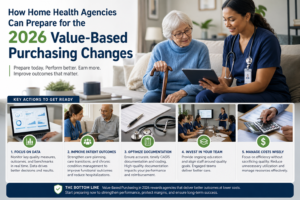
Quality performance requirements for MA preferred provider relationships are generally more demanding than the CMS quality standards that govern traditional Medicare home health. MA plans increasingly tier their preferred provider networks based on quality performance — directing higher volumes to top-performing agencies and reducing or eliminating referrals to lower-performing ones. This quality-based tiering creates a referral market where agencies’ quality metrics directly determine their access to MA-covered patients, compounding the VBP financial incentives for quality improvement with the referral access incentives that MA network tiering introduces.
Clinical standards for MA home health coverage decisions are determined by plan-specific coverage policies that define the criteria under which skilled nursing and therapy services are covered. These policies may align closely with traditional Medicare standards or may differ substantially in ways that affect both clinical decision-making and documentation requirements. When an MA plan’s coverage criteria require specific functional status thresholds for PT coverage, or require documentation of specific evidence-based approaches for OT authorization, or limit coverage to specific visit frequencies regardless of clinical justification, the agency’s ability to provide appropriate care within coverage constraints and to document clinical necessity in ways that meet plan criteria determines both clinical quality and financial viability.
The clinical implications of MA coverage criteria for therapy practice deserve honest recognition. Some MA plan coverage decisions are clinically sound — aligning with evidence-based standards for service frequency and duration. Others are arbitrary limitations that do not reflect clinical evidence, that may prevent patients from receiving services they need, and that create ethical tensions for clinicians whose professional judgment conflicts with the coverage decisions the plan has made. Agencies operating in the MA environment need processes for managing these tensions — for ensuring that clinical decisions are made on clinical grounds while compliance with coverage requirements is maintained, and for utilizing available appeal and exception processes when clinical necessity exceeds coverage limits.
Patient communication about MA coverage — explaining to patients and families what their plan covers, what authorizations are required, what visit limits apply, and what options are available when coverage is exhausted — is an administrative and clinical function that agencies must perform accurately and transparently. Patients who do not understand their MA coverage make poor care decisions; patients who are surprised by coverage limitations mid-episode lose trust in the agency that did not prepare them; and patients whose coverage situations are misrepresented to them or withheld from them have grounds for complaints that can damage agency relationships with the plan.
Building MA expertise within the agency — through dedicated staff training on MA plan management, clinical training on MA documentation requirements, leadership engagement with MA plan representatives, and systematic tracking of MA authorization and denial patterns — is an investment that the growing MA market in Houston increasingly demands. Agencies that developed this expertise early are better positioned competitively than those that are still adapting.
Humane Care Therapy Inc. supports partner agencies’ MA management by providing clinical documentation that meets the specificity standards MA plans require for authorization and coverage determinations. Contact us at (281) 619-3771 or visit humanecaretherapy.com.
Looking for a therapy staffing partner for your home health agency? Learn more about our therapy staffing services in Houston.