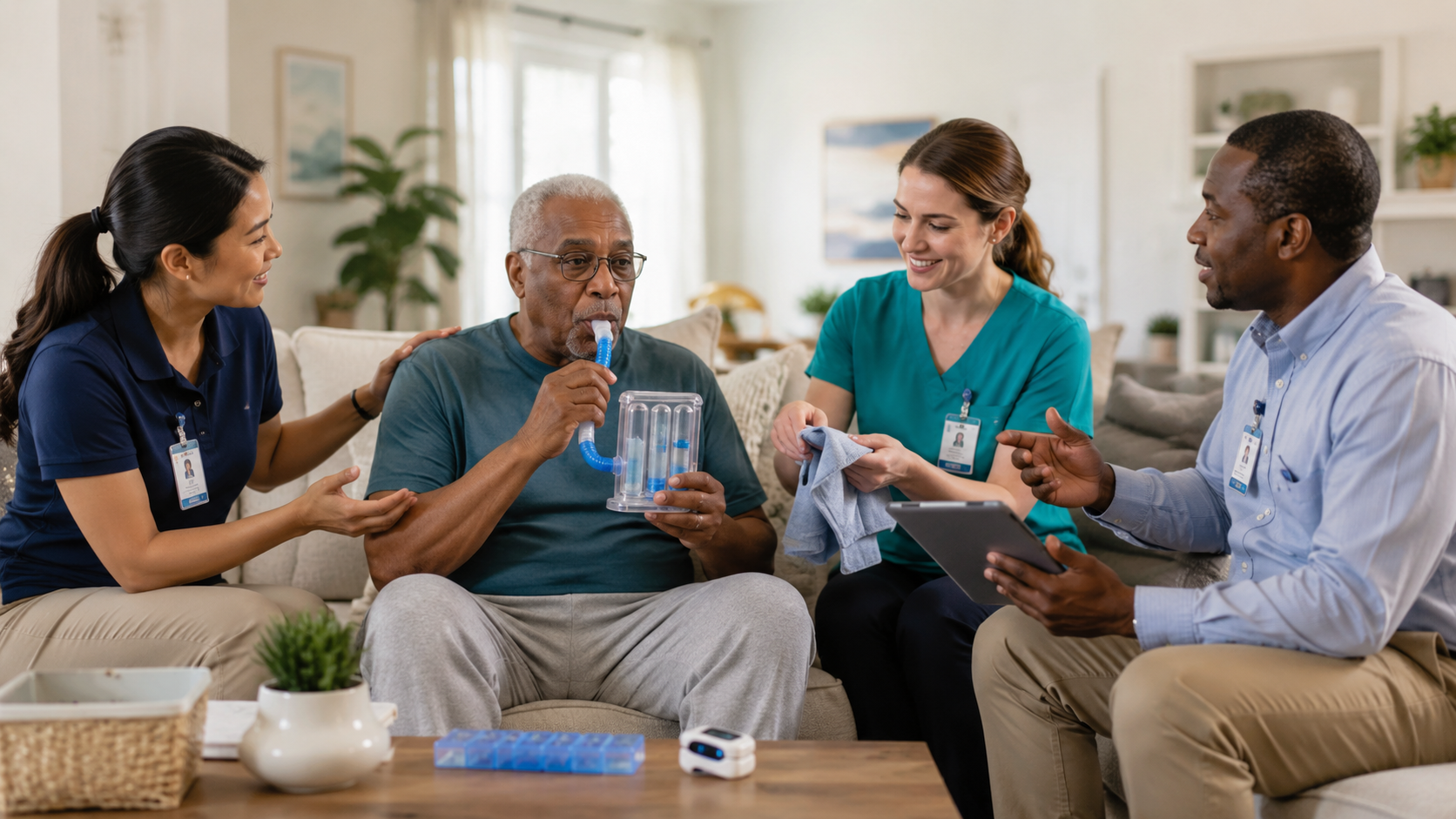
Clinical Strategies That Reduce Exacerbations, Improve Functional Capacity, and Support Self-Management in COPD Home Health Patients
Chronic obstructive pulmonary disease is one of the most prevalent conditions in the home health population nationally and in Southeast Texas specifically — where a combination of historical petrochemical and industrial occupational exposures, high smoking prevalence, and air quality challenges from the Gulf Coast industrial corridor have produced COPD prevalence rates that significantly exceed national averages in some communities. COPD is simultaneously one of the leading causes of disability, one of the most common reasons for hospital admission and readmission, and one of the conditions where home health therapy has the most specific, evidence-based, and consequential clinical contribution to make to patient outcomes — yet it is also a condition where the quality of home health clinical practice varies considerably and where generic approaches produce substantially inferior outcomes to COPD-specific evidence-based care.
Pulmonary rehabilitation in the home setting is the clinical intervention with the strongest evidence base for improving exercise capacity, reducing exacerbation frequency, and improving quality of life in COPD — and it is a clinical service that home health PT and OT can deliver in a modified form that maintains the essential therapeutic elements of pulmonary rehabilitation even without the outpatient clinic equipment and group format of formal pulmonary rehabilitation programs. The essential elements of home-based pulmonary rehabilitation include: progressive aerobic exercise training calibrated to the patient’s baseline exercise capacity and symptom response, resistance training targeting the peripheral muscle weakness that COPD produces through deconditioning and systemic inflammation, breathing technique training that specifically addresses the dysfunctional breathing patterns that worsen air trapping and dyspnea in COPD, and the self-management education that enables patients to recognize and respond to exacerbation early warning signs before hospitalization is required.
Breathing technique training is a PT and OT clinical contribution to COPD management that produces direct symptom relief in a population for whom dyspnea is the dominant disability-producing symptom. Pursed-lip breathing — exhaling through partially closed lips at a controlled rate that prevents dynamic airway collapse during exhalation, extends exhalation time, and relieves the air trapping that produces the hyperinflation characteristic of advanced COPD — provides immediate dyspnea reduction that patients can use independently during activity. Diaphragmatic breathing — retraining the patient to use the diaphragm as the primary inspiratory muscle rather than the accessory neck and shoulder muscles that COPD patients overuse at high energy cost — reduces the respiratory work of breathing and reduces the muscle fatigue that dyspnea produces. Forward-lean positioning that uses the arms for support and allows the diaphragm to work against a stable abdominal wall is a position-based breathing technique that provides immediate dyspnea relief during rest and activity.
Energy conservation and activity pacing are occupational therapy clinical contributions of central importance for COPD patients, because the breathlessness that limits daily activity in COPD is substantially modifiable through the strategic management of activity demand — planning activities to minimize the energy expenditure that produces dyspnea, organizing the home environment to reduce the energy demand of essential activities, prioritizing activities that are most important to the patient’s quality of life, and developing adaptive techniques that accomplish necessary activities within the patient’s respiratory capacity. The COPD patient who exhausts their available energy capacity on morning self-care activities and has nothing left for the afternoon activities that matter most to their quality of life requires OT energy conservation assessment and planning that redistributes the energy demand of their daily routine in ways that match activity scheduling to respiratory capacity.
Supplemental oxygen management education is a clinical function that home health PT and OT contribute to through both assessment and practical instruction. The COPD patient who is prescribed supplemental oxygen and who does not understand when to use it, how to adjust the flow rate for different activity levels, how to safely use oxygen while cooking or moving through the home, or how to manage their oxygen supply during community activities is not receiving the full clinical benefit of their oxygen prescription — and may be at risk from the safety hazards of supplemental oxygen use that inadequate patient education leaves unaddressed. OT instruction in oxygen management as an instrumental ADL — addressing the practical functional challenges of living with supplemental oxygen in the actual home environment — is a specific clinical contribution that most non-OT clinical education does not address with the functional specificity that home health OT provides.
COPD exacerbation action planning — the patient education that enables COPD patients to recognize the early signs of an exacerbating episode and to initiate the escalated self-management and clinical contact behaviors that prevent hospitalization — is a patient education intervention with strong evidence support for exacerbation-related hospitalization reduction. The specific early warning signs that COPD patients must recognize — increased dyspnea beyond their usual baseline, increased sputum production or change in sputum color, new or increased wheezing, reduced exercise tolerance compared to baseline — and the specific action plan steps that follow recognition — when to use rescue bronchodilator, when to start rescue corticosteroids if prescribed, when to contact the home health nurse, when to go to the emergency department — produce the early self-management response that reduces the proportion of exacerbations that progress to hospitalization.
Medical social work for COPD patients addresses the depression and anxiety that affect 40 to 50 percent of patients with moderate-to-severe COPD and that independently worsen COPD outcomes, smoking cessation support for the substantial proportion of COPD patients who continue to smoke, social isolation assessment for patients whose dyspnea limits community participation, and caregiver support for the family caregivers managing the demands of severe COPD at home. MSW connection with pulmonary support groups, smoking cessation programs, and the community resources that support COPD self-management provides the psychosocial and social support infrastructure that complements the physical rehabilitation and education that OT and PT provide.
Humane Care Therapy Inc. is therapist-owned and OT-operated — built by a clinician who understands COPD home health from the perspective of the therapist who walks through the patient’s door. We provide OT, PT, and MSW staffing with COPD-specific clinical training across Houston and Southeast Texas. Call (281) 619-3771, email info@humanecaretherapy.com, or visit humanecaretherapy.com.
Related HCT staffing services: Occupational Therapy and Physical Therapy staffing in Houston.