How OT and PT Clinicians With Lymphedema Expertise Create Clinical Value for Home Health Agencies and Their Patients
Lymphedema — the chronic swelling produced by lymphatic system compromise — affects more than 10 million Americans and is one of the most undertreated conditions in the home health patient population. Cancer treatment remains the most common cause in the United States, with breast cancer surgery involving axillary lymph node dissection or sentinel lymph node biopsy producing arm lymphedema in 20 to 30 percent of patients, and pelvic cancer treatments producing leg lymphedema in rates that vary by cancer type and treatment approach. But lymphedema also arises from non-cancer causes — infections, venous insufficiency, obesity, trauma, and primary lymphatic system disorders — that produce substantial limb swelling in patients whose cancer history does not explain their condition and who are frequently undiagnosed or inadequately treated as a result.
The fundamental challenge in home health lymphedema care is that effective lymphedema management requires specific clinical training that is not included in standard OT or PT education, that requires post-professional certification to practice competently, and that is in short supply relative to the patient need it must address. The gold standard of lymphedema treatment — Complete Decongestive Therapy, the international standard developed by the Lymphology Association of North America and equivalent international bodies — is a multi-component treatment program requiring specific certification that most home health therapists have not completed. Agencies that identify clinicians with CDT certification and deploy them specifically to lymphedema patients create a clinical capability that dramatically differentiates their service from agencies providing generic edema management to a population that requires specialty care.
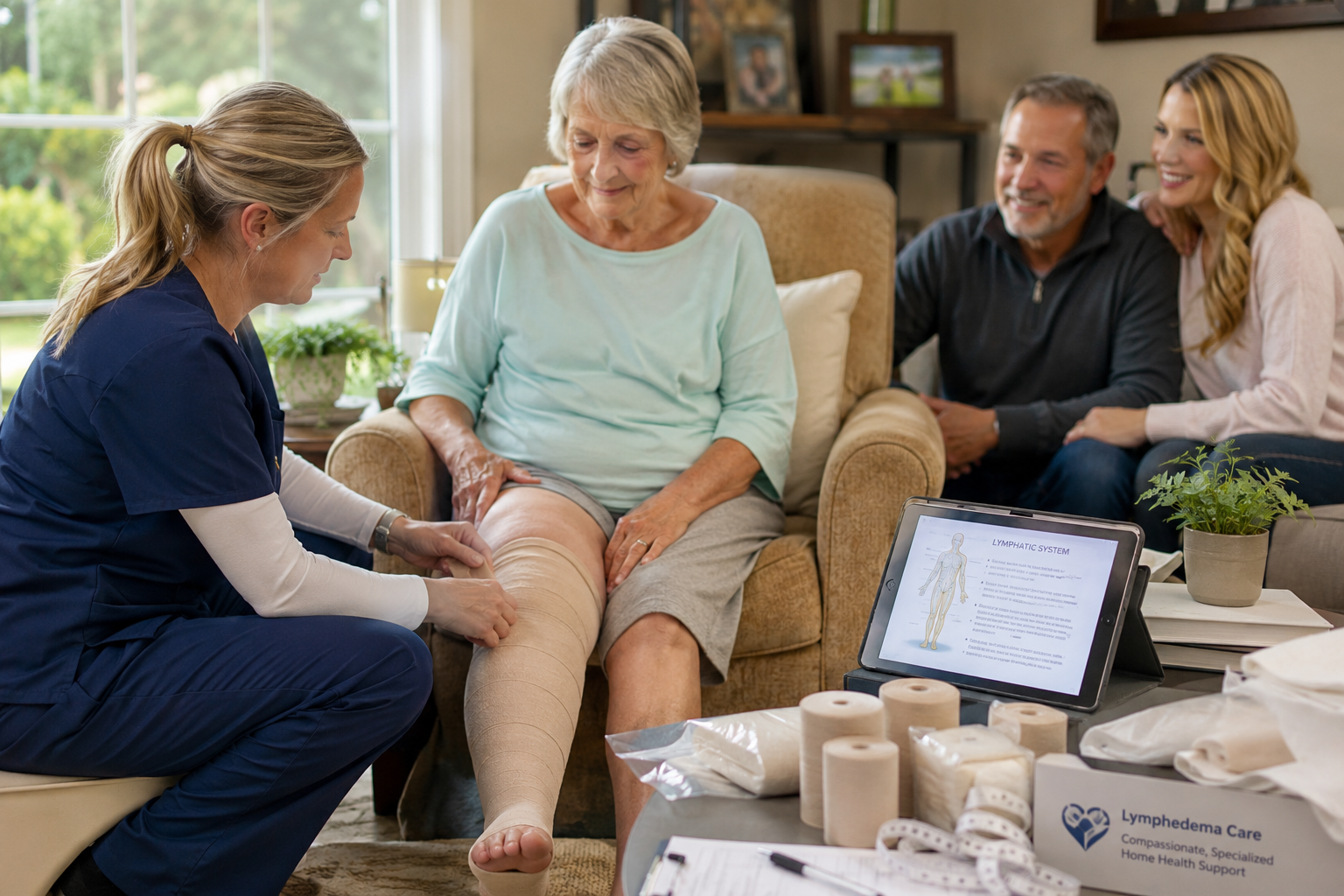
Complete Decongestive Therapy consists of two phases — an intensive phase designed to reduce lymphedema volume and transition the patient to self-management, and a maintenance phase focused on sustaining the achieved volume reduction through lifelong self-care — each of which requires specific clinical skills. The intensive phase combines manual lymph drainage, a specialized hands-on technique that activates lymphatic transport and redirects fluid through intact lymphatic pathways; multilayer compression bandaging, applied daily and requiring specific knowledge of bandaging sequences and tension application; therapeutic exercise performed while wearing compression garments or bandages; and meticulous skin care that prevents the skin infections that complicate lymphedema and that can dramatically worsen lymphatic impairment. Each of these components requires specific training to perform correctly.
Manual lymph drainage is the component most commonly misapplied by therapists without specific training. It is not massage. The techniques used in manual lymph drainage — light, rhythmic, directional strokes applied at specific anatomical locations in specific sequences — are entirely different from therapeutic massage, and applying standard massage techniques to lymphedematous tissue is both clinically ineffective and potentially harmful, as heavy pressure can damage fragile lymphatic vessels and exacerbate fluid accumulation. The therapist certified in CDT has trained extensively in the specific sequences, pressures, and directional approaches that activate rather than damage lymphatic transport.
The self-management phase of CDT — educating and training patients to maintain their achieved compression and fluid control independently — is both the most practically challenging and the most clinically essential component of long-term lymphedema management. Lymphedema is a chronic condition with no cure; the volume reduction achieved during intensive CDT treatment does not maintain itself without ongoing daily self-care. The patient who understands their condition, who has mastered self-administered simple lymph drainage techniques, who can independently apply and maintain compression garments or bandages, who practices the daily skin care that prevents cellulitis, and who recognizes the early signs of lymphedema exacerbation and knows when to seek additional care manages their condition effectively across decades of life. The patient who completes intensive CDT without thorough self-management education is likely to experience progressive volume increase as soon as skilled services end.
Home health is an ideal setting for lymphedema management because it allows assessment of the specific home environment factors that affect lymphedema self-care — the patient’s ability to apply compression garments in their actual home environment, access to appropriate sinks and bathing facilities for skin care, storage options for compression supplies, and the furniture and workspace arrangements that allow safe and effective self-care practice. Barriers to self-management that are invisible in a clinic setting — the patient who cannot don their compression garment because their furniture arrangement doesn’t allow the body positioning required, the patient whose household humidity makes garment donning extremely difficult, the patient whose bathroom layout makes the specific skin care routine impractical — are visible in the home and addressable with the environmental modifications and adaptive strategies that home-based OT assessment produces.
Compression garment knowledge is a specific clinical competency that lymphedema therapists must maintain. Custom and off-the-shelf compression garments differ in their compression class, their construction, their care requirements, and their appropriateness for different patient presentations — and the garment that provides appropriate compression for one patient may be wrong in compression class, compression gradient, or fit for another. Therapists who can assess garment fit, identify garments that are not providing therapeutic compression or that are creating problems such as tourniquet effects from proximal garment edges, and who know how to communicate effectively with lymphedema supply providers to obtain appropriate replacements provide clinical services that directly improve patient outcomes.
Skin integrity monitoring in lymphedema patients is a clinical responsibility that home health OTs and PTs share with nursing because cellulitis — bacterial skin infection in lymphedematous tissue — is the most common and most medically serious complication of chronic lymphedema. The compromised lymphatic system’s impaired immune surveillance makes lymphedematous limbs extremely susceptible to bacterial infection, and cellulitis in a lymphedematous limb can be limb-threatening in severe cases, always worsens the underlying lymphatic damage, and frequently produces acute medical crises requiring hospitalization. Therapists visiting lymphedema patients must know the clinical signs of incipient cellulitis — erythema, warmth, increased pain, local or systemic fever — and must communicate promptly with nursing when these signs are observed.
Humane Care Therapy Inc. includes CDT-certified OT and PT clinicians in our staffing network who provide specialized lymphedema management for home health agencies across Houston and Southeast Texas. Contact us at (281) 619-3771 or visit humanecaretherapy.com.
Related HCT staffing services: Occupational Therapy and Physical Therapy staffing in Houston.