What Every Home Health Therapist Must Know About Residual Limb Care, Prosthetic Training, and Functional Rehabilitation for Amputee Patients
Lower extremity amputation is one of the most prevalent and most functionally devastating diagnoses in the Houston home health population, driven primarily by the region’s high rates of diabetes and peripheral vascular disease — the conditions that account for the majority of non-traumatic amputations in the United States. Texas has one of the highest amputation rates in the country, and Harris County’s concentration of the populations most affected by diabetes-related amputation — low-income adults, African American and Hispanic adults, adults with limited healthcare access who present with advanced peripheral vascular disease before receiving the preventive care that might have avoided amputation — makes lower extremity amputee home health care a substantial and clinically demanding component of the Houston home health market.
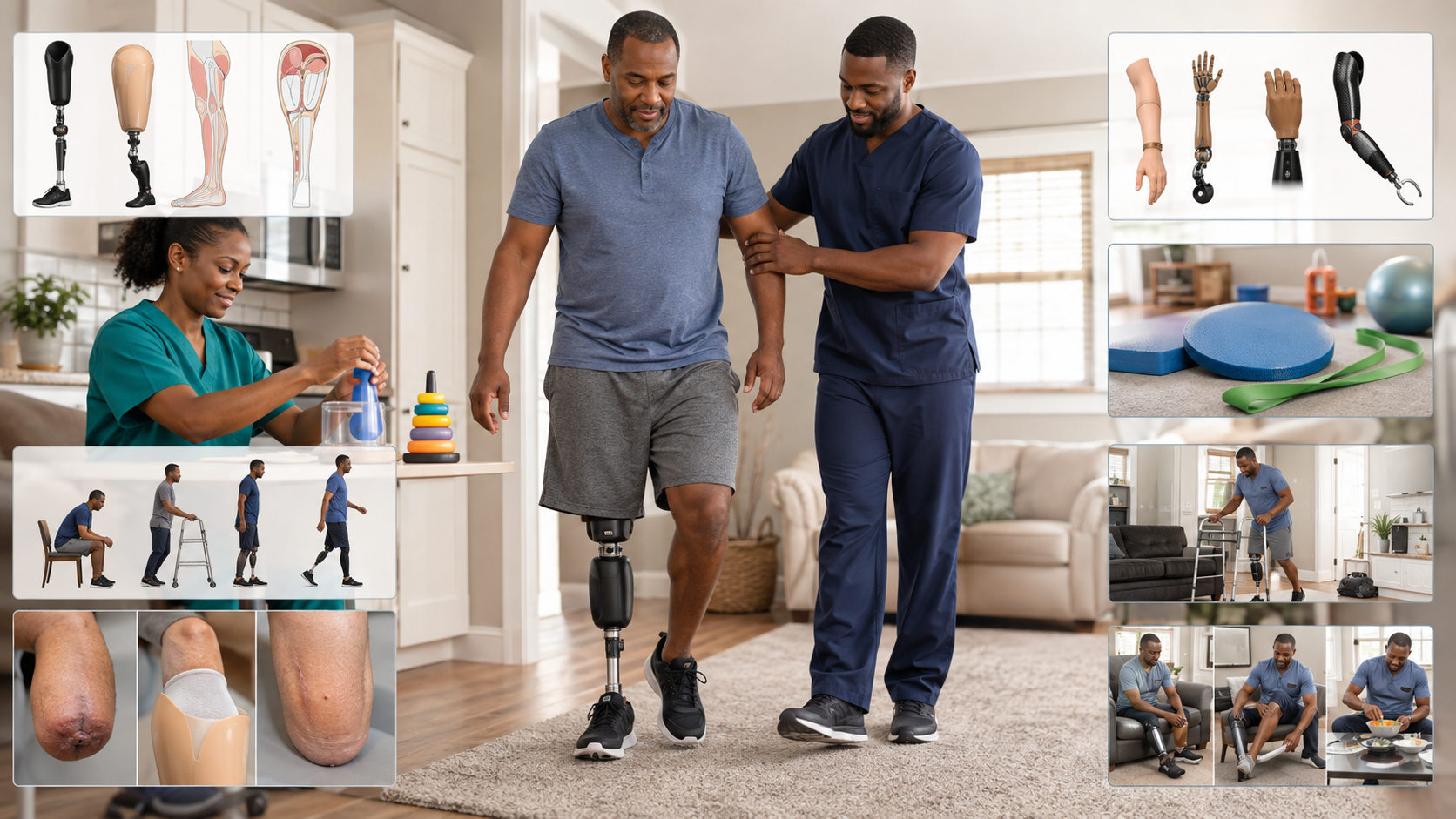
Residual limb care in the early post-amputation period is a foundational clinical contribution that both PT and OT provide in home health, addressing the wound healing, edema management, and limb shaping that prepare the residual limb for prosthetic fitting. Residual limb wound care observation — assessing the surgical wound for the signs of healing complications that require nursing and physician notification, distinguishing normal post-operative tissue changes from concerning findings — is a clinical observation and communication competency that complements the nursing wound care that is the primary responsible discipline. Residual limb edema management through compression wrapping or shrinker sock application shapes the residual limb toward the conical form that prosthetic socket fitting requires and reduces the volume fluctuation that delays prosthetic fitting. PT and OT instruction in residual limb wrapping technique — and caregiver return-demonstrated competency for patients who cannot independently manage their own residual limb wrapping — directly affects the speed and quality of prosthetic fitting readiness.
Preprosthetic physical therapy focuses on the strength, flexibility, cardiovascular conditioning, and phantom limb pain management that prepare the amputee patient for the physical demands of prosthetic ambulation. Hip flexor and abductor strength for transfemoral amputees, hip extensor strength for all levels of lower extremity amputation, cardiovascular conditioning that addresses the substantially increased energy demand of prosthetic ambulation — a transfemoral amputee walking with a prosthesis expends approximately 60 to 100 percent more energy than a person without amputation walking the same pace — and core stability that supports the postural control prosthetic ambulation requires are the preprosthetic PT targets that determine whether the patient will have the physical capacity to successfully use a prosthesis when it is delivered.
Phantom limb pain affects 60 to 80 percent of amputees and is one of the most clinically challenging and most undertreated pain conditions in the home health population. The home health PT and OT who have specific knowledge of phantom limb pain — its neurological mechanisms, its relationship to pre-amputation pain history, and the specific interventions that have evidence support — provide clinical management that the patient who experiences phantom limb pain as mysterious, shameful, or untreatable has often never received. Mirror therapy — which uses a mirror reflection of the intact limb to create a visual illusion of the amputated limb and that reduces phantom limb pain by addressing the cortical reorganization that underlies phantom sensation — is an evidence-supported intervention that can be implemented in the home health setting with simple equipment and specific OT and PT instruction.
Prosthetic gait training in home health occurs when a patient has received their prosthesis from the prosthetist and requires supervised gait training to develop functional ambulation with the device. Home health prosthetic gait training provides the practice opportunity in the patient’s actual home environment — navigating the specific floor surfaces, thresholds, stairs, outdoor terrain, and community contexts that the patient’s life requires — that outpatient prosthetic gait training in a clinic setting cannot replicate. PT assessment of the patient’s prosthetic fit concerns — the skin breakdown patterns, pistoning, and gait deviations that indicate prosthetic fit problems requiring prosthetist consultation — is a clinical competency that enables home health PT to serve as the monitoring bridge between prosthetist visits.
Occupational therapy for lower extremity amputee patients addresses the profound ADL implications of single or bilateral lower extremity amputation — the dressing and bathing adaptations required when lower limb absence changes the mechanics of lower body self-care, the mobility aids and transfer techniques that safely manage household mobility without the prosthesis during bathing and nighttime activities, the home modification requirements that safe household navigation demands, and the adaptive equipment specifications for the patient’s specific amputation level and functional capacity. The bilateral lower extremity amputee patient presents OT with one of the most complex ADL rehabilitation challenges in home health, requiring a comprehensive functional assessment of every ADL domain and creative, individualized adaptive strategy development that standard OT protocols do not systematically address.
Upper extremity amputation home health is a significantly different clinical presentation from lower extremity amputation, requiring OT expertise in upper limb prosthetics, myoelectric device training, and the one-handed ADL adaptation that produces independence for patients who choose not to use prosthetic devices for some or all daily activities. The upper extremity amputee patient’s functional rehabilitation in home health focuses on adapted ADL technique development, prosthetic use training when a prosthesis has been provided, and vocational and avocational activity adaptation that addresses the patient’s specific life role demands. MSW vocational rehabilitation referral — VR services fund prosthetic devices, prosthetic training, and workplace modification for amputees of working age — is a specific community resource connection that directly affects the functional and economic outcomes of the upper extremity amputee patient.
Humane Care Therapy Inc. provides OT and PT staffing with amputee-specific clinical training for home health agencies across Houston and Southeast Texas. Contact us at (281) 619-3771 or visit humanecaretherapy.com.
Related HCT staffing services: Occupational Therapy and Physical Therapy staffing in Houston.