How Home Health Clinicians Navigate the Distinct Clinical and Systems Complexity of Caring for Veterans With Service-Connected Limb Loss
Veteran amputees, particularly those with combat-related traumatic limb loss from recent conflicts, represent a distinct clinical population within the broader amputee home health care this series has previously addressed, carrying specific considerations around advanced prosthetic technology, VA benefits and care coordination, and the psychological dimensions of combat-related trauma that intersect with limb loss in ways that civilian amputee care, whether from diabetes or accident, typically does not present with the same combination of factors. Houston’s substantial veteran population and its VA medical infrastructure make this an important population for home health agencies serving this community to understand well.
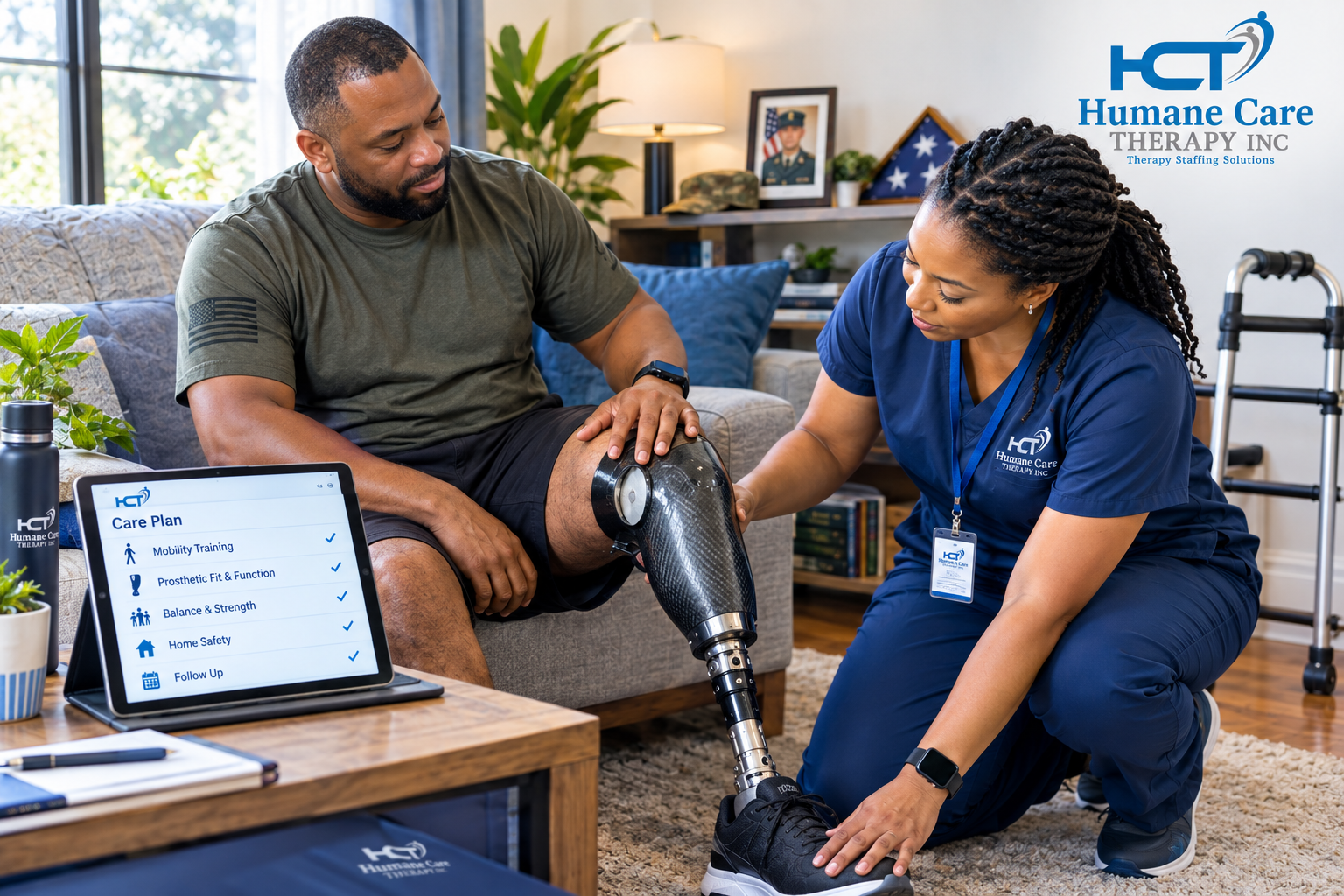
Advanced prosthetic technology for veteran amputees frequently exceeds what most home health clinicians encounter in civilian amputee practice, because VA benefits and dedicated military and veteran prosthetic research investment have produced access to microprocessor-controlled prosthetic knees, myoelectric upper extremity prostheses with sophisticated control systems, and other advanced prosthetic technology that many veteran amputees, particularly those with combat-related limb loss from recent conflicts, have access to at rates that exceed typical civilian amputee access to comparable technology. Home health PT and OT serving veteran amputees benefit from specific familiarity with these advanced prosthetic technologies, their maintenance and troubleshooting considerations, and the more sophisticated gait and functional training approaches that fully utilizing this technology’s capabilities requires, distinct from the more basic prosthetic technology that home health clinicians may more commonly encounter in general amputee practice.
Multiple and complex trauma frequently accompanies combat-related amputation, because the blast injuries that produce a substantial proportion of combat amputations frequently produce polytrauma, concurrent traumatic brain injury, additional orthopedic injuries, hearing loss from blast exposure, and burns that require the home health team to address a multi-system injury pattern rather than an isolated limb loss, drawing on the polytrauma and TBI clinical knowledge this series has addressed elsewhere and integrating it with amputee-specific rehabilitation in ways that single-system clinical training does not fully prepare clinicians for.
Post-traumatic stress disorder affects a substantial proportion of veterans with combat-related injuries, and the psychological dimension of combat-related amputation carries particular complexity because the amputation itself may serve as an ongoing physical reminder of the traumatic combat event that produced it, potentially triggering trauma-related symptoms during the very rehabilitation activities, wound care, prosthetic fitting, functional training that recovery requires. MSW trauma-informed care approaches, discussed elsewhere in this series in the context of trauma-informed practice broadly, carry particular clinical weight for this population, requiring specific sensitivity to how rehabilitation activities may intersect with trauma symptoms and specific coordination with the VA’s mental health resources that many veteran amputees are already engaged with or should be connected to.
VA benefits navigation and care coordination represents a systems complexity dimension of veteran amputee care that civilian amputee patients do not present, because VA disability benefits, VA prosthetic provision and maintenance systems, and the coordination between VA medical care and community-based home health services that many veterans receive through VA Community Care programs require home health clinicians and agency administrative staff to understand VA-specific processes distinct from Medicare and commercial insurance systems. MSW facilitation of VA benefits navigation, and clear communication channels between the home health team and the veteran’s VA care team, addresses a coordination complexity that significantly affects whether veteran amputees receive the full benefit of the VA resources they have earned through their service.
Peer support specific to veteran amputee identity carries particular value for this population because the shared experience of military service and combat-related injury creates a peer connection distinct from general amputee peer support, with organizations including the Wounded Warrior Project and VA-specific peer support programs connecting veteran amputees with others who share both the limb loss experience and the military service context that shapes how many veterans process and integrate that experience. MSW connection with these veteran-specific peer support resources, alongside the general amputee peer support this series has previously discussed, addresses a population-specific psychosocial resource that general amputee peer support does not fully replicate.
Family and caregiver considerations for veteran amputees often involve military spouses and family members who are themselves navigating the adjustment to a service member’s combat-related injury alongside their own experience of military family life, deployment-related relationship strain that may predate the injury, and the specific caregiving demands that combined limb loss and potential polytrauma create, requiring MSW family support that understands the specific military family context alongside the general caregiver support this series has addressed for other populations.
Humane Care Therapy Inc. is therapist-owned and OT-operated and our clinical leadership understands that veteran amputees, particularly those with combat-related limb loss, deserve care that honors both their specific clinical complexity and their service. We provide OT, PT, SLP, and MSW staffing with veteran amputee clinical training for home health agencies across Houston and Southeast Texas. Call (281) 619-3771, email info@humanecaretherapy.com, or visit humanecaretherapy.com.