
Clinical Strategies for Managing the High-Risk Transition Period When Patients Move From SNF Rehabilitation to Home Health Care
The transition from skilled nursing facility rehabilitation to home health care is one of the highest-risk care transitions in the post-acute continuum. A transition in which patients move from an institutional setting with round-the-clock nursing availability, on-site therapy access, and structured medication administration to a home environment with intermittent professional visits and substantially greater self-management demand. Transition failures at this juncture readmission to the hospital, unsafe home function, medication errors, and caregiver overwhelm are common enough that CMS quality metrics specifically track post-SNF readmission rates, and the home health team’s clinical practice in the first days and weeks after SNF discharge substantially determines whether this transition succeeds or fails.
Understanding the functional and clinical gap between SNF discharge status and home functional demand is the starting point for effective SNF-to-home transition management. The SNF discharge functional status that qualified a patient for SNF discharge often based on functional performance within the structured, equipment-rich SNF environment with staff assistance readily available frequently overstates the patient’s actual functional independence in the different physical layout, different equipment availability, and different assistance availability of their actual home. The home health OT and PT who conduct their own independent functional assessment in the actual home environment during the first visit rather than assuming the SNF discharge functional status transfers directly to home performance identify the functional gaps that the transition itself creates and that require immediate clinical attention.
Medication reconciliation at SNF-to-home transition deserves particular clinical vigilance because SNF medication management administered by nursing staff on a structured schedule differs substantially from the self-administration or caregiver-administration model that home care requires, and because SNF discharge medication lists frequently contain discrepancies with what the patient was taking prior to SNF admission, with new medications started during the SNF stay that the patient and family may not fully understand, and with medications that were appropriate during the SNF stay but that require adjustment for the different monitoring availability of the home setting. The home health nurse’s medication reconciliation, supported by OT assessment of the patient’s actual capacity to self-administer the reconciled medication regimen, addresses a transition point where medication errors are particularly likely.
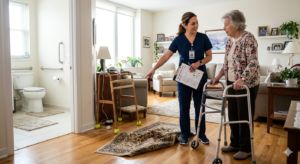
Equipment and home environment gaps between the SNF and home settings require specific home health clinical attention in the first visit. The patient who ambulated safely in the SNF’s wide, uncluttered, well-lit hallways with grab bars and consistent flooring may face a substantially different safety profile in a home with narrow doorways, stairs, throw rugs, and inadequate lighting. The durable medical equipment ordered for SNF discharge walker, bedside commode, shower chair may not have arrived, may not fit the home’s physical layout, or may be inadequate for the home’s specific safety demands. The home health team’s first-visit assessment of these environment and equipment gaps, and rapid action to address safety-critical gaps, addresses the period of highest fall and injury risk in the transition.
Caregiver readiness assessment at SNF-to-home transition is a clinical priority because the SNF setting’s professional staff availability masks caregiving demands that become suddenly and fully visible only once the patient is home. The family caregiver who observed but did not personally perform transfer assistance, wound care, or medication administration during SNF visits may be significantly underprepared for the caregiving role they must immediately assume at home. OT and nursing collaborative caregiver assessment and rapid, intensive caregiver training in the first home visits rather than assuming SNF-provided discharge education adequately prepared the caregiver addresses a readiness gap that directly affects both patient safety and caregiver sustainability.
Communication between the SNF and the home health agency, when it occurs with genuine clinical specificity rather than as a formality, substantially improves transition quality. SNF discharge summaries that specifically describe the patient’s actual functional performance in structured therapy sessions, the specific clinical concerns the SNF team identified but did not have time to fully address, and the specific caregiver training that was and was not completed during the SNF stay provide the home health team with clinical context that generic discharge paperwork does not capture. Home health agencies that proactively request this clinical detail from SNF discharge planners and therapy teams, rather than working solely from standard discharge documentation, receive better transition information than agencies that accept whatever documentation the SNF’s standard process produces.
The first 72 hours after SNF discharge represent the period of highest transition risk, and home health scheduling and clinical prioritization that reflects this risk window front-loading visit frequency in the days immediately following SNF discharge, prioritizing the functional and medication safety assessment that identifies transition gaps, and maintaining low-threshold availability for caregiver questions and concerns during this period produces better transition outcomes than a standard visit frequency schedule that does not specifically account for the elevated risk of the immediate post-SNF period.
Humane Care Therapy Inc. is therapist-owned and OT-operated and our clinical leadership understands that the SNF-to-home transition is a distinct, high-risk clinical period requiring specific clinical attention, not a routine start of care. We provide OT, PT, SLP, and MSW staffing with transition-of-care clinical training for home health agencies across Houston and Southeast Texas. Call (281) 619-3771, email info@humanecaretherapy.com, or visit humanecaretherapy.com.
Looking for a therapy staffing partner for your home health agency? Learn more about our therapy staffing services in Houston.