What Every Home Health Clinician Must Know About Dementia-Specific Assessment, Intervention, and Family Support
Dementia is one of the most prevalent diagnoses in the home health population and one of the most clinically demanding — demanding not because the technical clinical skills it requires are particularly complex, but because it requires the combination of clinical adaptation, communication flexibility, behavioral understanding, family systems knowledge, and emotional resilience that no single clinical training program develops comprehensively. The home health clinician who enters the home of a patient with moderate Alzheimer’s disease brings the same professional training they bring to every other patient encounter — and encounters a clinical environment that requires them to apply that training in fundamentally different ways.
Understanding the dementia staging landscape is foundational clinical knowledge for every discipline serving this population. Mild cognitive impairment — the stage at which memory and executive function changes are noticeable but do not yet significantly impair independent function — represents the stage at which home health intervention can most significantly delay functional decline and caregiver burden through cognitive engagement, activity structuring, and proactive safety planning. Mild dementia produces noticeable functional impairment in complex tasks while relatively preserving basic self-care, allowing significant therapy participation with appropriate adaptation. Moderate dementia produces substantial functional impairment across both complex and basic ADLs, requiring therapeutic approaches that rely less on verbal instruction and reasoning and more on cueing, demonstration, routine, and caregiver collaboration. Severe dementia requires palliative-oriented goals of care that focus on comfort, dignity, meaningful engagement within remaining capacities, and caregiver support.
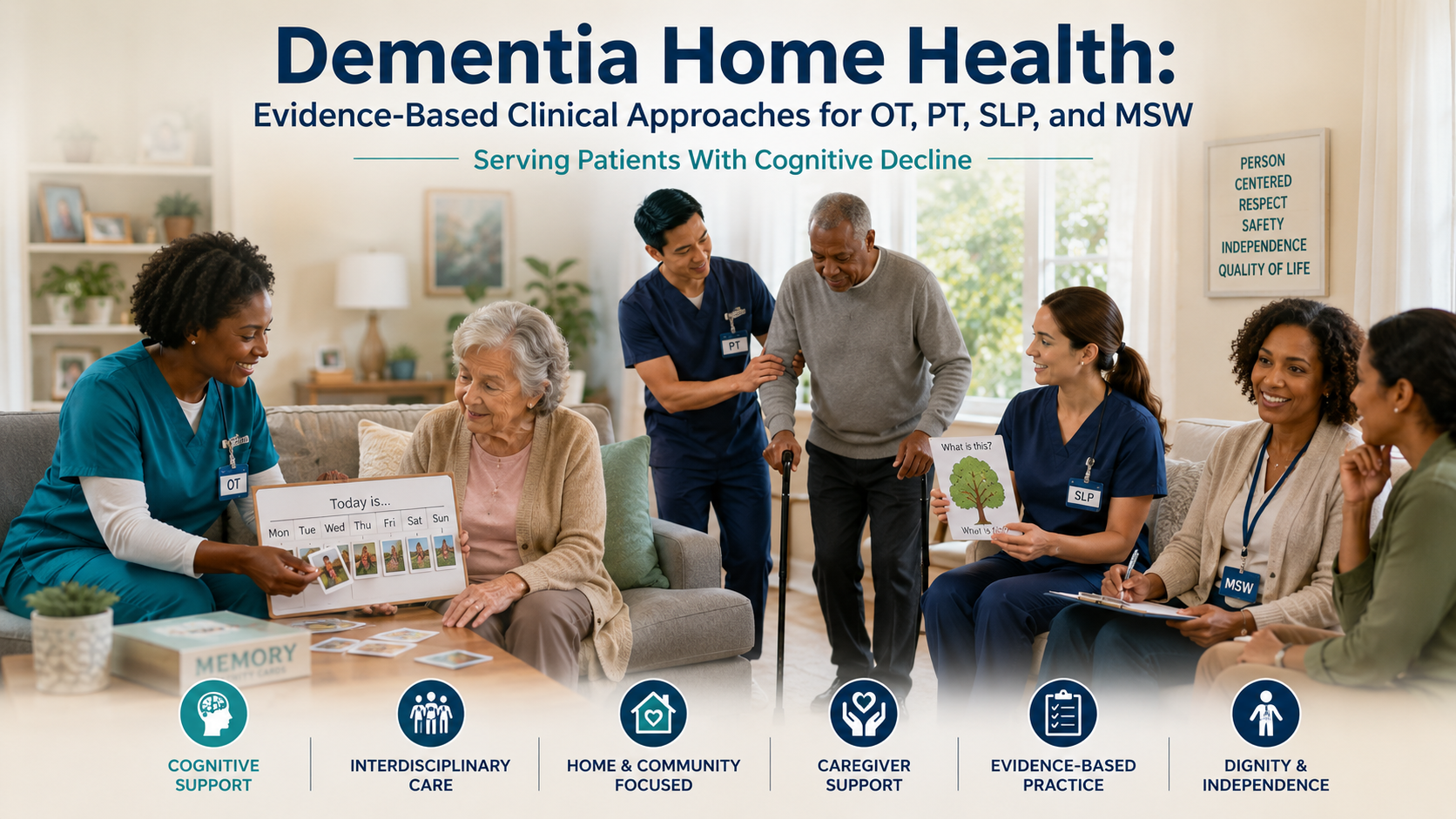
Occupational therapy for patients with dementia is one of the highest-impact clinical contributions in this population because OT’s focus on meaningful occupation and environmental adaptation directly addresses the functional engagement and safety challenges that dementia produces. Activity analysis for dementia patients examines which activities the patient can still participate in meaningfully — and with what level of cognitive cueing and environmental support — rather than which activities the patient can perform independently. The OT who designs simplified activity structures, environmental modifications that reduce cognitive demand, and visual cueing systems that support participation in valued activities without requiring the working memory that dementia impairs is providing a clinical service with direct quality-of-life impact that standard ADL rehabilitation approaches do not capture.
Physical therapy for patients with dementia must adapt standard assessment and exercise instruction approaches to accommodate cognitive limitations while preserving the physical activity benefits that PT is specifically positioned to provide. The Berg Balance Scale, the Timed Up and Go test, and other standard PT assessment tools assume the patient’s ability to follow verbal instructions — an assumption that moderate and severe dementia frequently violates and that requires adaptation through demonstration, hand-over-hand guidance, and simplified single-step instruction. Exercise programs for patients with dementia must rely on procedural memory — the implicit memory for motor sequences that dementia preserves longer than declarative memory — and on the behavioral cuing strategies that prompt movement participation without requiring the cognitive engagement that verbal exercise instruction assumes.
Speech-language pathology for dementia addresses both the communication changes that accompany cognitive decline and the swallowing changes that develop as dementia progresses. Cognitive-communication intervention in early and middle-stage dementia focuses on supporting functional communication through the compensatory strategies — written reminders, structured conversation formats, supported recall techniques — that preserve communication participation as episodic and working memory decline. Caregiver communication training — teaching family members and care staff the communication strategies that reduce behavioral disturbance, maintain relationship quality, and support the patient’s remaining communication capacity — is a high-impact SLP contribution that extends the clinical benefit of SLP assessment into every interaction the patient has with their care network.
Behavioral and psychological symptoms of dementia — the agitation, aggression, wandering, sleep disturbance, and depression that affect 80 to 90 percent of patients with dementia at some point in their disease course — are among the most challenging clinical presentations that home health therapists encounter and among the most consequential for caregiver wellbeing and care sustainability. Non-pharmacological behavioral intervention is the first-line recommended approach for BPSD in current clinical guidelines, and home health therapy is well-positioned to contribute to this approach through the activity-based interventions, environmental modifications, sensory-based interventions, and caregiver education that OT, PT, SLP, and MSW collectively provide. Understanding the antecedent-behavior-consequence framework for behavioral analysis — identifying what triggers problematic behaviors, what the behavior communicates, and what environmental or interaction modifications reduce trigger exposure — is a clinical skill that all disciplines serving dementia patients should develop.
Medical social work for patients with dementia and their families addresses the complex family system dynamics, planning needs, and emotional burden that dementia creates across the disease trajectory. Dementia diagnosis and disclosure is itself a clinical event that requires sensitive communication support — helping families navigate the shock, grief, and practical implications of the diagnosis while supporting the patient’s understanding and autonomy to the extent that cognitive capacity allows. Future planning facilitation — supporting the family in completing advance directives, establishing legal decision-making authority, identifying residential care options for the future when home care is no longer sustainable, and accessing the community resources that support home-based care for as long as possible — is an MSW clinical contribution that reduces the crisis-driven decision-making that dementia caregiving too often produces.
Humane Care Therapy Inc. provides OT, PT, SLP, and MSW staffing with dementia-specific clinical training for home health agencies across Houston and Southeast Texas. Contact us at (281) 619-3771 or visit humanecaretherapy.com.
Related HCT staffing services: Occupational Therapy, Physical Therapy, Speech-Language Pathology, and Medical Social Work staffing in Houston.