What Every Home Health Clinician Needs to Know to Serve Patients With SCI Safely and Effectively in the Community
Spinal cord injury represents one of the most clinically demanding patient populations in home health — a population whose medical complexity, functional limitations, and psychosocial needs span every discipline’s scope and whose care requires a level of SCI-specific clinical knowledge that general home health training does not systematically develop. Yet SCI patients in the community are a real and growing home health referral population, particularly as acute rehabilitation stays shorten, as more SCI survivors live longer with the advances in SCI medicine, and as the Houston medical center’s trauma infrastructure generates a consistent stream of SCI survivors who transition from inpatient rehabilitation to home-based care and who require skilled home health services to sustain their community integration.
Understanding SCI neurological level and completeness is foundational clinical knowledge for every therapist serving this population. The neurological level of injury — the most caudal segment of the spinal cord with intact motor and sensory function bilaterally — determines the pattern of functional capacity and functional limitation the patient presents with. A C6 complete injury produces a very different functional picture from a T4 complete injury or an L2 incomplete injury, and the therapy assessment, goal-setting, and intervention must be specifically calibrated to the patient’s actual neurological level and completeness rather than applied from a generic SCI rehabilitation framework. The ASIA Impairment Scale classification — which distinguishes complete injuries (AIS A) from incomplete injuries with preserved sensation only (AIS B), incomplete injuries with some motor function below the level (AIS C and D), and neurologically normal (AIS E) — provides the clinical classification framework that home health therapists serving SCI patients must understand and apply.
Autonomic dysreflexia is the most immediately life-threatening medical emergency that home health clinicians serving patients with SCI at or above T6 must be prepared to recognize and respond to. AD is a sudden, massive sympathetic nervous system discharge triggered by a noxious stimulus below the level of injury — most commonly a full bladder, bowel impaction, or skin pressure injury — that produces a hypertensive crisis: systolic blood pressures above 150 mmHg and frequently above 200 mmHg, accompanied by pounding headache, profuse sweating above the level of injury, flushing, piloerection, and bradycardia. Every home health therapist serving a patient with cervical or high thoracic SCI must know AD recognition, the immediate management — sitting the patient upright, identifying and removing the triggering stimulus, and contacting emergency services if blood pressure does not reduce promptly — as a clinical safety competency as important as any other clinical skill.
Skin integrity management is a clinical priority that pervades every aspect of SCI home health care, because pressure injuries are the most common and most serious preventable complication of SCI, because SCI patients lack the sensory feedback that normally prompts spontaneous position changes, and because the consequences of pressure injury in the SCI population — from local wound complications to osteomyelitis, sepsis, and death — are substantially more severe than in most other home health populations. PT and OT skin integrity contributions include weight-shifting education and training for pressure relief during wheelchair sitting, proper positioning in both wheelchair and bed, pressure-relieving surface assessment and specification, and caregiver education in the skin inspection and repositioning routines that protect skin integrity across all hours of the day and night.
Respiratory management is a significant clinical concern for patients with cervical and high thoracic SCI, because the respiratory muscle paralysis that accompanies high-level SCI reduces vital capacity, impairs cough effectiveness, and produces the respiratory insufficiency that makes respiratory infection both more likely and more dangerous than in patients without SCI. PT assessment of respiratory function — vital capacity, peak cough flow, respiratory pattern — and intervention through breathing exercises, assisted cough techniques, and respiratory muscle training when appropriate provides clinical benefit that directly reduces the respiratory complication risk that is among the leading causes of morbidity and mortality in the SCI population.
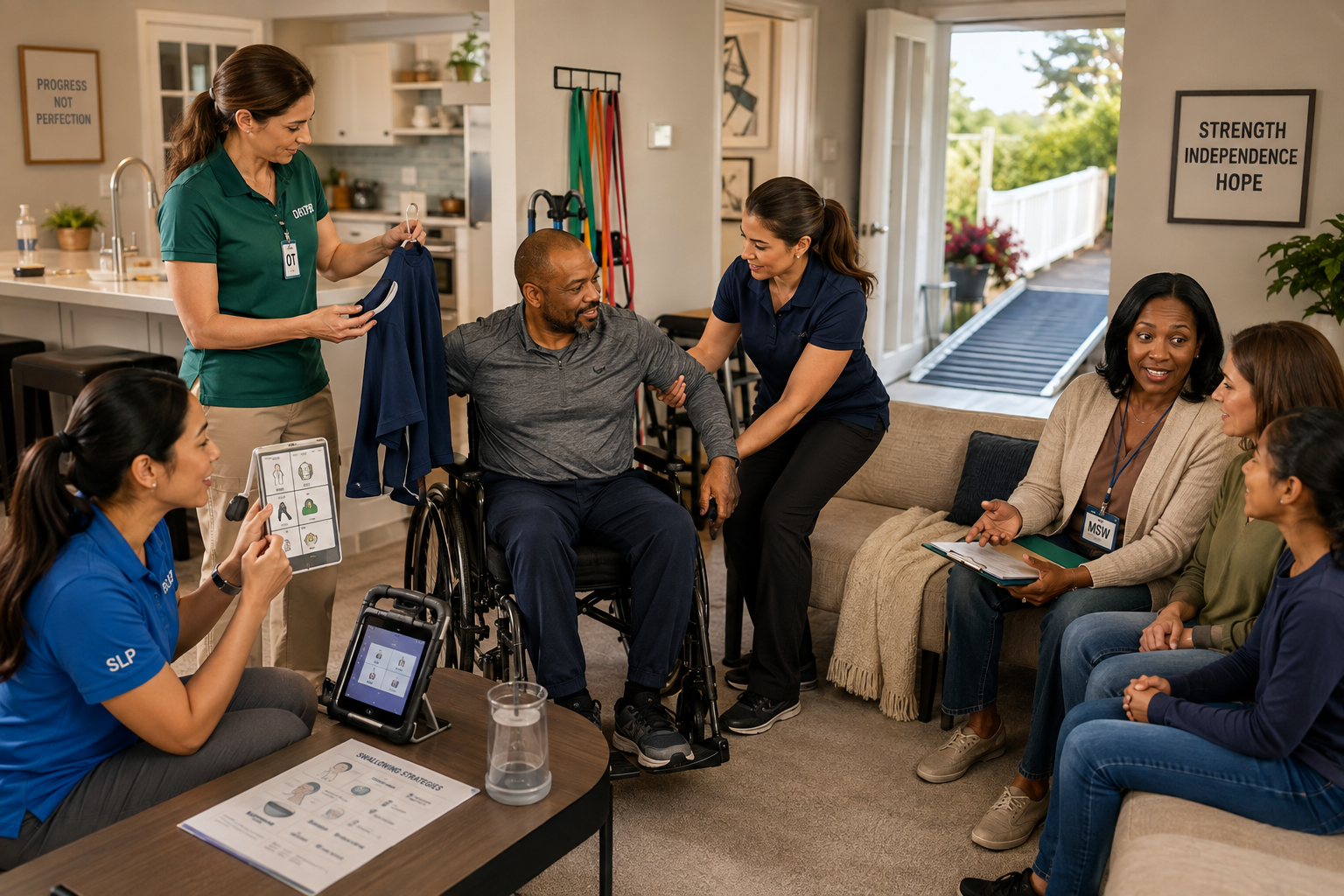
Occupational therapy for SCI patients addresses the profound and specific ADL implications of upper extremity paralysis or weakness that cervical SCI produces. The C5-level patient who has biceps function but no wrist extension has a very different ADL functional profile from the C6 patient with radial wrist extension, the C7 patient with triceps function, or the C8 patient with finger flexion — and the adaptive strategies, assistive technologies, and equipment specifications that OT prescribes must be specifically calibrated to each patient’s preserved muscle function and functional potential. Mobile arm supports, tenodesis splints, universal cuff adaptations, and environmental control technologies that allow patients with cervical SCI to manage their home environment with preserved motor function require OT expertise in SCI-specific assistive technology that general home health OT training does not systematically develop.
Neurogenic bladder and bowel management are medical management domains that directly intersect with home health therapy through their implications for therapy session safety, skin integrity, and the patient’s functional independence in community participation. The PT who is unaware of the patient’s bladder management schedule and the risk of autonomic dysreflexia from bladder overdistension during exercise that exceeds scheduled catheterization timing is conducting sessions with an unmanaged safety risk. The OT who addresses bladder and bowel management independence as ADL — assessing the patient’s functional capacity to perform intermittent self-catheterization, assisting with adaptive equipment for bowel program independence, and addressing the scheduling and routine structure that supports neurogenic bladder and bowel management — is addressing a functional independence domain of profound importance to the patient’s quality of life and community participation that no other discipline addresses as specifically.
Medical social work for SCI patients and their families addresses the life disruption of a catastrophic neurological injury — the depression and adjustment disorder that affect the majority of SCI survivors in the first years after injury, the relationship and family system impacts of a sudden and permanent disability, the vocational and financial implications of a condition that frequently occurs in young adults at the beginning of productive careers, and the community reintegration planning that determines whether the SCI survivor can build a meaningful and self-determined life in the community. MSW advocacy for community resources — adaptive sports programs, peer support networks, Independent Living centers, vocational rehabilitation services, and the accessibility assessment and modification resources that community participation requires — provides a psychosocial and practical support network that complements the physical rehabilitation that OT and PT provide.
Humane Care Therapy Inc. provides OT, PT, SLP, and MSW staffing with SCI clinical knowledge for home health agencies across Houston and Southeast Texas. Contact us at (281) 619-3771 or visit humanecaretherapy.com.
Related HCT staffing services: Occupational Therapy, Physical Therapy, Speech-Language Pathology, and Medical Social Work staffing in Houston.